
City Crime
Whither Security Of Nigeria?

The dismantling of the police unit called the Special Anti-Robbery Squad (SARS) by the Federal Government was as a result of the hues and cries of the youths over the recklessness of the unit. It was a speedy response to the hitherto peaceful protest of the youths.
The protesting youths had accused SARS of several criminal acts like extra-judicial killings, maiming of suspects and unfriendliness to the society in general. The hostility against the youth was palpable; artists with dreadlocks were often molested, intimidated and arrested. The scenario made every youth a suspect in the Nigerian nation.
The right to the freedom of expression protected by Section 39 and the right to dignity of human person protected by Section 34 of the Constitution of the Federal Republic of Nigeria 1999 as amended were whittled down as the youths could not make tattoos on their bodies without risking arrest by the SARS operatives.
In spite of the fact that bail is free in Nigeria, SARS charged large sums of money as fees. Suspects were treated like culprits despite the fact that suspects or accused persons are presumed innocent until proven guilty by a court of competent jurisdiction.
The SARS operatives were adjudged to have committed a hell of heinous crimes against Nigerians especially the youth.
But SARS was not bereft of virtues, it played a key role in the suppression of violent crimes in the society. In areas where other police units could not thread, SARS went with courage and strength. Hoodlums, cultists and other criminals dreaded SARS.
To most criminals, the ending of SARS is a welcome development as they have been granted unhindered access to perpetrate evil and wreak mayhem in the society. Last week, the youth protest in Lagos and other parts of Western Nigeria was hijacked. It snowballed into looting, arson and wanton destruction of lives and property. Those who had expressed sympathy over the killing of peaceful protesters by soldiers, were overwhelmed by a rude shock over the monster the protest had become. Palliatives stored in warehouses consequent upon the global pandemic, COVID 19, were looted.
In Benin City, there was a jail break that released all prisoners in the maximum security prison. In Delta State, many policemen were killed as hoodlums took liberty for license. The policemen in Delta State had to protest over the killing of their colleagues, stating that, “Police are human beings.”
In Cross Rivers State, hoodlums in guise of EndSARS and police brutality protest, have unleashed heinous crimes against the state in spite of Governor Ben Ayade’s promises to lessen the sufferings of youth. His unprecedented creation of jobs in the simmering period of COVID 19 did not help matters. The hoodlums set ablaze private, public and corporate buildings and nobody can say for certain whose interest the hoodlums are serving.
In Plateau State, youths turned into palliatives hunters have descended on a warehouse in Jos. What manner of youths?
On 24th October, 2020, hoodlums invaded palliatives warehouse at Gwagwalada, Abuja and carted away everything in store. This perhaps consists of the cardinal points of their reformation agenda. In Lagos, many youths are expressing sentiments that the destruction of the properties are targeted at a particular ethnic group.
Regrettably, the preponderance of hoodlums that wreaked havoc in Southern Nigeria are part of the youths expected to take over the reins of power from the ageing generation of the present day rulers. In the present circumstances, what is the future of our great nation? Little wonder then that some governors do not want to tolerate anything protest. The seeming expression of the fundamental rights of protesters has led to sorrow, tears and blood to many Nigerians.
In Rivers State, the Indigenous People of Biafra, hijacked the protest, invaded police stations in Oyigbo, Eleme, Obio/Akpor and Port Harcourt Local Government Areas. In Oyigbo, the Police Area Command and Afam Divisional Police Stations were burnt down, while some policemen were killed in the process. Oyigbo residents believe that guns had been looted by the proscribed group.
IPOB, for no justifiable reason, attacked Hausas living in Oyigbo that left people on both sides dead.
The ugly situation, made Governor Nyesom Wike to impose a 24-hour curfew on the areas ravaged by the outlawed IPOB.
At Iriebe in Obio/Akpor Local Government Area, robbers are robbing in broad daylight in what has become nightmarish. The paramount ruler of the community is calling for security agencies to come to their rescue. Efforts are being made by the state government to bring perpetrators of the Oyigbo mayhem to book as Governor Wike has put a bounty of N50,000,000 (Fifty million naira) on the alleged mastermind of the crisis.
One Mr Stanley Mgbere is alleged to have been the mastermind of IPOB mayhem.
The dismantling of SARS and the ban on use of guns by the local vigilante has put paid to the efforts of the government and communities to maintain security in the society. With SARS gone, the enfeebled Nigeria police lack the capacity to fight violent crimes. Pathetically, both the Nigeria police and citizens they are expected to protect have become vulnerable to criminals with sophisticated weapons.
Again, the looting of police armouries that characterised the invasion of stations has left no one in doubt that firearms have entered into the wrong hands and it will be difficult to mop up the firearms. Nobody is safe any longer, everybody has to be careful not to fall prey to the antics of criminals. The proliferation of small arms in South-East and South-South has fueled violent crimes and separatist agitation. The recent happenings since the dismantling of SARS have made it crystal clear that Nigeria needs strong policing to stem the growth of criminal activities.
EndSARS protest has left in its wake, the loss of lives and incalculable damages; a huge loss to the entire nation.
What does anybody expect from a nation where the politicians live in splendor while the masses live in misery? The demonstration was a release from pent-up frustrations among Nigerians. Even the little that should trickle to poor is denied them. The denial of the masses of palliatives meant for them at the height of COVID 19 pandemic, demonstrates leaders’ insensitivity to the plight of the ordinary citizens. The list is endless.
However, the primary function of government is the maintenance of law and order. With the scrapping of SARS, the society is likely going to witness an upsurge in crime rate. President Muhammadu Buhari’s terse address belies government’s resolve to restore law and order throughout Nigeria. Section 10 of the Police Act highlights government power vested on the police to ensure public safety.
No government anywhere in the world either wants to throw in the towel or allow protesters making hydra-headed demands to force it out. It does not thrive on public opinion. The call to end SARS and police brutality was victorious but a pyric victory at that as our security system is likely to collapse if nothing is done to salvage the situation.
Chidi Enyie



A former staff of the Rivers State Newspaper Corporation, publisher of The Tide Newspapers, Idongpee Akwaowo Reuben, has been appointed the Acting Registrar/Chief Executive Officer of Chartered Chemists of Nigeria (ICCON) by the Federal Government of Nigeria.
Akwaowo’s appointment follows the expiration of the second tenure of the former Registrar, Chemist Jwalshik Wilford.
According to a letter released from the office of the Minister of State for Health and Social Welfare dated August 5, 2026, the Minister of State for Health and Social Welfare, Dr. Iziaq Adekunle Salako, said the appointment was with immediate effect.
The minister had earlier announced Akwaowo’s appointment during a meeting with the Permanent Secretary, Heads of Departments, and Directors in June 10, 2026 in the Minister’s Conference Room.
He said the appointment was automatic and effective 1st June, 2026 following the satisfactory handover that followed the succession procedure.
The Minister nullified the earlier process put in place for a substantive appointment, citing it as a contravention of the provision of the ICCON Act.
He further directed that the appointment letter be issued without further delay.
The Minister admonished the new ICCON Chief Executive to take charge and ensure that the Institute is on the path of peace and progress to deliver her mandates.
In his response, Akwaowo thanked the the Federal Government for the appointment which, he said, has laid every uncertainty surrounding the leadership of the Institute to rest.
He pledged his unalloyed loyalty to the Federal Government and the Minister and promised to work with his Management Team to align with the policy directives of the Ministry as well as the renewed hope agenda of the Federal Government.
Akwaowo joined ICCON in 2005 as a pioneer staff, rose through the ranks and served in many capacities transcending virtually all the departments in the Institute including HOD, Administration/Accounts & Finance.
Most recently, he served as the pioneer Team Lead and the Registrar/CEO Representative in the National Chemical Personnel Audit excercise to Chemical companies and Chemistry Departments in Tertiary Institutions as part of the Institute’s regulatory mandates.
He has attended several courses and workshops and represented the Institute at various conferences and fora.
Akwaowo is a Chartered Chemist and also a member of a number of professional bodies.
He rose to the rank of Director, Scientific in 2025, and was until his appointment, the Coordinator, Zonal Offices of ICCON.
City Crime
Bayelsa Water Coys Raise Alarm Over Business Threats …Set To Resist Multiple Levies Amid High Production Cost

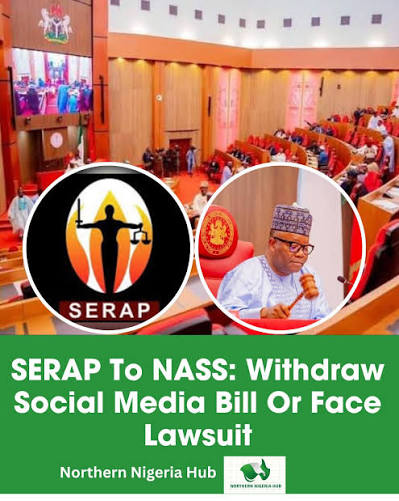
The Socio-Economic Rights and Accountability Project has asked the National Assembly to immediately withdraw the proposed Nigeria Data Protection (Amendment) Bill, 2026, describing it as a backdoor attempt to regulate social media and expand government control over online expression.
SERAP warned that it would institute legal action if the bill is passed in its current or substantially similar form.
The bill, sponsored by Senator Ned Nwoko (APC, Delta North), seeks to compel social media platforms, data controllers and data processors operating in Nigeria to establish physical offices in the country.
It also empowers the Nigeria Data Protection Commission to shut down or prohibit the operations of any entity that fails to comply within 30 days.
In a letter dated July 18, 2026, and addressed to Senate President Godswill Akpabio and Speaker of the House of Representatives Tajudeen Abbas, SERAP said the proposed amendment posed a threat to constitutionally guaranteed rights.
The letter, signed by SERAP Deputy Director Kolawole Oluwadare and issued on Sunday, read in part, “Requirements compelling technology companies to establish local offices would increase government leverage over platforms, facilitate political pressure, make censorship demands easier and expose local employees to retaliation.
“The Bill would create sweeping powers capable of shutting down or excluding social media platforms from the Nigerian market and expose millions of Nigerians to serious violations of their constitutionally and internationally guaranteed human rights.”
SERAP argued that the bill revives previous attempts to regulate social media that attracted widespread public opposition.
“The current Bill revives substantially similar proposals previously introduced by Senator Nwoko, raising renewed concerns that localisation requirements are being used as a vehicle for expanding governmental control over digital platforms and online expression,” it said.
The organisation warned that it would challenge the legislation in court if enacted.
“Should the Bill be enacted into law in its current or substantially similar form, SERAP shall promptly take all appropriate legal actions to challenge its legality in the public interest and to ensure that Nigerians’ fundamental rights are fully protected,” the letter stated.
According to SERAP, the proposed legislation would give the Nigeria Data Protection Commission excessive powers to block digital platforms without adequate procedural safeguards.
“The Bill constitutes a backdoor attempt to regulate social media and increase governmental control over online expression through corporate localisation requirements rather than through transparent and constitutionally permissible regulation,” it said.
The group argued that the bill lacks provisions for prior judicial authorisation, meaningful opportunities for compliance beyond the proposed 30-day period, and safeguards to protect the rights of millions of Nigerians who rely on digital platforms.
SERAP also cited the judgment of the ECOWAS Court of Justice on Nigeria’s suspension of Twitter, arguing that the proposed amendment could produce similar consequences by indirectly excluding social media platforms from operating in the country.
“The Bill also risks recreating the very dangers previously condemned by the ECOWAS Court of Justice. In SERAP and Others v. Federal Republic of Nigeria, the Court held that the suspension of Twitter violated the rights to freedom of expression, access to information and media freedom protected under the African Charter.
“Although the present Bill differs from the Twitter suspension in form, it creates the possibility of achieving the same result indirectly by empowering regulators to prohibit digital platforms from operating in Nigeria.
“The National Assembly should not enact legislation capable of producing, through indirect regulatory means, the very restrictions on fundamental rights that regional human rights law prohibits,” the organisation said.
It maintained that while governments have a legitimate interest in regulating digital platforms, such measures must comply with constitutional guarantees and international human rights standards.
The organisation further warned that mandatory localisation requirements would increase compliance costs for technology companies, startups, educational institutions and artificial intelligence developers.
“The proposed amendment conflicts directly with the objectives of the Nigeria Startup Act 2022 and the National Digital Economy Policy and Strategy.
“Mandatory localisation requirements substantially increase compliance costs, particularly for startups, open-source projects, educational institutions, research organisations, AI developers and smaller technology companies, while reducing Nigeria’s attractiveness as a destination for innovation and investment.
“No major democratic jurisdiction requires every social media platform to establish a physical office as a blanket precondition for providing services.”
SERAP added, “The National Assembly should immediately reject and withdraw the Bill, as it is manifestly incompatible with the Nigerian Constitution and Nigeria’s obligations under the African Charter on Human and Peoples’ Rights and the International Covenant on Civil and Political Rights.”
-

 News2 days ago
RSG Targets Nine Million Residents in Mosquito Net Distribution Campaign
-

 Oil & Energy2 days ago
Aiyedatiwa Signs New Electricity Bill
-

 Oil & Energy2 days ago
NLNG Commissions Research And Innovation Centre In RSU
-

 Maritime2 days ago
Marine Minister Commends President Tinubu On NPERA Bill Assent
-

 News2 days ago
KenPoly Holds Eight Convocations, August 29
-

 News2 days ago
RSG Begins Another Phase of Projects Commissioning Today
-

 News2 days ago
RMAFC Completes Revenue Sharing Review, Proposes New Pay
-

 Maritime2 days ago
NAGAFF Petitions IGP Over Alleged Maritime Police Harassment