
News
2020 Budget Scales 2nd Reading, As Reps Decry Poor Education Allocation

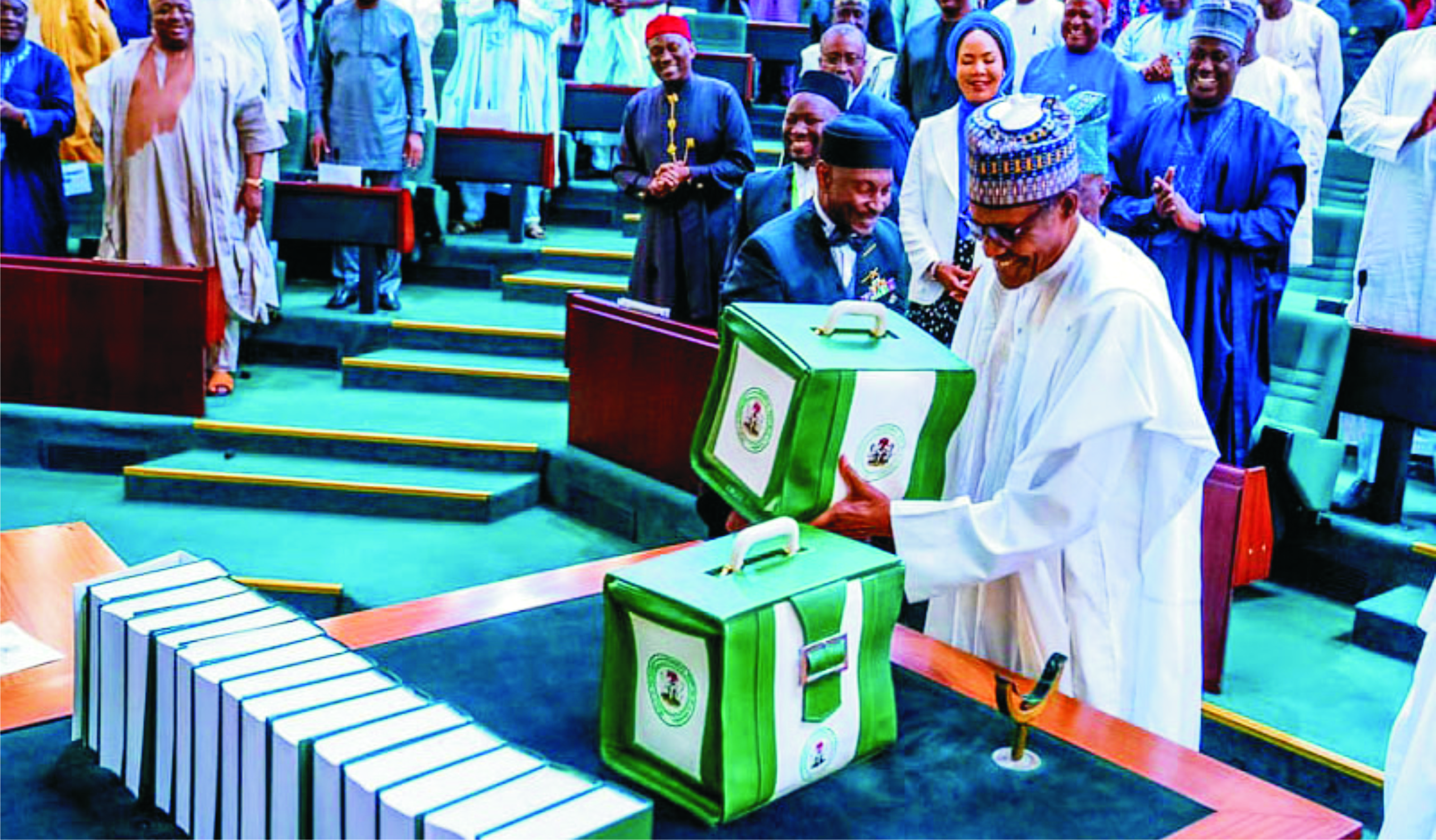
After two days of debate, the House of Representatives has passed the 2020 budget for second reading.
The bill was extensively debated by members of the House for straight two days, and when it was put to vote by the presiding officer, Deputy Speaker Idris Wase, the “ayes” had it.
Wase subsequently referred the bill to the committee on appropriation and other relevant standing committees of the House.
The N10.3trillion bill was submitted, last Tuesday by President Muhammadu Buhari.
While debating the budget, the House of Representatives said that the N48billion capital budgetary allocation for education in the 2020 appropriation was poor.
This followed a unanimous adoption of a motion moved by Rep. Babajide Benson (APC-Lagos) in commemoration of World Teachers’ Day at plenary presided over by the Speaker of the House, Hon Femi Gbajabiamila, yesterday.
Education, however, got an additional N112billion allocation under Universal Basic Education Commission.
There is also TETFUND, which has a budget in three figure billions.
Nevertheless, the House stressed on the need for an increase in the budgetary allocation to the Education sector in the 2020 appropriation bill to better equip teachers with the required training and adequate facilities in schools.
It also expressed concern that teachers in the country were overworked and remained among the worst paid in the world with poor welfare packages and teaching environments in spite of their contributions to societal development.
The green chamber also urged the Federal Government to improve on the welfare and support schemes for teachers.
It called for more training for teachers using the Science, Technology, Engineering and Mathematics (STEM) approach to address education policy and curriculum choices in schools.
The legislature emphasised that the training would improve competitiveness in science and technology development in the country.
The green chamber also called for the employment of more teachers to address the issue of inadequate staffing and low productivity within the education sector.
The House further mandated the committees on Tertiary Education and Services, and Basic Education and Service to ensure implementation.
The legislature, however, recognised and honoured the best teacher and principal in Nigeria to appreciate and show support for their selfless sacrifices towards societal development.
However, senators belonging to the All Progressives Congress (APC) and Peoples’ Democratic Party (PDP), yesterday, commended President Muhammadu Buhari for adhering strictly to the provisions of the Fiscal Responsibility Act by ensuring the timely submission of the 2020 Appropriation Bill to the National Assembly.
The lawmakers, during the second day of debate on the 2020 Budget estimates, said the early submission of the appropriation bill will facilitate its quick passage by the National Assembly, as well as return the country’s budget cycle to the January-December timeline as provided by Constitution.
Senator Matthew Urhoghide (PDP, Edo South) applauded Buhari over his determination to reverse the poor annual budgetary practice that characterised late submission of the appropriation bill to the National Assembly.
He said: “What President Buhari did this year, is a complete deviation from what we have been seeing in terms of procedure in the presentation of our annual budget estimates to the National Assembly.
“For the first time, the provisions of the Fiscal Responsibility Act (FRA) were strictly adhered to. Last year, we had the budget presented to the National Assembly before the MTEF/FSP came.
“We know the Act states very clearly that MTEF/FSP must come first, and the National Assembly must pass it, before the budget estimates come.
“This is the first time we are adhering strictly to this procedure. It is commendable on the path of President Buhari and the leadership of the National Assembly.”
Urhoghide, while calling on the Federal Government to ensure that capital expenditure in the 2020 budget benefits Nigerians, added that “the provisions of the FRA as regards the budgetary execution and meeting of targets must be adhered to.”
“It is the responsibility of the Finance Minister to meet with the joint Committee of Finance of the Senate and House of Representatives, so that there is a quarterly briefing of releases and distribution of funds. This is lacking, that is why there are mistakes in the execution of the budget,” Urhoghide said.
Another lawmaker, Senator Bassey Akpan (PDP, Akwa-Ibom North-East), also commended Buhari for throwing his weight behind the amendment of the Deep Offshore Inland Revenue Act.
According to the lawmaker, Nigeria stands to benefit “an additional N400billion for this year” with an amendment to the Act.
He, however, stressed that the Committees on Appropriation and Finance of the National Assembly have a task to balance the submission of the President.
“What we do as a National Assembly must reflect equitable distribution of available resources to the good of all Nigerians,” Akpan said.
Senator Clifford Ordia (PDP, Edo Central), while lending his voice to the debate of the budget estimates, said “this budget of growth and job creation is apt at this point in time in the history of our national development because when fully implemented, it will go a long way in removing our youths from the streets.”
He added: “The infrastructural development of this country needs to be handled holistically with timelines. This is the only way we can be able to attract investors to this country.”
While commending Buhari for providing N296billion sinking fund for payment of local contractors, Ordia urged the Federal Government to ensure that those owed over a period of time are duly paid.
Speaking on the manufacturing sector, the lawmaker said “It is supposed to be one of the major sectors contributing to our GDP. Unfortunately, this is not the case.
“Presently, the manufacturing sector and in fact the private sector only contribute about nine percent to our GDP.
“This will not create the right environment that would create jobs for our young school leavers,” Ordia added.
Senator Ayo Akinyelure (PDP, Ondo Central) bemoaned the high level of unaccountability by Ministries, Departments and Agencies (MDAs) of government charged with the responsibility of revenue generation.
According to him, revenues accruable to agencies such as the Nigerian National Petroleum Corporation (NNPC), Nigeria Immigration Service (NIS) and Federal Inland Revenue Service (FIRS) if accounted for, are sufficient to fund the Nigeria’s annual budget.
He said: “Not much emphasis is made in the revenue of government. The revenue of NNPC if accounted for can fund the national budget.
“The internal revenue of the immigration is not accounted for. They are made away with by contractors.
“When we talk about increase in VAT, the Federal Inland Revenue must double its efforts when it comes to remittance of revenues.”
Akinyelure, however, advised that if revenues accruable to government are properly allocated to several projects, same would go a long way in bringing about the much desired development expected by Nigerians.
The Senate adjourned debate on the 2020 budget estimates till next week Tuesday.
Meanwhile, a senior lawyer, Dr Olisa Agbakoba has written to President Muhammadu Buhari on issues surrounding the 2020 appropriation bill laid before the joint session of the National Assembly, last Tuesday.
In the letter, a copy of which was made available to newsmen, yesterday, the Senior Advocate of Nigeria (SAN), applauded the President for laying the budget estimate in good time. He, however, drew the president’s attention to salient issues regarding the budget and made some recommendations.
The letter reads, “I applaud the unusual departure of the Government of Nigeria by laying the budget estimates in good time and the reciprocity of the National Assembly to pass the estimates in 2019! This is record-breaking, but alas, this is only as good as can be said of the budget estimates.
“In a country of 200 million and 50 per cent living in poverty, the budget reflects many missing fundamentals. The starting point with this budget is a diagnosis of our condition. I would diagnose that Nigeria is afflicted with malignant metabolic economic syndrome complicated by high inflation, high interest rates, mass unemployment, weak infrastructure, slow growth, unclear borrowing policy, unaccountable subsidy, etc.
“To turn things around, I like to assume that you have charged the new Economic Advisory Council to give us short and immediate solutions. Working from my diagnosis of Nigeria’s economic disease, we need to work out a macro-economic development framework that lays out a harmonized fiscal, monetary, investment, legal, institutional and regulatory agenda. Fiscal policy or rate at which government spends, must be dramatically expansionary. We cannot have an anaemic budget of N10trillion for 200 million Nigerians, which is equivalent to N50,000 per person, per annum. This will keep us in poverty abysmal when we need double digit growth!
“On the basis of a GDP of $400billion, the baseline annual budget should be 20 per cent which approximates N20-30trillion annual spend rather than the miserly N10trillion budget. Our annual spend is anaemic and we have to infuse large money. For monetary policy, we need urgent quantitative easing, which is easing of all interest rates in particular to slack the heavy burden of high-interest rates on lending afflicting long-suffering Nigerians. We must be very proactive to look for new funds.
“Traditionally, public revenue has depended on tax and oil receipts but there are far too many other sources- the maritime sector is laden with cash, agriculture and the blue ocean, trade, the real sector, and controversial as it may appear, revenue that can be derived from new legislation on immunity from criminal prosecution. Government must consider legislation on criminal immunity to those who have plundered us, and we will likely see massive inflows of our money in foreign banks back to us. At present, the money is out of our reach anyway! I estimate $100billion will flow back if we grant immunity from criminal prosecutions but with civil sanctions.
“Engagement of the private sector in partnerships will yield a massive stock of revenue. We need our Dangotes, Jim Ovias, Mike Adenugas, Innosons to be involved, just like the Chaebols of South Korea. I know that the Onitsha-Nnewi-Ogidi market axis can generate up to N10trillion if the proper incentives are offered.
“Foreign and domestic investments in infrastructure is possible if the proper legal institutional and regulatory environment is established. Public revenue will be enhanced by, at least, N3trillion if we rebase foreign exchange rates from N305 to N360 and remove fuel subsidy at once.
“Additionally, we must review public expenditure. Far too much money is consumed by recurrent receipts. Downsizing government is a task that needs immediate attention by implementation of the Oronsaye report. Our public sector borrowing requirement needs review so that our revenue to debt ratio is less than 30 per cent. Banks must focus on their primary function of lending not trading as we have seen in purchase of Treasury bills in excess of N400billion. Tax collection efficiency and not increase should be the policy and chairman of FIRS, Fowler, and Godwin Emefiele, CBN governor are two public servants deserving special mention for their innovation.
“As an expert in shipping and hydrocarbons, I query why government only sees dollars from a barrel of crude when the value chain has at least 34 soft and hard by-products other than crude oil. In my field, there is banking, shipping, legal and insurance, but very little of the cash from this value chain from crude oil stays in our economy. We need to reset the clock. I will assume that that the budget estimates is just the start of a turnaround process of economic transformation.
“Having held their meeting with you, can the Economic Advisory Council give us a short turnaround plan to create jobs, opportunities and double digit growth? A good plan can create 10 million jobs annually, open the economy, expand local production and put the economy into double digits and pull millions out of poverty in addition to good education and healthcare.”


News
Rivers DPOs Receive Awards For Outstanding Performance In Crime Prevention …As Students, Media Group Honour CSP Worgu, CSP Yusuf

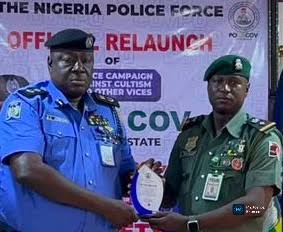
Two Divisional Police Officers (DPOs) in Rivers State have been honoured by separate groups for their contributions to security, crime prevention and improved community-police relations in their respective areas of responsibility.
The beneficiaries are the DPO of Afam Police Division, CSP Endurance Worgu and his counterpart at Oyigbo Police Division, CSP Bello Yusuf.
CSP Worgu was honoured by a group of students under the aegis of Rivers State Graduate Students Associations for what they described as his commitment and outstanding performance in the discharge of his duties.
The students, led by Chidi John Enyie, Esq. said CSP Worgu was selected based on his track record and status as one of the longest-serving young DPOs of Rivers State origin.
According to the group, CSP Worgu has made significant contributions to the protection of lives and property in the area since assuming office following the #EndSARS period.
The students said they were particularly impressed by the improvement in community-police relations under his leadership, noting that professionalism had remained a key feature of his service.
Enyie represented by Comrade Briggs Soku, said the students community was pleased to identify with a Rivers indigene who had distinguished himself in the police force.
He said the students considered it necessary to encourage and celebrate CSP Worgu because of his achievements as a young Rivers man excelling in a profession that many people from the state were often reluctant to join.
Receiving the award at his office in Afam, CSP Worgu expressed gratitude to God and the students for finding him worthy of the honour.
The DPO said the recognition had boosted his morale and encouraged him to sustain his efforts towards maintaining peace and security in the area.
He said he least expected the honour, particularly because it came from the students, adding that the recognition would further motivate him to serve the people better.
CSP Worgu assured residents of Afam that the police would sustain the existing peace in the area.
He appealed to members of the public to support the police by providing credible and timely information, stressing that useful information from residents would make the job of security personnel easier.
Meanwhile, the Ikwerre/Etche Media Association has also honoured the DPO of Oyigbo Police Division, CSP Bello Yusuf, for his efforts in tackling criminal activities in the area.
The media group presented the award following the swift tracking and arrest of five suspected kidnappers who had allegedly terrorised residents of the Kom-Kom axis and other parts of Oyigbo.
The group commended CSP Bello for what it described as his determined efforts to restore confidence and security in the affected communities, particularly Kom-Kom and Obeama.
According to the group, the arrest of the suspects demonstrated the DPO’s commitment to tackling criminality and safeguarding residents.
The media association said residents had received the development with relief, noting that the police action had sent a strong message to criminal elements operating in the area.
Responding, CSP Yusuf appreciated the group for the recognition and reaffirmed that there would be no room for criminality in Oyigbo.
He also commended the media for its role in disseminating credible information to the public, saying the media had remained supportive of the police in the fight against crime.
CSP Yusuf warned criminal elements operating in Oyigbo to leave the area or be prepared to face the full weight of the law.
He assured residents that the police would continue to pursue criminals and work to dismantle their hideouts, regardless of where they might be operating.
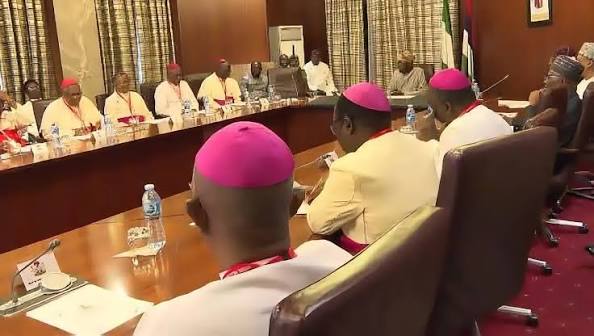
The 5000 Achievers Christian Forum and Colleges of Bishops, Archbishops and Apostles, a Christian interdenominational organisation, has endorsed President Bola Ahmed Tinubu and all candidates of the All Progressives Congress (APC) in Rivers State for the 2027 general elections.
International President of the forum, Archbishop Lucky Aroh, disclosed this during the ordination and consecration of three new Bishops, as well as an award ceremony held in Port Harcourt.
Aroh said the performance of the APC-led Federal Government had endeared the party to the organisation, prompting the forum to declare its support for President Tinubu and other APC candidates in Rivers State.
He said the forum would support all APC candidates in the state during the 2027 elections and urged Nigerians to vote for the party.
Aroh, who is also the General Overseer of Caring Peoples Church, Port Harcourt, charged the newly consecrated Bishops to see their new positions as a great responsibility and dedicate themselves to the advancement of the kingdom of God.
He cautioned them against conduct capable of bringing their offices into disrepute, stressing that their activities would be closely watched by members of the public.
“As Bishops, the eyes of the public are on your activities. You must therefore conduct yourselves in a manner worthy of your calling,” he said.
Also speaking, the International Coordinator of the forum, Bishop Saint Robinson, urged the newly consecrated Bishops to work diligently towards winning souls for the kingdom of God.
Robinson, who was the guest speaker at the event, stressed that the activities of Bishops must at all times be guided by godly principles.
He also called on members of the church to support and cooperate with the newly consecrated Bishops in the discharge of their responsibilities.
The Secretary of the College, Apostle Elizabeth Ayadi Abaye, said the organisation was established to advance the kingdom of God and promote spiritual development.
According to her, the forum has organised several crusades, conferences, prayer meetings, ordinations, consecrations, enthronements, empowerment programmes and other spiritual development activities across the country as part of efforts to win souls for Christ.
Abaye said the organisation has members across the world and disclosed that more programmes had been scheduled to promote the spiritual development and wellbeing of humanity.
The three Bishops consecrated at the ceremony were Prince Alban Chike, Testimony Omenihu Shedrach and Prince Ifemena.
Among those honoured at the event were the Chairman of the Community Development Committee (CDC), Abali Community, Port Harcourt City Local Government Area, Manuchimso Prince Lemmy Wopara, and Clifford Oko Jaja, Coordinator of the 5,000 House-to-House for President Tinubu.
By: John Bibor
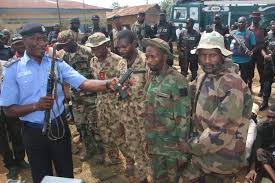
The Rivers State Police Command has arrested a 49-year-old suspected fake soldier, Andrew Atausi, and several other suspects in connection with various criminal activities, including kidnapping, armed robbery, cultism, one-chance robbery and the alleged murder of police officers.
The State Commissioner of Police, CP Olugbenga Adepoju, disclosed this in Port Harcourt, recently during a press briefing at the Command Headquarters, where he said the arrests formed part of the operational achievements recorded by the Command between June and August 2026.
Adepoju said Atausi was arrested on August 10 by police operatives along Ada George, Port Harcourt, while dressed in military uniform and driving a Toyota Hilux painted in Army colours.
The Commissioner said investigation revealed that Atausi was not a member of the Armed Forces, adding that he was suspected to be a serial car snatcher, with three suspected stolen vehicles recovered from him.
He said the recovered vehicles included three Toyota Hilux vehicles without registration numbers and a Toyota Corona Premio with registration number BNY 380 ES, noting that the chassis and engine numbers of the vehicles had allegedly been tampered with.
Adepoju added that an axe and military accoutrements were also recovered from Atausi, as investigation continued into the circumstances surrounding the vehicles and other items recovered from him.
On the June 29 attack on police officers at Aluu Division, the Commissioner said three members of the gang allegedly responsible for the incident had been arrested by operatives of the Violent Crime Response Unit, VCRU-AKU.
The suspects, identified as Maduabuchi Emeka, 34, alleged gang leader; Doctor Chinedu Owhor, 42, and Kamachi Joe, 28, alleged armourer, reportedly led operatives to their hideout at Omagwa where two AK-47 rifles stolen during the attack were recovered.
Adepoju recalled that two police officers were killed during the Aluu attack, while others were wounded and one officer had his leg amputated, stressing that efforts were ongoing to apprehend the fourth suspect.
On kidnapping, the Commissioner said five members of a suspected kidnapping syndicate were arrested in Oyigbo Local Government Area, adding that they allegedly confessed to operations in Kom-Kom, Railway, Obeama and Afam communities.
He said two other suspects from the same network, Anele Ogbogu, 35, alleged to be the gang’s armourer, and Kenneth Eke, 38, were arrested on July 27, with one AK-47 rifle and one SMG rifle recovered.
The Commissioner further disclosed the arrest of suspects in connection with alleged firearm offences, armed robbery, cultism and one-chance robbery, with firearms, ammunition and other exhibits recovered during the operations.
Adepoju assured residents that the Command would sustain intelligence-led, proactive and community-oriented policing in collaboration with other security agencies, while urging members of the public to continue providing credible information that would assist the police in combating crime across Rivers State.
By; King Onunwor
-

 News2 days ago
RSG Targets Nine Million Residents in Mosquito Net Distribution Campaign
-

 Oil & Energy2 days ago
Aiyedatiwa Signs New Electricity Bill
-

 Maritime2 days ago
Marine Minister Commends President Tinubu On NPERA Bill Assent
-

 Oil & Energy2 days ago
NLNG Commissions Research And Innovation Centre In RSU
-

 News2 days ago
KenPoly Holds Eight Convocations, August 29
-

 News2 days ago
RSG Begins Another Phase of Projects Commissioning Today
-

 News2 days ago
RMAFC Completes Revenue Sharing Review, Proposes New Pay
-

 Maritime2 days ago
NAGAFF Petitions IGP Over Alleged Maritime Police Harassment