
Politics
Obasanjo’s Letter

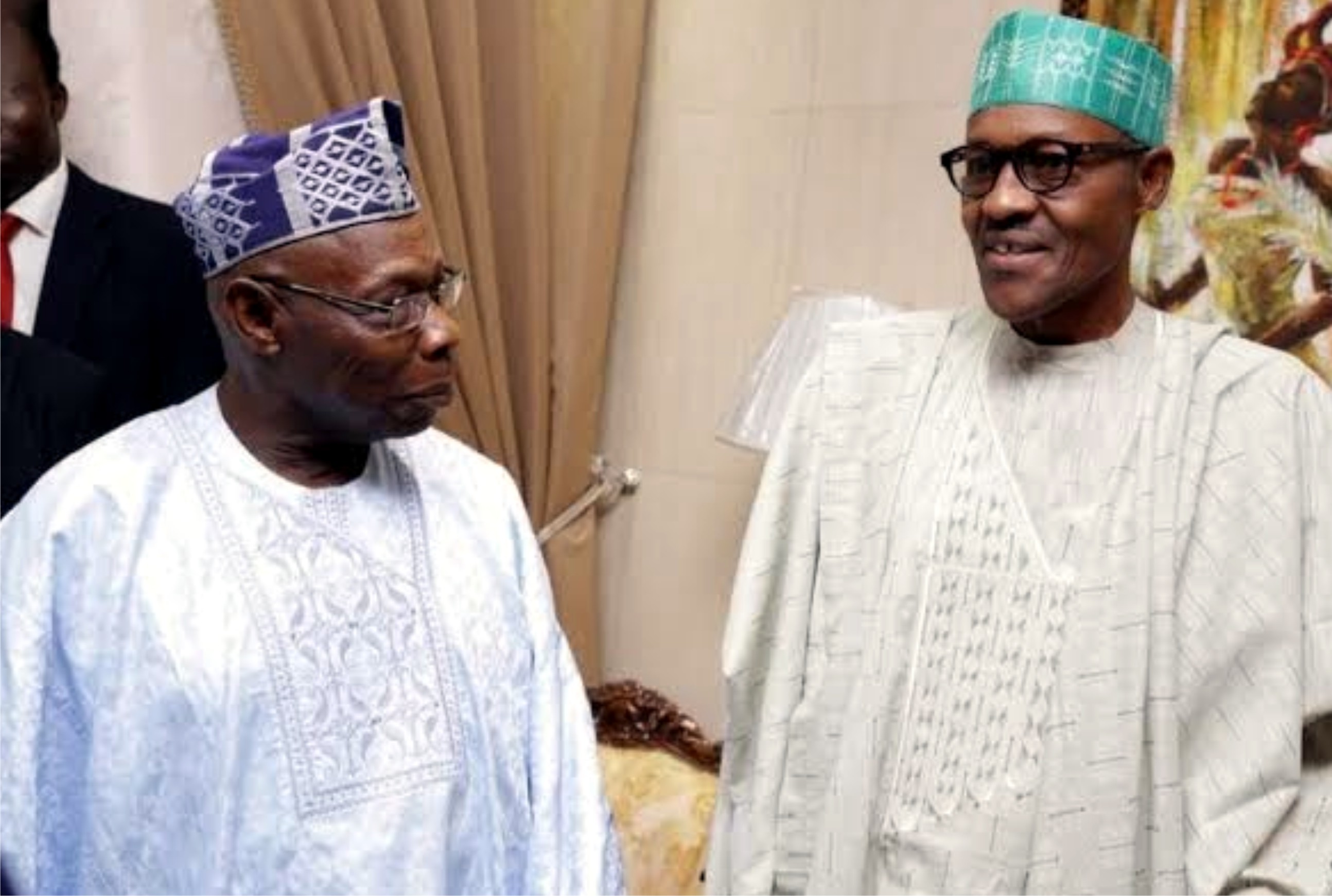
There is this African adage that says, “A dancer does not see his back”. This assertion is apt as it is the spectators that judge the dancing skills of a dancer and could, when asked to make a comment, point out the mistakes the dancer makes.
In essence, dance steps follow a drum beat or musical beat and when a dancer performs well, follows the correct rhythm, he or she is commended for a job well done. Also, in the political realm, the accolades or criticisms follow the same pattern as it takes only the professional to see the fault in any political setup and offers good advice to those at the helm of affairs.
Just this week, former President, Chief Olusegun Obasanjo sent an open letter to incumbent President Muhammadu Buhari on the state of the nation where he expressed worry over the security situation and other lapses of the administration. This is not the first time Chief Obasanjo has done so. During the presidency of the late Alhaji Shehu Shagari, he counselled the former President and hauled abuses and condemnation at him. Under Ibrahim Babangida, he did same and the reaction was not different under Yar Adua and Dr Goodluck Jonathan. His pen danced and danced and the reward he got was not different.
Chief Obasanjo two years back also wrote a letter to the same President Buhari on his handling of the ship of the nation but was criticised not minding the fact that it was the same Obasanjo that Buhari met to seek his support for the office of the Presidency in 2015.
That notwithstanding, advice is never a curse. That is why those who really want to succeed in life brook criticisms and never hits back at those who give them useful advice. But to say Chief Obasanjo who fought in Nigerian Civil War and even saw to the surrender of Biafra is an unpatriotic person is really ludicrous and laughable.
Obasanjo has paid his dues and most of his observations are done without malice and it is only a dumb-witted person, people who don’t love the country that will see nothing good in his observations and advice.
The issue is not that Obasanjo is a saint or knows it all, but the stark reality is that Nigerians are in trouble and probably have entered what motor park touts call a ‘one chance journey.”
Of all the points or observations made by the former president which really touch the fabric of the country’s future is the issue of Nigerians gradually losing confidence in the ability of the Buhari administration to fight criminality perpetrated by herdsmen, Boko Haram and kidnappers in virtually every part of the country.
Today, even the wealthy in the cities and the poor in the rural areas are afraid for their lives, our houses have become fortresses and our streets in the urban areas are now gated. There is no week that we don’t hear of killings and kidnapping on our waterways and highways which have become death traps to travellers’ and commuters. In short, no place is safe anymore in the country.
Basically, Obasanjo’s letter raises about 11 salient points which include the need for a national dialogue to discuss the way forward and suggested that all former presidents, heads of state, heads of security , governors (both present and past) and other major stakeholders in the country, including council chairmen be invited to deliberate on the issues confronting the country.
Another point he raised was that the government must be an inclusive one. This observation is quite apt because of serious lopsidedness in the composition of the country’s security structure and other critical appointments which show that they favour only one section of the country and people of a similar religious affiliation.
This to some Nigerians shows that the present administration is the most sectionally -minded government Nigeria has ever had. That even after the end of the Civil War under General Yakubu Gowon, Nigeria was a better place in terms of appointment of people to positions of trust.
The advice did not come as a surprise to all who have been following the trend in the country and for Chief Olusegun Obasanjo to use his pen once again to sound a note of caution on the nation’s march into the future calls for concern. According to him, it seems Nigeria has been handed over to a bunch of criminals that even the Chief of Army Staff seems confused and is blaming the spate of insecurity on sabotage and lack of commitment by personnel of the Armed Forces. Is it not the same government that said it has crushed Boko Haram? How come this confession that it is fighting the war against criminality suddenly overwhelming it?
For Obasanjo to say the security issue is hitting the very foundation of our existence is not far from the truth as herdsmen have become a threat to the corporate existence of the country, and if left unchecked, might eventually result in massive inter-tribal war on a national scale as acts of retributive justice may lead to ethnic cleansing as it happened in Rwanda in 1994. So to curb any upheaval of such nature, the president must start thinking of solution and stop living in a cocoon where he sees nothing, hears nothing and is not even aware that his security chiefs are also doing nothing.
It is quite sad that in Nigeria, we are never always truthful to those who occupy the office of the president or governor. That is why according to the late music maestro, Fela Anikulapo-Kuti, “Nigeria is a big blind country”. A country where advice is seen as a crime with those who render good advice hounded, called nasty names and even threatened with arrest or even arrested for disturbing the peace of the nation. To be truthful, President Muhammadu Buhari has failed in all facets of governance. Under his watch between June 2018 to May 2019, over 7,253 Nigerians have been killed. The figure released by Nigeria Security Trackers (NST), a project of the Council on Foreign Relations Africa, consists of those killed by Boko Haram and Islamic State in the Northern part of the country, herdsmen and extra-judicial killings by the military.
During the time frame according to the report, Borno and Zamfara recorded the highest number of killings, contributing to 49% of the total deaths within the last one year. Borno recorded 2,384 killings while 1, 157 people were killed in Zamfara. Other states that make up the most affected states are Kaduna, 540, Benue 330, Adamawa 303, Yobe 264, Taraba 176, Plateau 166, Rivers 160 and Katsina, the President home state, with 127 deaths.
One of the factors that ensured President Buhari’s success in the 2015 election was the issue of insecurity and most Nigerians thoughts that with his military background he would do a better job in the fight against criminality, but today, the tale is different as things are worse. States which never experienced bandits before are now bearing the brunt of banditry, robbery and kidnapping. States like Sokoto, Kebbi in the north and Ekiti, Oyo and Kogi axis are now seeing people killed on the highways, homes and farms. Not just there alone, farmers both in the South-South and South-East regions are even not faring better.
The situation is so bad that even elderly women are reportedly raped in their farms, killed or maimed and yet nothing is done to arrest and prosecute the culprits.
To Obasanjo, this is due to poor management of or mismanagement of our diversity, and when the silence by the victims becomes too much, something might set up a spark which might result in unforeseen circumstance. The earlier we tackle this malady, the better for the future of the country. And the only way forward is for President Muhammadu Buhari to be presidential in his actions by abiding by his oath of office to ensure the safety of lives and property of Nigerians and obey the constitution.
A country can survive one civil war but might not survive a second one which also involves ethno-religious differences.
Tonye Ikiroma-Owiye



The Independent National Electoral Commission (INEC) has extended the deadline for political parties to submit the list of candidates for the 2027 governorship and state Houses of Assembly elections from Saturday, August 8, to Tuesday, August 11, 2026.
The commission announced the extension in a statement issued on Saturday and signed by the National Commissioner and Chairman of its Information and Voter Education Committee, Mohammed Haruna.
According to INEC, the decision followed appeals by political parties for additional time to complete the submission process through the dedicated online portal.
“The submission window, which according to the revised Timetable and Schedule of Activities for the General Election was originally scheduled to close on Saturday, 8th August, 2026, has been extended to Tuesday, 11th August, 2026,” the commission said.
In a a related development, INEC announced the suspension of PVC collection in Osun State ahead of the August 15 governorship election.
The commission said voters who applied for replacement of lost, damaged or defaced Permanent Voter Cards would have until midnight on Sunday, August 9, to print downloadable copies of their cards.
The electoral body explained that the deadline was necessary to enable it compile data on downloaded PVCs and produce final statistics on the total number of cards collected ahead of the election.
INEC said PVC collection in Osun commenced at the Registration Area level from July 22 to 28, 2026, but was extended to July 31 following complaints about large crowds and difficulties experienced by voters at collection centres.
The exercise subsequently moved to the local government level and ran from August 1 to 7.
The commission also disclosed that replacement downloadable PVCs had been made available to voters in Odo-Otin and Ife Central Local Government Areas following the theft of cards during attacks on the two collection centres.
It stressed that the stolen cards could not be used to vote.
INEC reassured Osun residents of its preparedness for the August 15 governorship election.
“The commission reiterates that the stolen cards cannot be used to vote.
“INEC reassures the people of Osun State of its readiness to conduct a free, fair, credible and inclusive governorship election on 15th August, 2026,” the statement said.
The commission said the deadline, initially set for Saturday, 8 August, has been extended to Tuesday, 11 August 2026, following appeals from political parties for more time.
INEC also announced that the window for voters who applied to replace lost, damaged or defaced PVCs to download their replacement cards will close at midnight on Sunday, 9 August.
The move is to enable the commission compile final PVC collection figures ahead of the 15 August Osun governorship election.
INEC said replacement downloadable PVCs have also been provided to affected voters in Odo-Otin and Ife Central Local Government Areas after hoodlums carted away cards from two collection centres, stressing that the stolen cards cannot be used to vote.
The commission reaffirmed its readiness to conduct a free, fair, credible and inclusive election in Osun State.
Gov. Kefas made the remarks over the weekend at the Federal Medical Centre (FMC), Jalingo, during the flag-off of the second phase of the Renewed Hope Medical Outreach in Taraba State, organised as part of activities marking Prof. Yilwatda’s 58th birthday.
The governor commended Prof. Yilwatda for choosing to mark his birthday by providing medical care to people in need.
“What Professor Nentawe did is a powerful demonstration of what leadership should be,” Gov. Kefas said.
He assured that his administration would continue to support initiatives that complement government efforts to improve healthcare delivery and the wellbeing of residents.
Speaking at the event, Prof. Yilwatda called on Nigerian leaders to embrace the culture of giving and use their positions to touch the lives of the less privileged.
He said his decision to celebrate his 58th birthday in Taraba State was deliberate and informed by the needs of underserved communities, particularly people who face difficulties accessing healthcare because of distance and financial constraints.
According to him, the intervention followed a needs assessment and was extended across the three senatorial districts of the state.
He said the exercise commenced on August 3 at Takum General Hospital and covered the Federal University Teaching Hospital, Wukari; First Referral Hospital, Sunkani, Ardo-Kola Local Government Area; General Hospital, Bali; General Hospital, Gembu; and FMC Jalingo.
Prof. Yilwatda said the intervention provided medical services to thousands of beneficiaries, including people who required surgical procedures.
He said sustainable national development could only be achieved when strong institutions placed Nigerians at the centre of development.
“Leadership is about service,” he said, urging political and public leaders to make giving back to society an important part of their responsibilities.
He reaffirmed his commitment to serving Nigeria and its people, saying his personal vision was to make every day of his life useful to humanity.
“Every day that I live, the vision is: let it be useful to humanity,” he said.
The Taraba State Commissioner for Health, Dr. Bordiya Buma, commended the initiative, saying it was consistent with the Renewed Hope agenda and efforts to strengthen healthcare delivery in the state.
Dr Buma said the second phase followed the successful completion of the first phase, which was conducted simultaneously in six local government areas, with two LGAs selected from each of the three senatorial districts.
According to him, more than 10,000 patients were attended to during the first phase, including people with medical and surgical conditions.
He disclosed that 327 general surgeries, 71 eye surgeries and 575 dental procedures were carried out during the exercise.
The commissioner expressed appreciation to President Bola Tinubu for the Renewed Hope Medical Outreach and thanked Prof. Yilwatda for supporting the initiative and choosing Taraba State as a beneficiary.
The Minister of Health and Social Welfare, Prof. Muhammad Ali Pate, also commended Prof. Yilwatda for choosing Taraba State to mark his 58th birthday through a medical outreach.
Prof. Pate said making healthcare the centrepiece of the birthday celebration was significant because health affects everyone.
-

 News3 days ago
RSG Targets Nine Million Residents in Mosquito Net Distribution Campaign
-

 Oil & Energy3 days ago
Aiyedatiwa Signs New Electricity Bill
-

 Maritime3 days ago
Marine Minister Commends President Tinubu On NPERA Bill Assent
-

 Oil & Energy3 days ago
NLNG Commissions Research And Innovation Centre In RSU
-

 News3 days ago
KenPoly Holds Eight Convocations, August 29
-

 News3 days ago
RSG Begins Another Phase of Projects Commissioning Today
-

 News3 days ago
RMAFC Completes Revenue Sharing Review, Proposes New Pay
-

 Maritime3 days ago
NAGAFF Petitions IGP Over Alleged Maritime Police Harassment