Connect with us

Maritime

FG Promises More Sea Ports -Osinbajo

Published

on

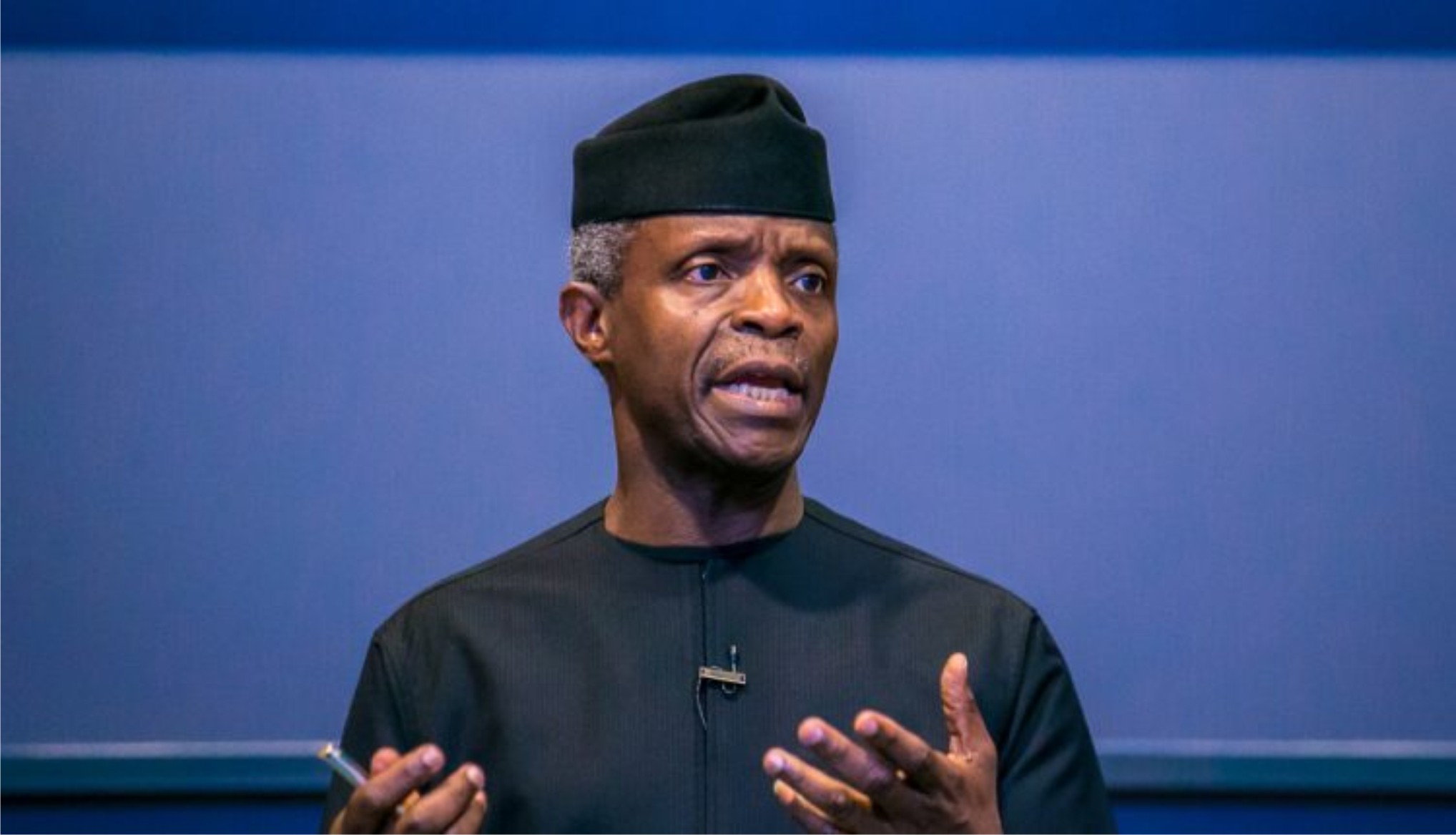
The Vice President, Prof. Yemi Osinbajo, has assured Nigerians that the Federal Government would build more sea ports across the country, to decongest the gridlock in and out of the Apapa ports.
Osinbajo stated this on Thursday shortly after the inspection of the Lilipond Transit Truck Park, Creek Road and other network of roads leading to the Apapa Port.
“We need to understand that this is a port that was designed to take 34 million metric tonnes daily but it is currently taking over 80 million metric tonnes.
“With this, it is obvious that there is need to find alternative quickly and to expand, where that is possible”, he said.
Osinbajo who was accompanied by Gov. Babajide Sanwo-Olu of Lagos State and the Managing Director of the Nigerian Ports Authority (NPA), Hadiza Bala Usman, among others, stated that “The Lekki Port is an ongoing project which will be a great help when completed because it will support the Apapa and Tin Can ports.
“Also, we are dredging the Warri Port which is aimed to decongest the traffic into and out of the Apapa and Tin Can ports.”
The vice president assured that the Federal Government would continue to implement short and long term measures to ensure long lasting solution to the gridlock in the Apapa area of Lagos State and its environs.
“You will see that the entry route to the port has been cleared. So, we need to understand that there are short term and mid-to-long term solutions.
“One of the mid-to-long term measures is to decongest the cargo traffic coming into the port,” he said.
Osinbajo also said that the FederalGovernment was set to improve infrastructure and callup system for trucks and the ports while working on harnessing opportunities of the intermodal transport system.
“Also, the Lagos-Kano rail is also starting from the Apapa ports. So, we expect that we should be able to get cargo out of the Apapa Port using the rail than take cargo out of the port using the hinterlands and some are using badges at the moment.
“So, I can tell you that there are different approaches toward getting better movement in and out of Apapa.
“The other thing is the clearing of the trailers and tankers on the road so that there can be easy access to the port and you will see that there is considerable improvement within the axis.
“The Mile 2 end is the axis where we think that there is difficulty but we think that in the next couple of days, it will be resolved especially with the opening of the Tin Can Island trailer parks and the palliative work that is ongoing all the way to Mile 2,” he said
The Vice President expressed satisfaction over the work carried out by the Presidential task force vested with the responsibility of decongesting the truck-laden roads where residents spend all days grounded.
Recall that in May, a presidential task force was constituted to clear the Apapa road of articulated vehicles which had locked down the road, causing residents and commuters in the axis untold hardship.


Continue Reading

Maritime

CILT Nigeria Seeks  Anti- graft Agency Collaboration

Published

on

The Chartered Institute of Logistics and Transportation, CILT has sought collaboration with the Economic and Financial Crimes Commission, EFCC towards enhancing interconnectivity through a multimodal logistics and transportation system that involves the rail, road, sea, motorways and pipelines.
The request was made last week when  the President and chairman of Council, CILT,   Dr. Boboye Oyeyemi, led other executives on a courtesy visit to the Executive Chairman of EFCC, Ola Olukoyede at the Commission’s corporate headquarters in Jabi, Abuja.
“We can collaborate with the EFCC in terms of advocacy. When I’m talking of advocacy, I’m talking about the issue of the transport and logistics sector.
“We can have anti-corruption awareness within the transport sector. Another key issue has to do with professional ethics and training. We believe that we can collaborate with EFCC in the area of public transport as regards to integrity programmes for industry professionals and also research policies addressing logistics vulnerabilities in financial crimes,” he said.
He also identified logistics and supply chain expertise as another area of collaboration with the EFCC.
 According to him, “There’s no way you can conduct an investigation without bumping into the issue of logistics and transportation. We believe that we can look into this and offer professional memberships to your members of staff at different levels.
“We believe if they are members of the institute, it will lessen the cost of your investigation.
“In our Academy, We can also offer to deliver lectures in this area to enhance professionalism. So, before your Cadets pass out from the Academy, members of the Institute can make lectures to be delivered in the areas of logistics and transport so as to enhance their professionalism.
 “,At the end of the day, they will have professional certificates and also have enhanced capacity to investigate the issues of logistics and transportation.”
He blamed the delay in the clearance of goods in Nigerian seaports to logistical inadequacies.
 “There’s so much serious problem in logistics in Nigeria, so many duplications. And it’s not giving Nigeria a good image. You are talking about bringing investors.
0″I don’t want to bring investors if it would take weeks to clear their goods,” he said.
By: Nkpemenyie Mcdominic, Lagos
Continue Reading

Maritime

Nigeria Customs, Malaysia Strengthen Bilateral Agreement ….As Trade Hits 1.82tr in 5 Years

Published

on

The Nigeria Customs Service (NCS) has advanced its strategic engagement with the Royal Malaysian Customs Department (RMCD).
This followed an official visit by the Comptroller-General of Customs, Bashir Adewale Adeniyi, to the RMCD Headquarters on the sidelines of his participation at DSA Malaysia 2026.
The engagement comes against the backdrop of expanding bilateral trade, with Nigeria’s imports from Malaysia increasing from NGN 159.9 billion in 2020 to NGN 716.0 billion in 2024, and cumulative trade value reaching approximately NGN 1.82 trillion over a five-year period.
The Nigeria customs boss was received by the Director-General of the Royal Malaysian Customs Department, Dato’ Haji Amran bin Haji Ahmad, whose appointment in March 2026 reflects a strong reform-oriented leadership in enforcement and regulatory administration.
Both leaders held high-level discussions focused on institutional collaboration, customs modernisation, and coordinated border management frameworks to strengthen efficiency and regulatory integrity.
The Comptroller-General emphasised that the scale and trajectory of Nigeria–Malaysia trade relations necessitate a more structured and formalised customs-to-customs partnership.
 He noted that Malaysia remains a significant trading partner to Nigeria, with key imports including crude palm oil, refined palm olein, jet fuel, food preparations, machinery, and other industrial inputs.
He further underscored the critical role of customs administrations in facilitating legitimate trade while safeguarding national economic and security interests.
Both administrations acknowledged the absence of a formal legal framework guiding bilateral customs cooperation despite longstanding trade relations.
To address this gap, both parties agreed to initiate processes toward establishing a Mutual Recognition Agreement under the framework of the World Customs Organisation (WCO), to be pursued through appropriate diplomatic channels.
This initiative is expected to provide a structured basis for cooperation, enhance mutual trust, and support reciprocal trade facilitation measures.
The engagement also provided an opportunity for the Royal Malaysian Customs Department to present its evolving border management architecture, including the establishment of the Malaysian Border Control and Protection Agency (AKPS) as an integrated frontline border control body.
In his aresponse, the Comptroller-General highlighted the Nigeria Customs Service’s Authorised Economic Operator (AEO) programme and other trade facilitation frameworks designed to ensure predictable clearance processes, reduce transaction costs, and strengthen compliance.
Both sides emphasised the importance of deeper collaboration in intelligence sharing, enforcement coordination, and technology-driven border management, particularly in addressing illicit trade and transnational trafficking.
To this end, the NCS reiterates its commitment to strengthening bilateral and multilateral partnerships as part of its broader modernisation agenda.
The Service noted the outcome from this engagement will enhance operational capacity, improve trade facilitation, and reinforce border security, while supporting Nigeria’s economic growth objectives.
As part of ongoing efforts to deepen institutional collaboration, the Comptroller-General also used the opportunity to visit the Nigerian  Diplomatic Mission and Defence Office in Malaysia, commending their roles in advancing Nigeria’s interests and supporting nationals abroad.
By: Nkpemenyie Mcdominic, Lagos
Continue Reading

Maritime

Customs Deploys Seven Patrol Vessels, Boost Waterway Anti-smuggling

Published

on

The Nigeria Customs Service NCS has deployed seven operational patrol vessels to Western Marine Command to combat smuggling and other maritime crimes
The vessels, comprising two gunboats and five logistics boats, were officially handed over to the Command recently, increasing its fleet to significantly enhance patrol coverage and rapid response capacity within its area of responsibility.
Speaking during the handover ceremony, Comptroller of Western Marine Command, Patrick Ntadi, said the deployment reflects the Service’s strategic commitment to strengthening enforcement across critical maritime corridors.
“These assets are a clear demonstration of our resolve to secure Nigeria’s waterways against economic sabotage and transnational crimes.
“We are not only expanding our operational capacity but also ensuring that our officers are better equipped to respond swiftly and effectively,” he said.
Ntadi described the expanded fleet as a major boost to ongoing anti-smuggling operations, noting that it addresses previous logistical challenges and strengthens deterrence along key waterways.
“The fight against smuggling is dynamic, and we must remain proactive.
“This deployment, alongside continuous training and inter-agency collaboration, will significantly improve our enforcement outcomes and protect national revenue,” he added.
To support the effective deployment of the vessels, officers of the Command recently underwent an intensive training programme conducted by SEWA Africa Ltd, the contractor responsible for the boats.
The training focused on handling techniques, safety procedures, and operational efficiency.
Representative of SEWA Africa Ltd, Steven Okitiape, explained the training was designed to enhance both competence and safety among officers.
“This training serves as both a refresher and a capacity-building initiative, ensuring that officers can maximise the performance of these vessels while maintaining the highest safety standards,” he said.
By: CHINEDU WOSU
Continue Reading

Trending