
Women
Aso ebi: Gate Pass To Social Gatherings

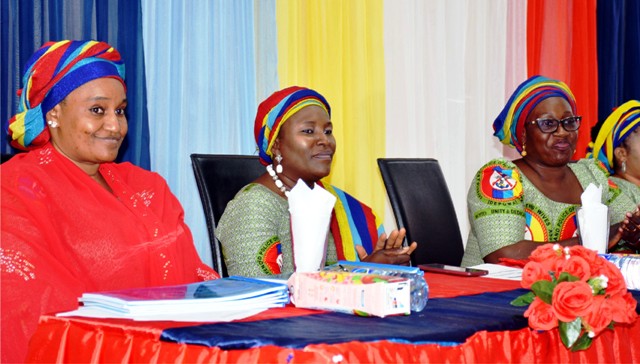
A popular Yoruba adage says, “Eni o wo ankara o je semo” meaning: the guest who does not wear uniform fabrics, popularly called ‘Aso ebi’ will not eat at the social gathering the fabric is meant to celebrate.
‘Aso ebi’, usually worn by family members and friends at ceremonies, has in contemporary times, become the gate pass to social events such as weddings, burials, harvests, ordination of religious leaders, political rallies and campaigns in Nigeria. It gives a sense of belonging to those who adorn them during the events. It equally makes the celebrator to feel loved and important.
According to Wikipedia, ‘Aso ebi’ is a uniform-attire traditionally worn in Nigeria and in some other West African countries as an indicator of cooperation and solidarity during ceremonies and festive periods. `Aso ebi’ can be made with Ankara, Lace, ‘Aso oke’ (hand woven fabrics), Damask, George, `atiku’, `Senator’, and a host of others materials for both men and women.
The prices of these fabrics range from N500 per pack to N150,000 depending on the class, status and taste of the celebrator. They are mostly sewn in native blouse and wrapper/skirt or gown for women and native shirt and trousers/wrapper and even ‘agbada’ for men.
‘Aso ebi’ adds beauty, colour and glamour and grandeur to events.
Analysts note that guests who wear ‘Aso ebi’ to social functions are usually believed to have directly or indirectly contributed to the success of such functions.
They also argue that those determined to identify with a celebrator through adorning of ‘Aso ebi’ often do not mind the quality or market value of the fabric.
According to analysts, a guest who refuses to adorn ‘Aso ebi’ may receive cold reception especially from ushers at the event no matter how highly placed or influential he may be.
Thus, most guests purchase ‘Aso ebi’ and appear in them on the day of the events, whether convenient or not, just to fulfill all righteousness, since they are not likely to wear them after that day.
It is also believed that some people see the purchasing of these outfits as an opportunity to acquire more clothes as they may not have the time to go to markets to buy fabrics.
A fashion designer, Mrs Seun Olujide, says an average of 10 ladies send ‘Aso ebi’ to her shop for sewing weekly because of one event or the other.
“This keeps us busy, helps us to hone our designing skills, and deepens our mastery of the art while we make a living from it.
“When our clients wear their fabrics, it gives them a sense of belonging when they get to the event venue because no one likes to feel left out. We are also fulfilled as fashion designers when our clients bring us commendation from their friends and admirers about our works.
“Personally, when I attend a wedding in ‘Aso ebi’, it increases my confidence. I don’t feel like outcast or someone who does not want to support her friend or family member,” she says.
Mr Ojo Ogidi, however, notes that some people exploit ‘Aso ebi’ buyers by selling to them at high prices, noting that this makes such people unable to sell more packs of `Aso ebi’ because some intending buyers would have carried out market survey and observed the exploitation.
“To beat such pranks, two or more potential buyers will jointly buy just a set, instead of the individuals buying a set each,’’ he argues.
A civil servant, Mr Funmi Ajayi, says she teamed up with four others and bought a set of lace materials for a wedding which the event host sold at a skyrocketing price.
“We decided to buy a set and share it among ourselves. Each of us gave to our fashion designer who combined it with other matching fabrics and sewed.
“Our host gave us a single gift which we gave to the oldest among us. By doing so, we contributed to the success of the wedding and were accorded the same recognition at the reception as others who bought and wore the full set of the lace material,’’ Ajayi says.
Mrs Boluwatife Alabi of April Fabrics, Lagos, is of the opinion that an event without ‘Aso ebi’ is incomplete.
“What is a wedding without the ‘Aso ebi’ ladies? What is a celebration of life without friends and family members cladding in `Aso ebi’ of various materials and styles?
“I make it a point of duty to select the best fabrics for my clients because the more colourful the fabrics, the more colourful the event will be,’’ the fabrics seller argues.
She explains that ‘Aso ebi’ sellers add a little amount to the market price of the fabrics to cover the cost of souvenirs to be given to guests.
“I am aware of instances where certain amount are added to the cost price by organisers, but that is to cover for souvenirs that will be distributed to guests during the function.”
A student, Miss Itunu Asamany, believes that ‘Aso ebi’ is vital to social functions as it serves as a means of identification with age mates, relatives, groups or friends.
“It always makes such events beautiful, colourful and well organised. The bride during her wedding will be able to identify her friends and close relatives by what they wear,’’ she says.
Asamany, however, condemns charging of outrageous prices for ‘Aso ebi’ by some celebrators. She is convinced that the high prices are exploitative and can discourage many potential `aso-ebi’ buyers.
“Some people go as far as adding 30 per cent of the cost price to the selling price; this is not fair at all.
“I won’t break a bank to please my friend. If the selling price of the ‘Aso ebi’ is beyond my budget, I will not buy it but go for what is within my power.”
However, a trader, Mr Koko Adeola, has a different view. He says he will not mind spending a huge amount of money on ‘Aso ebi’ for close friends but won’t bother doing so for an acquaintance.
“I will not buy an expensive “Aso ebi’’ from someone who is just an acquaintance. The level of relationship I have with you will determine whether I will attend your function in `Aso ebi’. A major advantage of ‘Aso ebi’ is that it helps to identify invited guests from those who gate-crashed,’’ he says.
He observes that ‘Aso ebi’ is less expensive for men. “Men are lucky when it comes to buying ‘Aso ebi’ because, many times, all they need to buy is just the cap which may not cost more than N500.’’
A businesswoman, Ada Mbah, is worried that ‘Aso ebi’ can breed unhealthy rivalry between families, especially, during entertainment and sharing of gifts at events.
“Why should the family and friends of the groom be refused food and drinks because they are wearing a different fabric (‘Aso ebi’) from those of the bride?
“I attended an event without wearing the ‘Aso ebi’ and I was told that only people with the uniform would be entertained and given gifts.
“I was embarrassed because I bought the fabric but did not wear it to that particular occasion. I really felt bad because I was addressed very rudely and treated like outcast.
Mbah’s friend, Deborah Ige, is of the opinion that a guest can still be treated badly even when wearing Aso ebi. She recalls when she was ignored during entertainment at a ceremony even with her ‘Aso ebi’.
He says: “I bought the fabric for the event, but when it was time for entertainment, I only got a bottle of water.’’
According to her, getting the required attention during social gatherings with or without ‘Aso ebi’ will depend on planning.
“There are instances where the population of the guests is more than what the host has budgeted for; he or she will resort to rationing foods and drinks,’’ she argues.
A marketer, Mr Joseph Omojola, is of the opinion that since ‘Aso ebi’ has become the trending gate pass to events whether secular or religious, there is the need for more security consciousness to ensure that criminal elements do not disguise as family members or friends by wearing the ‘Aso ebi’.
Analysts are convinced that wearing ‘Aso ebi’ is a major way of promoting African culture, and if well managed, will reduce foreign influence on Africans’ dressing.
They suggest that African governments should do more to promote local production of the indigenous fabrics at affordable costs and consider using them for school uniforms and office wears on certain days of the week.
Onijala writes for News Agency of Nigeria.
Busayo Onijala


Women
Hearty Cheers To Nigeria’s Flamingos …Kudos To All Nigerian Women Who Chose To Excel In Male Turfs

For ages, football and soccer pitch in Nigeria were literally identified as areas specifically meant for the menfolk, in line with the societal expectation that physical dominance belongs exclusively to men. Our pitches and the likes were formerly mapped out as men’s domain!
As years rolled by, a new generation of daughters arose. The barriers were broken. Our women and girls graced the pitches and took solid grounds. Not, just to watch and not just to participate, but to conquer.
Nigeria’s female national football teams have consistently flown the country’s flag high, serving as absolute power houses on the African continent and earning immense global respect.
The year 2026 will forever be etched in gold. In Nigeria, and African football history as the year Nigeria’s U-17 women’s national team, the Flamingos took over the male turf, rewrote the global script at the FIFA U-17 Women’s World Cup in Morocco, emerging the first African female Team to conquer the World and bring home the World Cup.
The journey through the seven matches were clearly tough and rough but the Nigerian teenage Queens defied all odds , faced the global big hooves , beat them in their games and made Africa; Nigeria proud . They broke all barriers and won their six matches. They conquered football behemoths like Brazil in the semi-finals with a stellar 3-1 victory, and stood face-to-face with multi-time global champions, Japan in the grand finale in Rabat. When the final whistle blew, sealing a tense 2-1 victory over Japan, the Flamingos achieved the unthinkable: they became the first African nation in history (male or female) to lift the FIFA U-17 World Cup trophy. .
I hail the Midfielder, Oluebube Umejiaku , who ignited the pitch and tamed the world former bests, clinching the prestigious ” FIFA Golden Ball as “ “Player of the Tournament.” Under the tactical brilliance of Head Coach Akeem Busari, the young Nigerian girls stood firm and displayed “what they got”
They did not just win; they dismantled barriers. After an initial setback, they surged forward with six consecutive victories.
As the African Queens landed home amidst thunderous ovations, the Presidency and the Senate took turns to celebrate the Young World Conquerors. Tuesday, the Senate, following the prayers of a Motion on the Flamingos glorious outing sponsored by Distinguished Senator Abdul Ningi applauded the U-17 World best. The World record attained by the players gave room for off politics deliberations in the Red Chamber as all Senators united in commendations over this national feat. The lawmakers took turns to eulogise the female players and splashed the team with cash sum of one hundred million naira.
Senate President Godwill Akpabio, speaking on behalf of his colleagues said, “I want to commend the Flamingos, the U-17 youth team of Nigeria, for defeating major countries such as Brazil and Japan to win the Under-17 World Cup for Africa for the first time and for Nigeria.”
He also appealed to the Federal Government and corporate Nigeria to adequately reward the players and invest in the foundational development of women’s sports. The lawmakers also commended the National Sports Commission (NSC) under Mallam Shehu Dikko for his good work which yielded the world trophy to Nigeria.
Wednesday, the Senate, President and his colleagues continued the shower of praises as they hosted the Flamingos in the National Assembly.
Same day, the team was hosted at the Presidential Villa by the First Lady, Senator Oluremi Tinubu. The players at the Villa received gifts of One hundred million Naira each from President Bola Ahmed Tinubu .
From the women’s world, the victory of the Flamingos speaks volumes. It is women breaking boundaries, venturing into male – dominated terrains not just to be seen but to excel not minding systemic hurdles.
Looking back, it is already established that soccer, the field of men had expanded. No longer a male preserve but a shared terrain where Nigeria’s female teams shake the world.
Before now, the Super Falcons (Senior Women’s National Team; undisputed Queens of Africa, dominated the Women’s Africa Cup of Nations (WAFCON) with multiple continental titles and historic triumphs. They qualified for every single edition of the FIFA Women’s World Cup since its inception in 1991. The Super Falcons maintained Continental Dominance and Rankings.
The Falconets, Nigeria’s U-20 Women’s National Team in turn carved their names in gold over the years as they consistently terrified traditional superpowers at the FIFA U-20 Women’s World Cup. They have a history of reaching deep into the tournament, famously securing runners-up position (Silver medals) at the FIFA U-20 Women’s World Cup on multiple occasions, fiercely challenging powerhouses like Germany and the USA. Maintaining African Supremacy, they routinely swept the African qualifiers, proving to be the ultimate conveyor belt of talent feeding straight into the senior Super Falcons squad.
Cheers to all Nigerian Women! Our Teams are the best!
Nneka Amaechi-Nnadi
-
Business3 days ago
BSG Partiner American Coy To Invest $100m In Gas Processing
-

 Oil & Energy3 days ago
FG To Double Oil, Gas Reserves, Moves To Intensified fresh Exploration
-
Business3 days ago
Seme Customs Intercepts Live Pacific Ridley Sea Turtle
-
Sports3 days ago
Fernandes Turns Down Man Utd Offer
-
Business3 days ago
159m small businesses registered on database in three years – SMEDAN boss
-
Sports3 days ago
Rivers To Host National Table Tennis Championship
-
Maritime3 days ago
Nimasa,China MSA Sign Bilateral Maritime Agreement
-

 Sports3 days ago
Kenyans Win PH International Marathon, Cart Home $10,000