
News
Shell, Amnesty Disagree Over Spills Response Allegations


The Shell Petroleum Development Company of Nigeria Ltd (SPDC) and Amnesty International have disagreed over allegations by the international human right watchdog that Shell and Eni were not deploying the best industry strategies in managing oil spills in the Niger Delta region.
While Amnesty International, last Friday accused the oil companies of negligence when addressing spills in the country, Shell, yesterday, denied the allegations of environmental mismanagement in the Niger Delta, reiterating its commitment to swift response to oil spill incidents as much as access and security conditions permit teams to mobilise and deploy to spill sites to investigate, clean up and remediate such areas.
The company said that this is in addition to deploying technology and best practice to make it more difficult for unauthorised persons to break pipelines and steal crude oil from its facilities.
Reacting to the Amnesty allegations in a statement made available to The Tide in Port Harcourt, yesterday, Shell’s Media Relations Manager, Bamidele Odugbesan, quoted General Manager, External Relations, Igo Weli, as saying, “SPDC, in collaboration with government regulators, responds swiftly to spill incidents as quickly as it can and cleans up spills from its facilities regardless of the cause.
“We regularly test our emergency spill response procedures and capability to ensure staff and contractors can respond rapidly to an incident. However, response to spills, clean-up and remediation depend on access to the spill site and ultimately on the security of personnel and equipment while work is ongoing,” Weli added.
He said Amnesty International’s allegations were false, without merit and fails to recognise the complex environment in which the company operates where security, a sole prerogative of government, remains a major concern with persisting incidents of criminality, kidnapping, vandalism, threats from self-described militant groups, among others.
Weli said the transparency in the online reporting of spill incidents by SPDC in its areas of since 2011, which Amnesty International itself acknowledged, demonstrates its commitment to creating awareness and enhancing collaboration with key stakeholders on oil spill response and clean-up processes and deepening understanding of the complex and challenging operating environment.
“SPDC reiterates its commitment to carrying out operations in line with best practice in a responsible and environment-friendly manner,” he added.
Investigations show that over the years, SPDC, the operator of a joint venture between the government-owned Nigerian National Petroleum Corporation (NNPC), SPDC, Total E&P Nigeria Ltd and the ENI subsidiary Nigerian Agip Oil Company Limited, has sustained air and ground surveillance as well as anti-theft mechanisms on equipment and pipelines to mitigate third-party interference and ensure that spills are detected and responded to as quickly as possible.
The company conducts daily over-flights of its pipeline network to identify any new spill incidents or illegal activities, and installed state-of-the-art high definition camera to a specialised helicopter that greatly improves the surveillance of our assets.
SPDC also works diligently to develop new hardware barriers and technologies to detect and prevent oil theft, sabotage, criminality and other types of third party interference that cause environmental damage, participating in industrial organisations in Nigeria as well as internationally to share best practices.
Investigations reveal that despite these and other efforts, criminals still target oil and gas infrastructure, causing spills.
However, the company explained it was continuing to focus attention on the detrimental impact of these activities on people, the economy and environment in engagements with the media, government officials, diplomats and community people.
It would be recalled that the London-based human rights group, had described the oil majors’ action as “serious negligence,” saying that they were “taking weeks to respond to reports of spills and publishing misleading information about the cause and severity of spills, which may result in communities not receiving compensation.”
Amnesty said the evidence of the negligence was exposed by a research project, adding that the oil giants’ “irresponsible approach to oil spills in the Niger Delta is exacerbating an environmental crisis.”
The Business and Human Rights Researcher, Amnesty International, Mark Dummett, said “Shell and Eni claim they are doing everything they can to prevent oil spills but Decoders’ research suggests otherwise. They found that the companies often ignore reports of oil spills for months on end; on one occasion, Eni took more than a year to respond”.
Amnesty International asked the Nigerian government to re-open investigations into 89 oil spills.
An Eni spokeswoman was quoted as saying that the rights group’s statements “are not correct and, in some cases, not acceptable,” adding it had provided a detailed response to Amnesty’s allegations.
Shell and Eni have for decades been two of the most active oil majors operating in the Niger Delta region.
Nigeria’s crude-producing heartland is an ecological disaster zone, scarred by decades of spills that have tainted the water and killed swathes of trees and other plants.
Yet, clean-ups and the associated compensation are highly contentious, with some local communities even blocking teams’ access to spill sites, allowing the damage to worsen, in the hope of extracting a bigger pay-out.
Under Nigerian law, companies must visit sites within 24 hours of reporting a spill.
Amnesty said that in one case, Italy’s Eni took more than a year to respond to a spill in Bayelsa State.
Susan Serekara-Nwikhana





Nobel Laureate, Professor Wole Soyinka, has called on Nigerians to reject silence in the face of extrajudicial killings and other abuses of human rights.
Soyinka stressed that accountability and civic courage remain essential to rebuilding public confidence in the nation’s institutions.
He made the call during the 28th Wole Soyinka Lecture held in Port Harcourt, last Friday as part of activities marking his 92nd birthday.
The lecture, themed “Reclaiming the Nigerian State through Accountability, Justice and Civic Courage,” drew participants from different sectors of society.
The renowned playwright and human rights advocate said the country’s greatest tragedy was not only the unlawful killings carried out by state and non-state actors, but also the silence that often follows such incidents, allowing perpetrators to evade justice.
According to him, indifference by citizens to abuses of power and violations of fundamental human rights has contributed to the persistence of extrajudicial killings and other forms of injustice across the country.
Soyinka said he dedicated this year’s lecture to victims of unlawful killings, noting that the event was intended to honour individuals who had lost their lives as a result of failures within the justice system and society’s inability to protect the sanctity of human life.
He stressed that the lecture was dedicated to what he described as the basic unit of every society – the human being, and urged Nigerians to place greater value on human dignity irrespective of ethnicity, religion or social status.
The Nobel Laureate recalled several incidents of violence, including the fatal shooting and killing of a young man in Ugheli in Delta State by a police officer, and the mob killing of Deborah Yakubu in Sokoto State sometime ago, lamenting that many of those responsible are yet to face justice.
He expressed concern that some perpetrators of violent crimes had openly admitted their actions without fear of prosecution, describing such situations as evidence of serious failures within the nation’s justice system.
Soyinka maintained that when justice is delayed or denied, public confidence in state institutions continues to erode, thereby encouraging further violations of human rights.
Responding to critics who accuse him of promoting religious or ethnic divisions whenever he spoke on such issues, Soyinka dismissed the allegations and pointed out that his advocacy has always centred on the protection of human life and the rule of law.
He urged Nigerians to remain vigilant and continue demanding justice in cases of alleged extrajudicial killings, including the recent shooting of a young man by a police officer, stressing that every life deserves equal protection under the law.
The literary icon also recalled an earlier pledge by a past incoming president to make public the files relating to unresolved assassinations and extrajudicial killings, questioning the status of the promised investigations.
He challenged citizens to continue asking questions about unresolved cases, insisting that justice, accountability and respect for human dignity are indispensable to building a peaceful, democratic and inclusive Nigerian society.
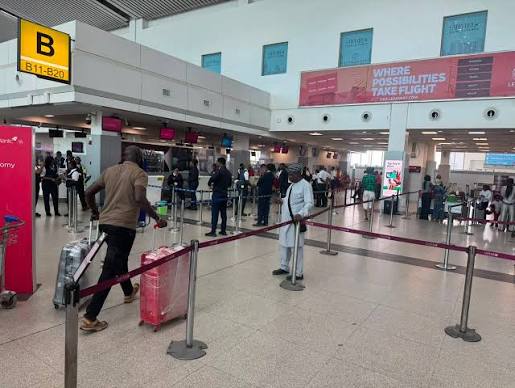
The Federal Airports Authority of Nigeria (FAAN) has clarified that there was no fire at Terminal 2 of the Murtala Muhammed International Airport, Lagos, contrary to its earlier advisory.
Earlier yesterday, FAAN had announced that a fire incident had occurred at Terminal 2 of the nation’s busiest airport, and assured that its Aerodrome Rescue and Firefighting Service had been deployed to contain the situation.
There were also reports that activities were briefly disrupted at the airport yesterday after smoke was seen inside parts of the terminal.
Videos circulating online showed passengers kept standing outside the terminal while firefighters responded to the incident.
However, in an update issued less than two hours later by the Director of Public Affairs and Consumer Protection, Henry Agbebire, and posted on FAAN’s official X handle, the authority said preliminary findings showed that the smoke seen at the terminal was caused by the discharge of the facility’s FM-200 fire suppression system.
“Further to our earlier advisory regarding the incident at Terminal 2 of the Murtala Muhammed International Airport, Lagos, the Federal Airports Authority of Nigeria (FAAN) wishes to provide the following update,” the statement read.
“Preliminary findings indicate that there was no fire at the terminal. The smoke observed within the affected area resulted from the discharge of the terminal’s FM-200 fire suppression system. The reason for the activation of the fire suppression system is currently being investigated,” FAAN stated.
The authority said normal operations had resumed at the terminal while investigations were ongoing to determine the cause of the incident.
“Normal operations have since resumed at the terminal, while detailed investigations are ongoing to determine the exact cause of the incident,” the statement added.
The authority thanked passengers, airlines, airport users and other stakeholders for their understanding and cooperation.
FAAN appreciated the understanding and cooperation of passengers, airlines, airport users and all stakeholders, and reiterated its commitment to the safety and security of all airport operations.