
Connect with us

City Crime

Bizman Seeks Legislation On Solar Energy

Published

on

A business consultant, Mr Cliff Odoh, has advocated for a legislation that would require new building plans to have solar energy components before being officially approved.
Odoh who is the Managing Director, Odosson Solar Company, said by making such demand, the slow development of solar in Nigeria would be a thing of the past.
The consultant who spoke to The Tide Friday in Port Harcourt stated that Nigeria had so much to do in Solar in the future because of the impressive weather but regretted that the pace at which solar energy was growing  in the country was too slow compared what obtains in other countries.
“Nigeria, like any other nation, would hardly achieve industrial advancement if our power supply situation remains the way it is.
“Let us take advantage of the impressive weather we have in view of its potentials on solar and the only way to do it is for the government to make laws that would compel all to think the solar way”, he said.
Odoh said the grid system might not be able to provide Nigeria the power supply she deserved for aggressive development especially in the remote areas of the country.
According to him, if properly harnessed, solar power would be a far better source of electricity supply adding that time had come for Nigeria to break away from national grid system.
“Solar can take you to the most remote places.  It gives you better and cleaner energy that is friendly to the environment”, he said.


Chris Oluoh

Continue Reading

City Crime

Dakar 2026: Nigeria Records Best-Ever Appearance At Youth Olympic Games

Published

on

Team Nigeria recorded its best-ever appearance at the Youth Olympic Games, winning three gold medals at Dakar 2026 in Senegal to surpass the country’s previous best performance at the competition since its debut.

It was a remarkable campaign defined by historic victories, record-breaking performances and the emergence of a new generation of Nigerian sporting talents, with three athletes etching their names into the country’s sporting history.

According to a press statement from the Special Assistant, SA to the Director -General of the National Sports Commission, Kola Daniel, Nigeria’s gold-medal haul came through Bright Gift, Rosemary Nwankwo and Praise Ugoh, whose outstanding performances in athletics delivered an unprecedented sprint double and a landmark victory in the women’s 400m.

Bright Gift made history by becoming the first Nigerian to win the men’s 100m title at the Youth Olympic Games, clocking an impressive 10.28 seconds to claim gold and set a new Games record.

Rosemary Nwankwo’s victory in the women’s 100m, completing Nigeria’s historic sprint double. Her 11.16-second performance made Nigeria the first country to win both the men’s and women’s 100m titles at the same edition of the Youth Olympic Games.

Praise Ugoh completed Nigeria’s golden campaign by winning the women’s 400m in a personal best of 52.76 seconds, becoming the first Nigerian to claim the event’s title at the Youth Olympic Games.

The three victories represent a new high for Nigeria at the competition, surpassing the two gold medals won at the inaugural edition in Singapore in 2010.

The National Sports Commission (NSC) has attributed the progress of Nigerian youth sports to sustained efforts in grassroots development, talent identification and the creation of competitive platforms through which young athletes can be discovered, nurtured and prepared for international competition.

The two technocrats, Mallam Shehu Dikko, and Hon. Bukola Olopade’s commitment to grassroots sports development has continued to drive initiatives aimed at building a strong pipeline of future champions.

A major component of this strategy is the Commission’s Invited Junior Athletes Initiative, alongside the National Sports Festival and the hosting of the CAA Africa U18/U20 Athletics Championships in Abeokuta. These platforms have provided opportunities for emerging talents to compete, gain exposure and progress towards representing Nigeria on the international stage.

The Director of Grassroots Sports Development at the Commission, Prince Niyi Beyeku, and other key players including Lekan Alabi epitomize the dedicated team behind implementing programmes and initiatives that strengthen talent discovery and development across the country.

The Nigeria Olympic Committee, under the leadership of its President, Engr. Habu Gumel, remained consistent in its support and leadership in coordinating Nigeria’s participation at the Games.

The Commission applauds all athletes’ coaches, technical officials, medical personnel and backroom staff whose hard work, preparation and dedication contributed to the team’s historic outing.

Beyond the medals, Nigeria’s performance in Dakar represents a significant statement about the country’s sporting future. The emergence of these young champions reinforces the importance of sustained grassroots investment and provides renewed optimism about Nigeria’s capacity to produce world-class athletes.

Continue Reading

City Crime

Tinubu Rewards Flamingos players With 100m Bonds

Published

on

President Bola Tinubu on Wednesday announced the award of a ?100 million Federal Government Savings Bond to each player on Nigeria’s victorious U-17 women’s football team, the Flamingos.

The bonds attract an annual interest rate of 14 per cent. The investment by the government for the players is for five years.

President Tinubu also announced a cash gift of ?100 million for the coach and ?50 million for each member of the technical crew.

The President announced the rewards during a reception at the Presidential Villa in Abuja for the Flamingos, who reportedly won the U-17 Women’s World Cup in Morocco.

The Flamingos defeated Japan to become the first African team to win the tournament.

President Tinubu was represented at the reception by the First Lady, Senator Oluremi Tinubu.
Continue Reading

City Crime

When Custody Becomes a Death Sentence

Published

on

Quote: “The moment the state takes a citizen into custody, it assumes a sacred duty to protect that life. Suspicion may justify arrest, but it can never justify neglect, abuse or death.”
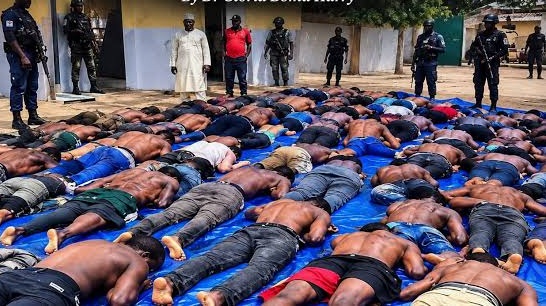
There are deaths that shock the conscience not merely because lives have been lost, but because of the circumstances in which those lives were entrusted to the state. The reported deaths of 37 suspected illegal miners in the custody of the Nigeria Security and Civil Defence Corps (NSCDC) in Minna, Niger State, an  incident which occurred on September 17, 2026, belongs  to this troubling category. The victims were reportedly arrested during enforcement operations against suspected illegal mining activities. Whatever offence they may have been suspected of committing, they remained citizens entitled to the protection of the law. They were suspects, not condemned criminals. Their detention therefore placed a corresponding responsibility on the authorities to safeguard their lives and dignity.
The Federal Government has since ordered a comprehensive investigation, while the Minister of Interior, Olubunmi Tunji-Ojo, constituted a 10-member independent committee to establish what happened, including the circumstances of the arrests, detention and deaths. Twenty NSCDC officers, in addition to the Niger State Commandant, have been suspended pending the investigation. Initially, the NSCDC indicated that a suspected disease outbreak might have been responsible for the deaths. However, survivors and relatives have made disturbing allegations concerning overcrowding, poor ventilation and the treatment of detainees. Reuters reported survivor accounts alleging that nearly 70 people were held in a very small cell and that an unidentified substance was sprayed inside. These accounts remain allegations and must be tested against medical and forensic evidence.
That is precisely why the investigation must be independent, transparent and exhaustive. Nigeria cannot afford a situation in which a tragedy of this magnitude is explained away by speculation, administrative statements or convenient assumptions. The families of the deceased deserve the truth, not conjecture. There is also a fundamental legal principle at stake. The fight against illegal mining is legitimate and necessary. Illegal mining can damage the environment, threaten communities, undermine public revenue and expose workers to dangerous conditions. Government therefore, has every right to enforce mining laws and apprehend those suspected of violating them. But enforcement must itself remain within the ambit of the law. President Bola Ahmed Tinubu has correctly stated that the fact that the detainees were suspected of illegal mining did not remove their right to life, dignity and humane treatment.
 He directed investigators to examine the conditions of detention, the number of people held in the facility, medical attention provided and the events preceding the deaths. He also stated that if evidence establishes that officials contributed to the deaths through abuse or negligence, those responsible should face prosecution. This is the proper standard. Government cannot fight illegality by creating another form of illegality. The tragedy also raises questions about detention management in our security institutions. If dozens of detainees were indeed confined in conditions incapable of providing adequate ventilation, sanitation, water, food and medical attention, then the matter goes beyond one unfortunate incident. It would point to institutional weaknesses requiring urgent correction.
Every security agency entrusted with human beings must have clear procedures for intake, identification, medical screening, monitoring, separation of vulnerable detainees, emergency response and access to medical care. These are not luxuries. They are basic requirements of responsible custody. The alleged presence of teenagers among the detainees makes the matter even more sensitive. Reports have indicated that some of those arrested were between 14 and 18 years old. If confirmed, their treatment should receive particular scrutiny because children and adolescents in state custody require special safeguards. The government has already taken an important administrative step by suspending officers and establishing an independent panel. But suspension is not justice. Nor should public anger substitute for due process. The investigation must identify exactly who was arrested, why they were arrested, where they were detained, how many people were held together, what happened inside the facility, what medical intervention was provided and what caused each death.
The investigation must also preserve evidence and give surviving detainees an opportunity to speak without intimidation. The Federal Government has directed that records and material evidence be preserved and made available to investigators. The committee has two weeks to complete its work and submit its report. Beyond determining individual responsibility, government should use the tragedy to strengthen custodial standards across all security agencies. A citizen should not disappear into government custody and emerge only as a corpse requiring explanations. The lesson is simple but profound: the power to arrest is not the power to destroy. The state may restrain a person’s liberty according to law, but it cannot suspend that person’s humanity. Nigeria must continue to confront illegal mining. It must also confront every abuse of official power that undermines public confidence in the institutions established to protect citizens.
More importantly, this tragedy should provoke a serious national conversation about what happens after an arrest. Too often, public attention focuses on the moment suspects are paraded before cameras, while little is said about what happens to them afterwards. Arrest is only the beginning of a legal process, not the end of it. Detainees must be properly documented, medically examined and held in facilities that meet acceptable standards. Their families should not have to search desperately for information about their whereabouts, while officers entrusted with their custody remain the only source of information. Where death occurs in custody, the burden of explanation cannot be shifted to grieving relatives. The state must account for the circumstances surrounding every death and demonstrate that reasonable measures were taken to preserve life.
 Let it be told that accountability should not begin only when a tragedy attracts national outrage; it should be built into the daily operations of every security agency. Regular inspection of detention facilities, independent monitoring, proper staffing, functional medical arrangements, accurate custody registers and prompt reporting of emergencies can prevent avoidable deaths. Officers must equally understand that lawful enforcement and humane treatment are not opposing principles. Indeed, the credibility of government is strengthened when those who enforce the law are themselves demonstrably bound by it. If the investigation establishes wrongdoing, negligence or abuse, appropriate sanctions should follow; if alternative causes are established, those findings should also be made public. What Nigerians need is not a predetermined narrative, but credible facts, transparent accountability and reforms capable of ensuring that no family again loses a loved one under circumstances that remain unexplained.
The 37 deaths should therefore not become another statistic that fades from public memory after investigations and official statements. Their deaths should compel reforms that make every detention facility safer, every arrest more accountable and every public officer more conscious of the precious lives placed in government custody. For when the state takes custody of a citizen, it assumes responsibility for that citizen’s life. Custody must never become a death sentence.
By: Sylvia ThankGod-Amadi
Continue Reading

Trending



