Business
Minimum Wage: Labour Urges FG To Set Up Tripartite Committee

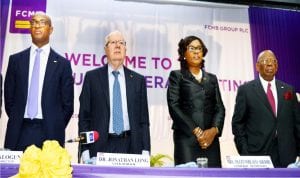
L-R: Group Managing Director, First City Monument Bank (Fcmb) Plc, Mr Ladi Balogun; Chairman, Dr Jonathan Long; Company Secretary, Mrs Funmi Adedibu and founder, Otunba Michael Balogun, during the 3rd Annual General Meeting in Lagos last Friday.
Nigeria’s organised labour
on Sunday in Abuja called on the Federal Government to constitute a tripartite committee consideration of the proposed N56,000 new National Minimum Wage.
The President of the Nigeria Labour Congress (NLC) Mr Ayuba Wabba, made the call at the 2016 May Day celebration with the theme: “Working Class and The Quest for Socio-Economic Revival”’.
The NLC and the Trade Union Congress of Nigeria (TUC) had penultimate Tuesday submitted a formal proposal of N56,000 new National Minimum Wage to the Federal Government.
Wabba said that the tripartite committee should comprise government; Federal and State, NECA, the organised private sector, and labour to begin the negotiations.
“During the last May Day, we had stated that as soon as the new government to be sworn in on May 29, 2015 settled down, we would table a proposal for a new National Minimum Wage demand.
“The National Minimum Wage Act which former President Jonathan signed into law in April 2011 has a five year re-opener clause for new negotiations to review the new minimum wage.
“In fulfillment of the above provision, we recently submitted a N56,000 proposal as new minimum wage to the Federal Government.
“Our proposal of N56,000 is just N4,000 more than the figure we put out for negotiation in December 2008, which was N52,000.
“This represents our awareness about the prevailing economic situation in the country,” he said.
Also speaking, the TUC President, Mr Bobbio Kaigama said the present economic hardship and its attendant effects on workers had made nonsense of the National Minimum Wage of N18,000.
He said that the N18,000 National Minimum Wage had been operational for over five years and called for an upward review of the existing minimum wage to N56,000.
“This has become necessary as the present one formally lapsed on 24th March, 2016.
“Indeed, even before we submitted our proposal, we had expected the Federal Government to appoint a committee to handle the issue.

Business
Association Seeks Intervention to Save Domestic Airlines
Business
CBN Reforms Impact Consumers As Dollar Card Spending Limits Rise
“Payment of tuition fees for undergraduate/postgraduate studies shall be subject to a maximum limit of $25,000.00 per semester,” the Manual states.
The expansion of international card limits also reflects growing confidence among lenders that foreign exchange liquidity has improved enough to support retail dollar transactions.
Speaking recently at the BusinessDay 14th Annual CEO Forum in Lagos, CBN Olayemi Cardoso, governor of the CBN said buying and selling activities now increasingly determine outcomes in the foreign exchange market, unlike in the past when market participants relied heavily on routine Central Bank interventions.
According to Cardoso, Nigeria’s net foreign exchange reserves have risen from just over $3 billion at the start of the reform programme to more than $40 billion, while gross reserves have climbed to about $52 billion, providing stronger confidence for investors and enabling the Central Bank to reserve interventions for periods of market stress rather than day-to-day liquidity management.
The restoration and expansion of international naira card spending limits are increasingly being seen as one of the clearest signs that the benefits of the CBN’s foreign exchange reforms are beginning to reach households, students and businesses making legitimate cross-border payments.
Business
WEC: FG Inaugurates Governing Board … As Nigeria Rejoins Council
The Secretary-General and Chief Executive Officer, WEC, Dr Angela Wilkinson, disclosed this in a statement, last Thursday.
“Nigeria’s participation comes at a pivotal time as the country seeks to expand energy access, strengthen energy security, accelerate gas development and mobilise the capital required for industrialisation and sustainable economic growth.
“WEC Nigeria will convene leaders from across the energy ecosystem, apply the WEC’s globally recognised Energy Trilemma framework to Nigeria’s unique context, and promote evidence-based dialogue, practical collaboration and informed policymaking.
“It will also ensure that Nigerian and broader African perspectives contribute meaningfully to global energy conversations,” she said.
Wilkinson expressed confidence that Nigeria would play a significant leadership role at the World Energy Congress scheduled for Riyadh in April 2027 and beyond.
The statement also quoted the Chairman of WEC Nigeria, Isa, as describing the country’s participation as an opportunity to deepen national and African leadership within the global energy community through practical solutions tailored to regional development priorities.
He said the platform would promote collaboration across sectors and attract sustainable investments into Nigeria’s energy sector.
The Chief Executive Officer of WEC Nigeria, Wunti, was quoted in the statement as saying that the council would connect leadership, evidence and investment to build a secure, affordable and sustainable energy system.
“This system will be capable of driving economic growth and shared prosperity.”
According to him, the platform will also connect Nigerian institutions and businesses with international knowledge, technology, partnerships and investment opportunities through the World Energy Council’s global network.
Recall that WEC, founded in 1923, is the world’s oldest independent and impartial community of energy leaders and practitioners, advancing informed, collaborative and practical action across the global energy system.