
Niger Delta
NDE Empowers 12 Beneficiaries In Bayelsa

The National Director
ate of Employment (NDE) has disbursed resettlement and equipment tools worth N2 million to 12 persons in Bayelsa.
Our correspondent reports that the beneficiaries are graduate apprentices from the NDE’s National Open Apprenticeship Scheme (NOAS) in the state.
The NDE’s Acting Director-General, Mr Kunle Obayan, who handed over the tools to the trainees, said the programme was part of the Federal Government’s efforts to curb unemployment..
Represented by Mr David Apakasa, the Bayelsa NDE Coordinator, Obayan said the programme was also developed to create an enabling environment for unemployed graduates to become self-reliant.
He said that 430 persons from 17 states had been trained and were being currently empowered.
He said that the programme would be extended to other vocational skills graduates in the remaining states and FCT, Abuja.
He advised the beneficiaries to be focused and hardworking.
“The NDE mandate is to fight unemployment and we will continue to do our best to impact positively in nation building. Skill acquisition is the key to socio-economic development;
“I urge you to make good use of the equipment; be employers of labour, to reduce poverty in the country,” he said.
In his remarks, Mr Abraham Wordaga, the Head of Department, NDE Vocational Skill Development in Bayelsa, said that the 12 persons were trained in electrical installation, barbing, computer operation and welding.
Other skills include catering, interior decoration, plumbing, hairdressing and fashion design.
Wordaga, who also urged the beneficiaries to utilise the tools meaningfully, said that the skill would not only make them self-reliant but also enable them to become employers of labour.
Mrs Desire Agama, one of the beneficiaries, thanked the NDE for the gesture.
She urged unemployed people in Bayelsa to avail themselves of the opportunity offered by the Federal Government to create jobs.


Niger Delta
Onuchuku Urges More Funding For Vocational, Technical Education …Calls For Collective Responsibility Among Stakeholders

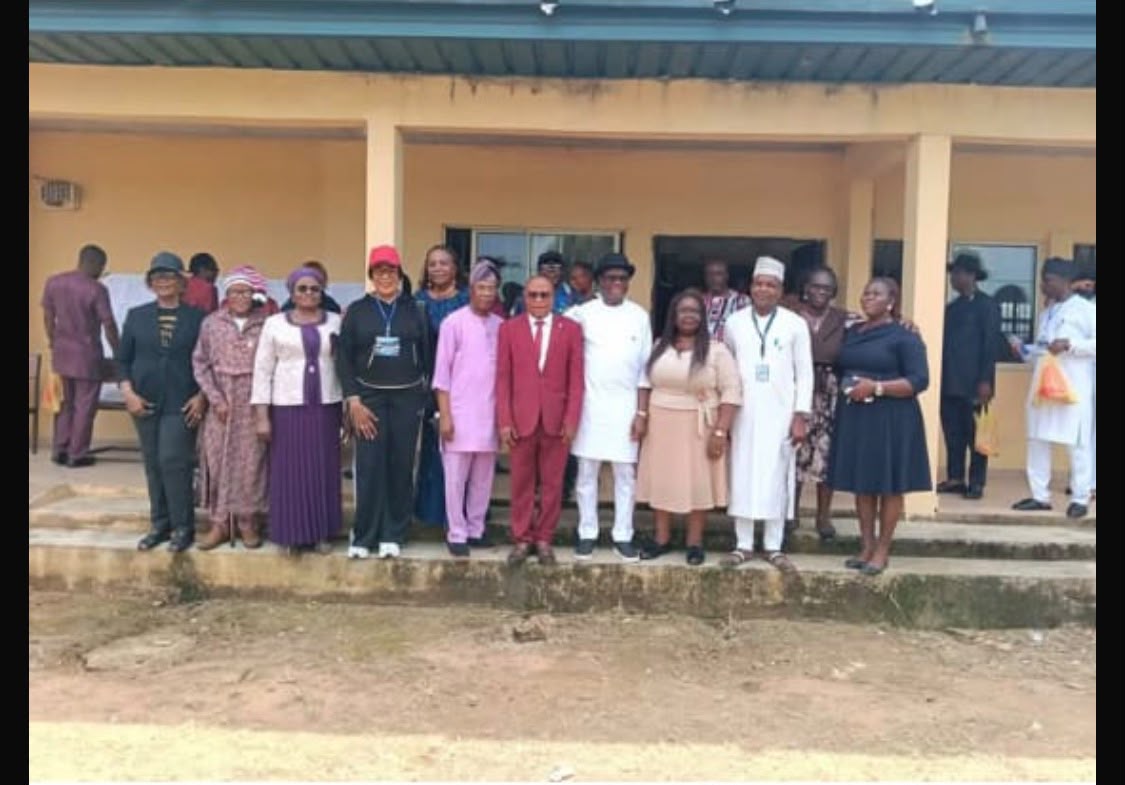
The Acting Vice Chancellor of Ignatius Ajuru University of Education, Prof Okechuku Onuchuku, has urged States and Local Governments to provide an enabling policy to adequately fund vocational and technical education.
He also called on educational institutions to maintain high academic and professional standards, while industries should contribute skills development.
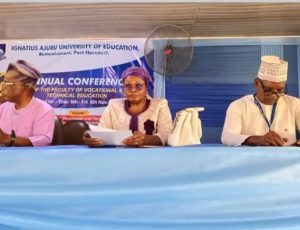
Onuchuku, who stated this last Thursday at the 10th Annual Conference of the Faculty of Vocational and Technical Education, IAUE, also called for collective responsibility among stakeholders.
The Acting VC, who was represented by the Dean of Vocational and Technical Education, Ndele Campus of the university, Prof. Isaac Ogundu, called for collective responsibility among key stakeholders in the industry. Expatiating on the call by the Acting VC in his presentation, Prof. Ogundu identified quality human resources and necessary opportunities for developing their productive capacities as factors that would determine a better future for Nigeria.
He said to attain quality assurance in programmes offered by tertiary institutions, the phenomenon need to be viewed as a strategic investment in human capital and national development.
Making reference to the theme of the conference, “Quality Assurance in Vocational and Technical Education: A Foundation for Sustainable Workforce in Nigeria”, Ogundu, who is the Dean, Faculty of Vocational and Technical Education, IAUE, said to attain quality assurance, there has to be collective commitment of all stakeholders.
He said: “building a sustainable workforce is a collective responsibility that requires the commitment of government, educational institutions, employers, professional bodies, teachers, students, and other wider society.

“Government must provide an enabling policy environment and adequate funding for vocational and technical education. Educational institutions must maintain high academic and professional standards. Industry must contribute to skills development and provide opportunities for practical workplace learning. “Teachers and instructors must demonstrate professional competence and commitment to continuous improvement. Students must take responsibility for their learning and embrace discipline, creativity, amd lifelong learning.”
He explained that quality assurance has become “an indispensable component of contemporary education” that provides the framework through which educational institutions establish standards.
According to him, the 10th edition of he conference “is particularly remarkable because it provides an opportunity to reflect on our achievements, assess the challenges confronting Vocational and technical education in Nigeria, and propose practical strategies for improving the quality, relevance, amd effectiveness of skills development.

“It also demonstrates the faculty’s determination to sustain a tradition of intellectual engagement that connects educational research with the practical needs of society, industry, and national development.”
Presenting the Lead Paper, Prof. Hilary Wordu of the Faculty of Education, Rivers State University, said Nigeria’s future will be determined more by what Nigerian do ith the knowledge they have.
“The future of Nigeria’s workforce will not be determined simply by how many people and do with what they have learned.”receive education, but increasingly by the quality of what they are able to know, understand, create and do with what they have learned.”
Sogbeba Dokubo
The Niger Delta Development Commission (NDDC) has dismissed reports on social media that a bridge project under construction in Otuogori community, Ogbia Local Government Area of Bayelsa State, had collapsed
The Commission said an incident occurred at the construction site of the 600-metre Otuogori-Otuegwe Bridge, but insisted that the bridge itself had not been constructed and therefore could not have collapsed.
Addressing journalists during an inspection of the project, the NDDC Director, Bayelsa State Office, Engr. Godknows Alamieyeseigha, described the reports as misleading.
“We don’t have a bridge yet because we are still at the stage of crossing the beams. So, no bridge has collapsed.
“However, there was an incident at the construction site, and we are assessing the circumstances surrounding what happened”, he said.
Alamieyeseigha dismissed suggestions that the incident resulted from structural failure, describing it as an accident during construction.
He expressed confidence that the construction company would address issues identified during the assessment and complete the project.
He also said no bridge had collapsed in Bayelsa State or any of the nine Niger Delta states.
The NDDC Director said the Commission’s current board and management, led by Chairman Chiedu Ebie, and Managing Director, Dr. Samuel Ogbuku, had prioritised quality assurance in project execution.
He added that NDDC engineers and independent consultants regularly inspected project sites across the region to ensure compliance with approved engineering designs and standards.
Also speaking, the Managing Director of the construction firm, Mr. Christian Emiezor, assured that the Otuogori-Otuegwe Bridge was being executed in line with high construction standards.
He explained that the project was still at the preparatory stage, with work focused on positioning the beams before the construction of the main bridge structure.
According to him, the incident occurred during the launching of the beams, which were being positioned on their bearings.
“We are constructing a 600-metre bridge, but as you can see, we have not constructed a bridge yet. What you are seeing is just preparations for the bridge”, Emiezor said.
He described the incident as a minor accident, explaining that a beam resting on a bearing but not yet secured could slide during the positioning process.
“What was going on was the launching of the beams, and in the process, there was a slight accident. Because the beam was resting on a bearing and had not been secured, it could slide. That was what happened”, he said.
Emiezor added that safety measures at the site prevented casualties. “The good thing is that, with the safety measures put in place, no life was lost”, he said.
Enoch Epelle
The second edition of the Niger Delta Blue Economy Investment Summit is expected to attract more than $600 million in investment capital into Nigeria’s blue economy sector.
The three-day summit, scheduled for March 18 to 20, 2027, will be held at Movela Hotels, Warri, Delta State.
Co-convener of the summit, Dr. Uche Igwe, disclosed in an interview with journalists, saying the annual event would bring together key decision-makers and operators to transform the Niger Delta’s blue economy potential into viable investment opportunities.
He said participants would be drawn from the government, the organised private sector, academia, civil society, traditional institutions and community groups across the Niger Delta and beyond.
Igwe said the maiden edition, held in February 2026, had recorded progress through partnerships and the identification of feasible projects requiring funding and further development.
“Since our maiden edition last February, a lot has been achieved. We now have partners who understand our region and who have identified several feasible projects.
“It is now time to go to the next level of ensuring that such projects are made bankable and the necessary funds required are mobilised to ensure that projects leave the drawing board and hit the ground running”, he said.
He commended the Delta State Government led by the State Governor, Sheriff Oborevwori, for providing what he described as an enabling environment for investment in the sector.
According to him, the second summit will focus on developing investment pipelines and exploring innovative financing mechanisms, including blue bonds, to attract capital into the sector.
“With the feedback we have got so far, more than $600 million of investment capital will enter the blue economy sector through our modest efforts”, Igwe added.
Also speaking, Senior Consultant at Gadfly Consulting Limited, Mr. Philemon Oghenedoro Adjekuko, called for stronger collaboration among relevant government agencies and private sector operators to support Nigeria’s ambition of building a $1 trillion economy by 2030.
He said the blue economy could contribute significantly to the country’s economic expansion if stakeholders moved beyond discussions to coordinate action and investment.
Adjekuko, who said he had spent the past three months engaging stakeholders as part of a study on blue finance, expressed optimism about the sector’s capacity to drive economic diversification and strengthen the non-oil economy.
“As someone who has been speaking to stakeholders in the last three months conducting a study ” he said.
Enoch Epelle
-
News3 days ago
RSG Reaffirms Commitment To STEM Education, Technological Advancement
-
Business3 days ago
‘NUJ, NPA’s Partnership Would Boost Port Producrivity, Economic Growth’
-

 News3 days ago
IGP Warns Police Officers Against Partisanship …Directs Regular Engagement With Journalists
-
Business3 days ago
Fire Threat Interrupts Asaba Air Peace Flight
-
 News3 days ago
Customs To Deploy AI, Scanners Against Snuggling
-
Business3 days ago
Fish Production Deficit, A Major Investment Opportunity – Minister
-

 Politics3 days ago
2027: INEC Begins Deployment Of Non-Sensitive Materials
-
Sports3 days ago
CAF Awards 2026 Gets A New Date