Connect with us

Education

Nigeria’s Educational System Undervalued -Buhari

Published

on

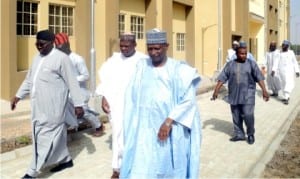
L-R:  Chairman, Governing Council of Gombe State University (GSU), Prof. Idriss Mohammed, Permanent Secretary, Ministry of Higher Education, Gombe State, Mr Danladi Musa and Vice Chancellor of the University, Prof. Ibrahim Umar, during an inspection visit to newly constructed students hostels by the Federal Government's Needs Assessment Team in Gombe on Wednesday

L-R: Chairman, Governing Council of Gombe State University (GSU), Prof. Idriss Mohammed, Permanent Secretary, Ministry of Higher Education, Gombe State, Mr Danladi Musa and Vice Chancellor of the University, Prof. Ibrahim Umar, during an inspection visit to newly constructed students hostels by the Federal Government’s Needs Assessment Team in Gombe on Wednesday

President Mohammadu
Buhari says the country’s educational system is highly undervalued.
He stated this recently during the 41st convocation ceremony for the conferment of post-graduate degrees, diplomas and certificates at the University of Benin, Edo State.
President Buhari, who was represented by the Minister of State for Education, Professor Anthony Onwuka, called on all stakeholders in the education sector to ensure the provision of qualitative and quantitative education in order to achieve national development.
At the event in which a total of 11,020 students received different higher degrees, the President decried what he described as the disregard for Nigeria’s education system by key players in the sector.
According to Buhari, “If there is one thing Nigerians agree on, it is the fact that our educational system is undervalued. Permit me to say, at this point and very sadly too, that the current standard of education in Nigeria has, unfortunately, succeeded in creating three classes of Nigerians: a minority that is well educated, a majority that is poorly educated and those without education at all.
“This is not healthy for our country and concerted efforts should be made to reverse the trend.
“Let me use this medium to reiterate the vision of the Federal Government in the provision of qualitative education, especially tertiary education for our teeming youths. This, however, requires the support of all stakeholders.”
He, however, noted that while the Federal Government would not relent in its efforts to overcome challenges caused by the activities of the Boko Haram sect and other misguided elements in the near future, Nigerians must guard the country’s educational values, against all odds.
“The Federal Government notes, with dismay, the incidents of bomb blasts and other acts of terrorism in our institutions of learning and pledges its determination to put a final stop to this ugly trend, as no responsible government will fold its arms and allow a system that has taken several years to build to be snatched overnight by the unwholesome activities of some enemies of progress,” he added.
While congratulating the graduates and honorary awardees, Buhari stressed the need for universities to focus on viable and entrepreneurial ideas that would assist the government.
He also urged the managers of tertiary institutions to continue to demonstrate prudence in the management of their resources as his administration would ensure that the Treasury Single Account blocks any form of diversion and misappropriation of government funds.
He said, “The government is determined to fight corruption at all levels, including our tertiary institutions. We cannot speak of effective and efficient funding of the education sub-sector if our universities are mired in crisis, fraud and loss of institutional vision.”
Governor Adams Oshiomhole of Edo State, in his remarks, frowned on the prevalence of land grabbing by unpatriotic individuals and groups.
He said the development had become a problem for the university and promised that the state government would not hesitate in demolishing illegal structures.
Honorary doctorate degrees were conferred on the Inspector-General of Police, Mr. Solomon Arase, and a consultant gynaecologist, Dr. Osagie Osato.


SogbebaDokubo

Continue Reading

Education

IAUE Trains HODs, Deans Ahead of NUC Resource Verification

Published

on

The Academic Planning Unit of Ignatius Ajuru University of Education, IAUE, has organized a Pre-Resource Assessment Workshop for Heads of Department and Deans as part of preparations for the forthcoming NUC Resource Verification exercise.
The workshop held on Tuesday, August 4, 2026, at the Postgraduate Hall of the University. It drew professors, deans and HODs from across faculties.
Declaring the workshop open on behalf of the Vice-Chancellor, Prof. Okechukwu Onuchukwu, the University Librarian, Prof. Emmanuel Okwu, welcomed principal officers and other participants. He described the session as critical to ensuring the University’s readiness for the NUC assessment.
Prof. Okwu stressed that the exercise was not routine but a strategic step toward meeting national standards. He urged participants to take the presentations seriously and implement recommendations in their departments.
The Director of the Academic Planning Unit, in his welcome address, said the workshop was designed to assess the level of preparedness of departments ahead of the verification. He noted that the University had already invested significantly in facilities and staffing and was now awaiting the NUC team.
Three resource persons took participants through key aspects of the verification process. The Director of Academic Planning, Prof. Joseph Kinanee, spoke on “NUC Resource Verification and Their Requirements.”
Prof. Levi Doe Kalagbor, Director of Quality Assurance, addressed “The Role of Staff in Successful Resource Verification Exercise.” Prof. Isaac Ogundu, Dean of the Faculty of Vocational and Technical Education, presented on “NUC Scoring Format/Guide and Its Implication for Approval Status.”
The presentations were followed by an interactive question-and-answer session. Participants sought clarifications on documentation, facilities and staffing ratios, and received detailed responses from the facilitators.
In his closing remarks, Prof. Okwu thanked everyone for their active participation and engagement. He expressed optimism that IAUE would record a successful outcome in the upcoming NUC resource verification. The programme ended with a closing prayer and refreshments.
Continue Reading

Education

UNIPORT VC Hails Postgraduate School Over Planned International Conference

Published

on

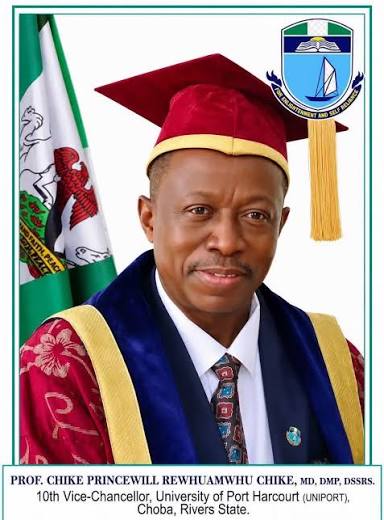
The Vice-Chancellor of the University of Port Harcourt, Prof. Chike Princewill, has commended the School of Graduate Studies for initiating an international conference, describing it as a timely move to boost research output, academic excellence and the University’s global visibility.
Prof. Princewill gave the commendation on Friday while receiving members of the conference planning committee set up by the School. The delegation was led by the Associate Dean of the School of Graduate Studies, Prof. Doris Adameh.
He applauded the committee for conceiving the project and urged members to pursue it with diligence and strategic planning. According to him, such academic gatherings are critical to positioning UNIPORT as a hub for cutting-edge research in the region and beyond.
The Vice-Chancellor specifically charged the committee to engage the University’s alumni as strategic partners in the execution of the conference. He noted that their networks, experience and resources would add significant value to the event.
Prof. Princewill further directed the team to reach out to former postgraduate students of the University to solicit their support and cooperation. He said their involvement would help ensure wider participation and a more successful hosting.
He stressed that alumni remain vital stakeholders in the University’s growth agenda. “Their contributions can significantly enhance the success of the event and strengthen our academic and research profile,” he stated.
Earlier in her remarks, Prof. Adameh said the committee was constituted by the School of Graduate Studies to plan and deliver an international conference that meets global standards. She noted that the process was already underway.
Prof. Adameh explained that the conference is designed to bring together scholars, researchers and professionals from across the world. The goal, she added, is to advance knowledge exchange and foster academic collaboration that will benefit both the University and the wider scholarly community.
By: Amadi Akujobi
Continue Reading

Education

Education Commissioner hails RSU’S  growth research as key to rivers development

Published

on

The Rivers State Commissioner for Education, Dr. Peters Nwagor, has commended Rivers State University, RSU, for its resilience, academic growth and research contributions, describing the institution as critical to the state’s socio-economic development.
Dr. Nwagor gave the commendation on Tuesday, August 11, 2026, during an official visit to the University in Nkpolu-Oroworukwo. He held talks with principal officers, provosts, campus heads, deans and directors at the Dr. Nyesom Ezenwo Wike Senate Building.
The Commissioner said the visit was to engage the University’s leadership on consolidating gains and strengthening capacity for quality teaching, cutting-edge research, innovation and community service. He noted that RSU occupies a strategic position in the state’s development agenda.
Reaffirming government’s commitment, Dr. Nwagor said education remains the bedrock of human capital development and economic transformation. He stressed that investments in infrastructure, staff development and digital learning must be matched with strong institutional systems, transparency and measurable outcomes.
He urged the University to prioritize key performance indicators such as accreditation performance, research output, internally generated revenue, student outcomes and graduate employability. According to him, these metrics should drive continuous improvement across faculties.
Dr. Nwagor also charged RSU to accelerate its digital transformation, establish research and innovation hubs to solve real societal problems, and maintain existing infrastructure. He advised management to explore sustainable funding through grants, endowments, alumni engagement and strategic industry partnerships.
The Commissioner emphasized that government and the University must play complementary roles. While government meets its statutory funding obligations, he said, the institution must strengthen internal efficiency and pursue legitimate private-sector collaborations.
The Vice-Chancellor, Prof. Isaac Zeb-Obipi, appreciated the State Government for its sustained support. He highlighted last year’s budgetary intervention for accreditation, approval of funds for the Faculty of Communication and Media Studies Film Festival slated for November 2026, and the implementation of the new minimum wage for RSU staff.
Prof. Zeb-Obipi, however, drew attention to pressing challenges. He cited shortages of teaching and non-teaching staff ahead of accreditation exercises, inadequate classrooms, libraries, equipment and office spaces, and acute accommodation deficits for staff and students.
The Vice-Chancellor appealed for support to recruit more personnel, retain retired academics on contract, and engage sabbatical and adjunct lecturers. He also requested funding for NUC and professional accreditation scheduled for October, stressing that successful outcomes are vital to RSU’s competitiveness. He reaffirmed management’s commitment to work with government to position RSU as a leading centre of knowledge, research and innovation.
By Amadi Akujobi
Continue Reading

Trending