Connect with us

Education

Polytechnic Education, Key To Dynamic Economy – Don

Published

on

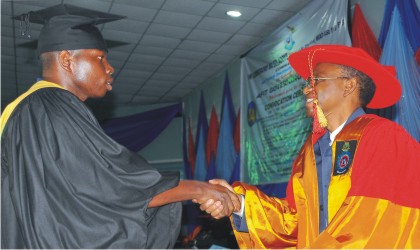
Governor Nasir El-Rufai of Kaduna State (right), presenting a certificate to the best Student, Flt. Lt. Christian Mensah, at the 44th Convocation of Air Force Institute of  Technology, in Kaduna on Wednesday.

Governor Nasir El-Rufai of Kaduna State (right), presenting a certificate to the best Student, Flt. Lt. Christian Mensah, at the 44th Convocation of Air Force Institute of Technology, in Kaduna on Wednesday.

A Polytechnic teacher, Dr
Adaku Ngozi Achilike, says a well-groomed polytechnic education is a necessity for the development of any society.
Dr Achilike, who made this assertion recently , at the 3rd National Conference  on Polytechnic Education held in Port Harcourt, noted that unlike university education which focuses on physical and intellectual skills, polytechnic education focuses on physical and practical skills.
The implication of this, she hinted, is that university  education at the end of the day provides what can be seen as “Blue print” to development while polytechnic education provides “revival”.
“It is important to note that ‘blue print’ is not required to produce excellence students but ‘revival’ can do the magic through paradigm shifts, bearing in mind the technological age we find ourselves at each point in time,” she said.
Polytechnic education, the Associate Professor of Business Education, continued” is deemed as that which offers opportunity for hands-on experience within dynamic on progressive learning setting, with emphasis on practice-base of the university.
According to her, it involves work attachment with industries as part of the curriculum. She however noted that such attachments are currently being done haphazardly.
Discussing on the topic “polytechnic education for science and technology in an emerging economy,” Dr Achilike made comparism between polytechnic education and skill/competency building, polytechnic education and knowledge base, as well as polytechnic education for science and technology.
Regarding skill/competency building, she stated that skill is the capacity to do things well with emerging technologies and can be learned or acquired.
Competency, on the other hand, is a sustainable way of doing things with conscious, superiority and mastery.
“Skills and competencies rule the  world while skills and competencies in science and technology shave/shape the world into a more vibrant place for the young and old.
She concluded that with vision 20:2020 by the corner, “well tailored polytechnic education is the desired veritable tool for great achievement and good placement, given skill competency, appropriate knowledge base for improved science and technology system to give a dynamic economic. We shall then compete with comity of nations”.
Narrowing down the topic of the conference to the Nigerian context, Dr Obasi O. Oko in his paper identified key stakeholders who must play their parts to develop Nigeria technologically.
According to him, “the government of Nigeria, the National Assembly, captains of industries, drivers of the polytechnic system and other stakeholders should change their negative attitudes towards technical education in general, and polytechnic education in particular.
“They should also accord the system the prime of place it deserves in the national scheme of things. For, in the system lies the future greatness of Nigeria in terms of techno-industrial development”, he said.


Sogbeba Dokubo

Continue Reading

Education

IAUE Trains HODs, Deans Ahead of NUC Resource Verification

Published

on

The Academic Planning Unit of Ignatius Ajuru University of Education, IAUE, has organized a Pre-Resource Assessment Workshop for Heads of Department and Deans as part of preparations for the forthcoming NUC Resource Verification exercise.
The workshop held on Tuesday, August 4, 2026, at the Postgraduate Hall of the University. It drew professors, deans and HODs from across faculties.
Declaring the workshop open on behalf of the Vice-Chancellor, Prof. Okechukwu Onuchukwu, the University Librarian, Prof. Emmanuel Okwu, welcomed principal officers and other participants. He described the session as critical to ensuring the University’s readiness for the NUC assessment.
Prof. Okwu stressed that the exercise was not routine but a strategic step toward meeting national standards. He urged participants to take the presentations seriously and implement recommendations in their departments.
The Director of the Academic Planning Unit, in his welcome address, said the workshop was designed to assess the level of preparedness of departments ahead of the verification. He noted that the University had already invested significantly in facilities and staffing and was now awaiting the NUC team.
Three resource persons took participants through key aspects of the verification process. The Director of Academic Planning, Prof. Joseph Kinanee, spoke on “NUC Resource Verification and Their Requirements.”
Prof. Levi Doe Kalagbor, Director of Quality Assurance, addressed “The Role of Staff in Successful Resource Verification Exercise.” Prof. Isaac Ogundu, Dean of the Faculty of Vocational and Technical Education, presented on “NUC Scoring Format/Guide and Its Implication for Approval Status.”
The presentations were followed by an interactive question-and-answer session. Participants sought clarifications on documentation, facilities and staffing ratios, and received detailed responses from the facilitators.
In his closing remarks, Prof. Okwu thanked everyone for their active participation and engagement. He expressed optimism that IAUE would record a successful outcome in the upcoming NUC resource verification. The programme ended with a closing prayer and refreshments.
Continue Reading

Education

UNIPORT VC Hails Postgraduate School Over Planned International Conference

Published

on

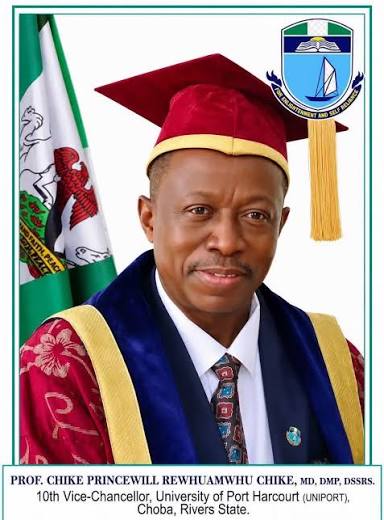
The Vice-Chancellor of the University of Port Harcourt, Prof. Chike Princewill, has commended the School of Graduate Studies for initiating an international conference, describing it as a timely move to boost research output, academic excellence and the University’s global visibility.
Prof. Princewill gave the commendation on Friday while receiving members of the conference planning committee set up by the School. The delegation was led by the Associate Dean of the School of Graduate Studies, Prof. Doris Adameh.
He applauded the committee for conceiving the project and urged members to pursue it with diligence and strategic planning. According to him, such academic gatherings are critical to positioning UNIPORT as a hub for cutting-edge research in the region and beyond.
The Vice-Chancellor specifically charged the committee to engage the University’s alumni as strategic partners in the execution of the conference. He noted that their networks, experience and resources would add significant value to the event.
Prof. Princewill further directed the team to reach out to former postgraduate students of the University to solicit their support and cooperation. He said their involvement would help ensure wider participation and a more successful hosting.
He stressed that alumni remain vital stakeholders in the University’s growth agenda. “Their contributions can significantly enhance the success of the event and strengthen our academic and research profile,” he stated.
Earlier in her remarks, Prof. Adameh said the committee was constituted by the School of Graduate Studies to plan and deliver an international conference that meets global standards. She noted that the process was already underway.
Prof. Adameh explained that the conference is designed to bring together scholars, researchers and professionals from across the world. The goal, she added, is to advance knowledge exchange and foster academic collaboration that will benefit both the University and the wider scholarly community.
By: Amadi Akujobi
Continue Reading

Education

Education Commissioner hails RSU’S  growth research as key to rivers development

Published

on

The Rivers State Commissioner for Education, Dr. Peters Nwagor, has commended Rivers State University, RSU, for its resilience, academic growth and research contributions, describing the institution as critical to the state’s socio-economic development.
Dr. Nwagor gave the commendation on Tuesday, August 11, 2026, during an official visit to the University in Nkpolu-Oroworukwo. He held talks with principal officers, provosts, campus heads, deans and directors at the Dr. Nyesom Ezenwo Wike Senate Building.
The Commissioner said the visit was to engage the University’s leadership on consolidating gains and strengthening capacity for quality teaching, cutting-edge research, innovation and community service. He noted that RSU occupies a strategic position in the state’s development agenda.
Reaffirming government’s commitment, Dr. Nwagor said education remains the bedrock of human capital development and economic transformation. He stressed that investments in infrastructure, staff development and digital learning must be matched with strong institutional systems, transparency and measurable outcomes.
He urged the University to prioritize key performance indicators such as accreditation performance, research output, internally generated revenue, student outcomes and graduate employability. According to him, these metrics should drive continuous improvement across faculties.
Dr. Nwagor also charged RSU to accelerate its digital transformation, establish research and innovation hubs to solve real societal problems, and maintain existing infrastructure. He advised management to explore sustainable funding through grants, endowments, alumni engagement and strategic industry partnerships.
The Commissioner emphasized that government and the University must play complementary roles. While government meets its statutory funding obligations, he said, the institution must strengthen internal efficiency and pursue legitimate private-sector collaborations.
The Vice-Chancellor, Prof. Isaac Zeb-Obipi, appreciated the State Government for its sustained support. He highlighted last year’s budgetary intervention for accreditation, approval of funds for the Faculty of Communication and Media Studies Film Festival slated for November 2026, and the implementation of the new minimum wage for RSU staff.
Prof. Zeb-Obipi, however, drew attention to pressing challenges. He cited shortages of teaching and non-teaching staff ahead of accreditation exercises, inadequate classrooms, libraries, equipment and office spaces, and acute accommodation deficits for staff and students.
The Vice-Chancellor appealed for support to recruit more personnel, retain retired academics on contract, and engage sabbatical and adjunct lecturers. He also requested funding for NUC and professional accreditation scheduled for October, stressing that successful outcomes are vital to RSU’s competitiveness. He reaffirmed management’s commitment to work with government to position RSU as a leading centre of knowledge, research and innovation.
By Amadi Akujobi
Continue Reading

Trending