
Business
NHA Decries Non-Implementation Of Electricity Tariff Reduction

The Nigeria Hotel Association (NHA) says the Federal Government’s 50 per cent power tariff reduction announced before the 2015 general elections has not been implemented.
The News Tide source reports that the Federal Government had on March 18, announced a 50 per cent slash in the extant tariff, few days to the March 28 presidential election.
The reduction was announced in Abuja by the Chairman, Nigerian Electricity Regulatory Commission (NERC), Mr Sam Amadi on Friday.
Amadi had announced that the reduction, which took effect from the end of March, followed the regulatory agency’s decision to remove collection losses from customer tariff under the multi-year tariff order.
The NHA President, Mr Lanre Awoseyin, however, told reporters in Lagos that the reduction was not documented and so, had not yet been implemented by the NERC.
“The electricity tariff reduction is just a political and a campaign gimmick which has not been effected by the Federal Government.
“There had been complaints from our members who said that their power tariff had not been reduced but remained exorbitant,’’ Awoseyin said.
The chairman urged the government to start implementing the reduction, adding that failure to implement might lead to reduction of staff in the industry.
“We pay exorbitantly for electricity monthly, so, we received with joy Federal Government’s decision to reduce the electricity bill consumption.
“However, failure to implement the reduction could result in mass retrenchment of workers in the hotel industry, thereby aggravating the country’s unemployment problem,’’ he said.
The president said that the Kaduna and Abuja Electricity Distribution Companies had also said that there was no document passed to them to authenticate the power tariff reduction.
“I was made to realise from the National Electricity Regulatory Commission that the declaration was only made without documentation.
“The distribution companies said they cannot implement what has not been documented,’’ he said
Awoseyin noted that failure to implement the reduction might force members to depend solely on power generators.
“If the reduction is not implemented, then we hotel operators will have to be cut off from DISCOs and maintain our businesses with electricity generators.
“Members held a meeting on Thursday and had decided to cut off from the DISCOs if the reduction is not implemented,’’ he said.
According to Awoseyin, government is not encouraging hoteliers to stay in business rather, government is compounding their problems.
“Imagine, small hotels which before now pay N100,000 monthly, have to pay N1.5 million which is not up to their turnover, this is only trying to discourage the hoteliers from business,’’ Awoseyin said.
The president then pleaded for an urgent intervention and implementation of the reduction, especially for hoteliers. (NAN)
PTB/EWE/PDE
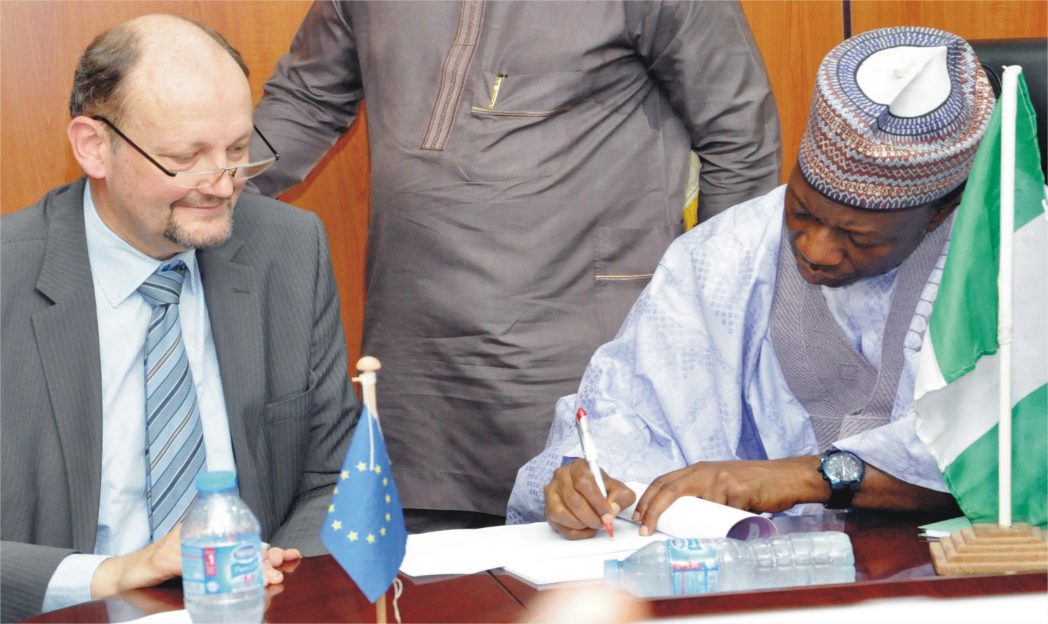
Minister of National Planning, Dr Abubakar Sulaiman (right), signing financial agreement for the 11th European Development Fund Support to strengthen community-based psychosocial and protection services for children and adolescents in Borno, in Abuja, recently. With him is the head, European delegation, Mr Michel Arrion.



Business
Jonathan, Diri, Others Laud Firm’s Milestone in Bayelsa …Says Project Will Drive Industrialisation, Create Jobs



-

 News2 days ago
RSG Targets Nine Million Residents in Mosquito Net Distribution Campaign
-

 Oil & Energy2 days ago
Aiyedatiwa Signs New Electricity Bill
-

 Oil & Energy2 days ago
NLNG Commissions Research And Innovation Centre In RSU
-

 Maritime2 days ago
Marine Minister Commends President Tinubu On NPERA Bill Assent
-

 News2 days ago
KenPoly Holds Eight Convocations, August 29
-

 News2 days ago
RSG Begins Another Phase of Projects Commissioning Today
-

 News2 days ago
RMAFC Completes Revenue Sharing Review, Proposes New Pay
-

 Maritime2 days ago
NAGAFF Petitions IGP Over Alleged Maritime Police Harassment