
Business
Capital Market Indices Up By 1.03%

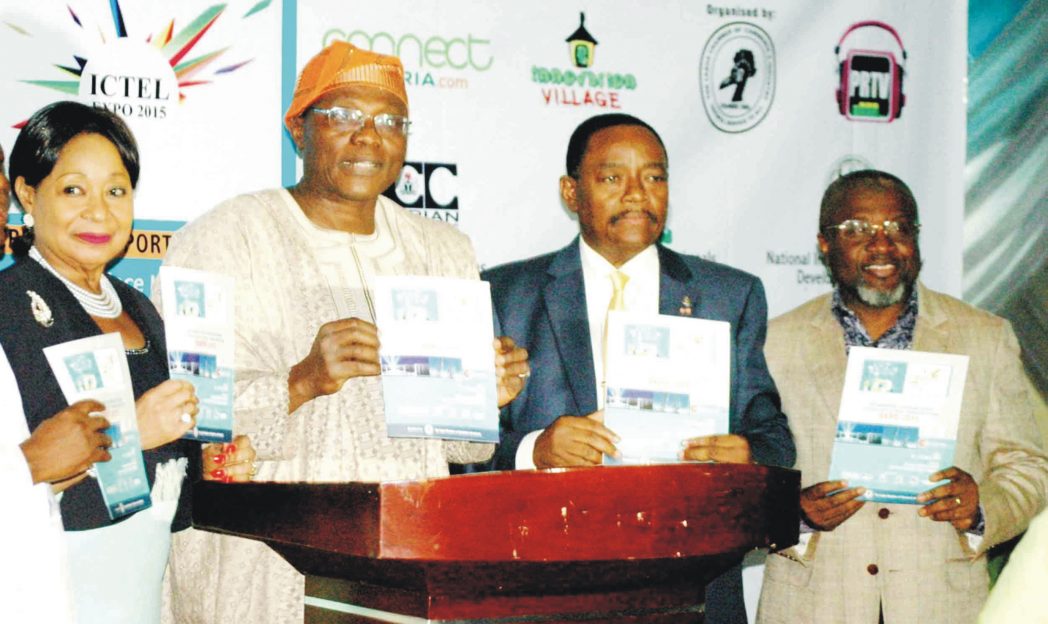
L-R: Vice President, Lagos Chamber of Commerce and Industry (LCCI), Dr Nike Akande, LCCI President, Alhaji Remi Bello, Vice President and Chairman, Trade Promotion Board, Dr Michael Olawale-Cole and Chairman, Specialised Exhibition Committee, Mr Sola Oyetayo, at the unveiling of Information Communication Technology and Telecommunications Industry (ICTEL) Expo 2015 in Lagos, recently. Photo: NAN
Trading on the Nigerian Stock Exchange (NSE) for the third consecutive day maintained an upward trend with the market indicators appreciating by 1.03 per cent.
The Tide source reports that the All-Share Index on Wednesday rose by 305.91 basis points or 1.03 per cent to close at 29,889.91.
This is against 29,584.00 posted on Tuesday due to price growth recorded by some highly capitalised stocks.
Forte Oil topped the gainers’ chart for the day, increasing by N9.82 to close at N206.34 per share.
Total Nigeria came second with N4 to close at N144, while Nigerian Breweries also appreciated by N4 to close at N136 per share.
Stanbic IBTC chalked up N1.10 to close at N29 and Zenith Bank rose by 83 kobo to close at N17.53 per share.
The market capitalisation rose by N102 billion or 1.03 per cent to close at N9.974 trillion compared with N9.872 trillion achieved on Tuesday.
Analysts attributed the persistent growth in spite of uncertainties surrounding the general elections to low price of equities and improved earning reports declared by companies in 2014 financial year.
They added that the retention of the Monetary Policy Rate at 13 per cent by the Monetary Policy Committee (MPC) of the Central Bank of Nigeria (CBN) contributed to the rally.
Conversely, Nestle and Mobil Oil topped the laggards’ chart having lost N5 each to close at N800 and N140 per share respectively.
Access Bank lost 30k to close at N5.60, while Dangote Cement dropped 28k to close at N152.60 per share.
NAHCO lost 19k to close at N4.61 per share.
In all, investors bought and sold 433.87 million shares worth N4.004 billion transacted in 3,915 deals, indicating an increase of 105 per cent.
This is in contrast with 211.43 million shares worth N2.85 billion traded in 3,808 deals on Tuesday.
An analysis of the activity chart showed that Mansard Insurance emerged the most traded equity with 86.28 million shares worth N263.14 million.
Zenith Bank sold 60.73 million shares valued N1.06 billion, while FBN Holdings accounted for 41.044 million worth N354.68 million.
Transcorp sold 40.79 million shares worth N115.89 million and Access Bank traded 39.354 million shares valued N223.78 million.



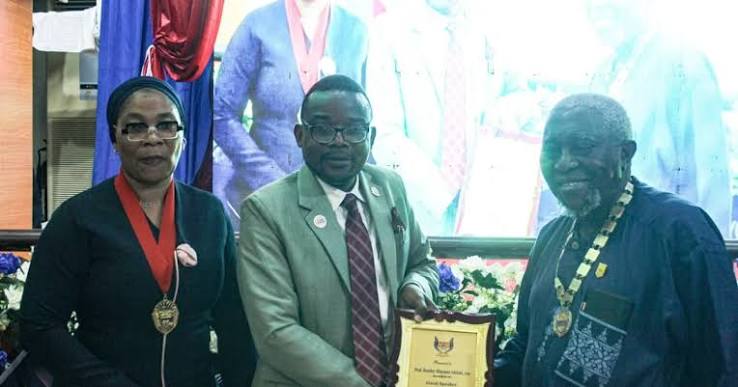
The NIM president also identified integrity, accountability, probity, honesty and efficiency as essential principles that needed to be strengthened in Nigeria’s workplaces and economy.
He argued that management failures extended beyond businesses to households and the wider society, making the promotion of sound management practices increasingly important.
Mustapha also renewed the institute’s call on the Federal Government to recognise 19 November as National Management Day, saying such recognition could strengthen its campaign for the United Nations to declare the date International Management Day.
The institute adopted 19 November for its annual celebration in 2016 to coincide with the birthday of Peter Drucker, widely regarded as the father of modern management.
Mustapha said the institute believed that official recognition by the Federal Government would strengthen its appeal to the United Nations to establish an international observance dedicated to the management profession.
The lecture featured Executive Director of the University of Lagos Business School, Prof. Sunday Adebisi, as guest speaker.
Other attendees included the Registrar and Chief Executive of NIM, Taiwo Olusesi, and a former president of the institute, Akinbayo Adenubi.

The Chief Executive Officer (CEO) of Moniepoint Microfinance Bank Babatunde Olofin, says transaction volume of the bank has hit one trillion naira daily.
Olofin said this at the unveiling of the bank’s North Central office in Abuja on Friday.
He said the bank also served a customer base of about 21 million and provided more than one million jobs in the country.
”Moniepoint is proudly Nigerian, owned by a Nigerian and managed by Nigerians.
?”With ?????????????????????our solid technologies and tailored-made products for businesses in Nigeria and retail customers as well, we are the bank to reckon with,” he said.
The CEO said the bank might be considering upgrade to a full-fledged commercial bank if the business required so.
According to him, this is a strategic decision which if the business requires it, we will communicate.
Fielding questions from newsmen, Edidiong Uwemakpan, the Vice-President Corporate Affairs of the bank, said the bank had been supporting agricultural activities to impact households.
”Moniepoint has always been hyper local and if you look at how we scaled our business, we understood how much Nigerians wanted to be able to interact with humans.
”From the very beginning, we built this distribution network of people that can be trusted, I think this is just an extension of our hyper-local strategy, getting closer to people,” she said.

-
News4 days ago
Parents Protest Scholarship Scheme Suspension At PAMO Varsity
-
 News4 days ago
US Hails Nigerian Military For Rescuing 125 Kidnap Victims
-
News23 hours ago
Bayelsa Boat Mishap: Tinubu Donates N250m As Death Toll Hits 29
-
News23 hours ago
Odu Pays Tribute To Late Chinwah, Describes Him As Courageous, Selfless Academic
-
Business4 days ago
Reps Raise Alarm Over N2trn Agricultural Loan Diversion
-

 Featured4 days ago
Presidents Xi, Trump, Putin Commit To Global Stability, Denuclearisation
-
Politics4 days ago
ADC Faults INEC’s Alleged Limited Capacity To Upload Election Result On IREV
-
Politics4 days ago
Tinubu Expands 2027 Campaign Tour To 19 States