
Nation
THE STATES

Borno
The Deputy Governor of Borno State, Alhaji Zannah
Mustapha, has commended the efforts of security agencies to end insurgency in the country.
Mustapha made the commendation in an interview with newsmen in Maiduguri.
He expressed optimism that the insurgency would end soon “going by the successes recorded by the military in its bid to flush out the insurgents”.
Mustapha said last week’s attack on Biu by the insurgents was a sign of desperation, noting that they had failed in previous attempts to gain entry into the town, hence the use of suicide bomb attack.
He commended youth vigilantes, local hunters and members of the community for keeping vigil against the insurgents especially in Biu.
“The military has been working in concert with vigilantes and other groups in safeguarding lives and properties in Biu.
“As it is now, it is very difficult for the insurgents to carry out attacks easily, so they have resorted to using female suicide bombers,” he said.
FCT
The Independent National Electoral Commission (INEC)
has advised politicians to invest their time and resources in positive strategies of winning elections rather than buying Permanent Voter Cards (PVCs) from prospective voters.
The Deputy Director, Voter Education and Publicity, INEC, Mr. Nick Dazang, gave the advice in an interview with newsmen in Abuja following a claim that politicians were buying cards and collecting their numbers.
Dazang said it was also advisable for politicians to use their time well in other endeavours that would help the political processes instead collecting Voter Identification Number (VIN) of registered voters.
He said buying people’s PVCs would be of no help as the cards could not be used by another person other than the original owners.
“Politicians should encourage those who have not collected to go and collect their PVCs.
“I don’t know of any implication of collecting people’s VIN numbers; they are just wasting their times,” he said.
Kebbi
The Independent National Electoral Commission (INEC),
National Commissioner, Hajia Amina Zakari, has reiterated the commission’s determination to announce the presidential and governorship elections within 48 hours after voting.
She stated this in Birnin Kebbi, Kebbi, during a public sensitisation and practical demonstration of accreditation and election processes.
Zakari said that the demonstration was to enable the commission to make amendments in areas of difficulty.
According to her, the demonstration will also enable electoral officers to be familiar with the process of accreditation and smooth election.
She appealed to registered voters to ensure they were in queue on time for accreditation, assuring them that collation of votes would be done properly after voting.
Kogi
The Abuja Electricity Distribution Company (AEDC) has
again explained that the rationing of power in Lokoja and other areas of its coverage was necessitated by low volume energy available for distribution.
The Manager, Public Relations of AEDC, Mr Ahmed Shekarau, said this while fielding questions from newsmen in Lokoja.
Shekarau said that it was not the wish of the company to ration power supply in its coverage area but was being forced to do so.
“The AEDC is being allocated 11.5 per cent of total energy available daily for distribution to customers nationwide.
“This volume, which reaches 450 mega watts even at peak generation periods, is insufficient to meet the demands of the company’s customers in FCT, Kogi, Nasarawa and Niger States.
“The AEDC is, however, optimising its load-shedding to address part of the problem in the short term.
Lagos
A lawmaker representing Egbeda/Ona-Ara Federal
Constituency in Oyo State, Olayemi Busari, said that he donated four 500 KVA transformers to communities in his constituency on February 14.
Busari, an Accord Party (AP) member, told newsmen in Lagos that the projects were part of the promises he made to the people during his electioneering campaigns.
He said that the benefiting communities were Aba Otun Area Ward 8 and Oke- Imole in the Olunloyo area of the Ona-Ara Local Government Area.
Others were the Amosun Community Ward 7 and Ogunkola Avenue, Hope area, Alakia, Old Ife road in the Egbeda Local Government Area of Oyo State.
Busari said that he donated the transformers on Valentine’s Day, to show his love for his people, and urged them to reciprocate the love by supporting his candidacy in the March 28 elections.
Nasarawa
A nutritionist at the Dalhatu Araf Specialist Hospital, Lafia,
Nasarawa State Mrs. Julie John, has advised mothers to give proper diet to their babies to avoid malnutrition.
John gave the advice in an interview with newsmen in Lafia.
According to her, after six months of exclusive breast feeding, mothers are expected to start introducing highly nutritious foods to their babies so as to avert malnutrition.
“From birth to six months, we encourage mothers to go on exclusive breast feeding.
“Where the problem starts is the six months that the mother is supposed to introduce other feeds to her baby. That is when most of the time we have problems of malnutrition,’’ she said.
Ogun
The Federal Road Safety Corps (FRSC) said that it was
collaborating with Ogun Traffic Compliance and Enforcement Corps (TRACE) to reduce gridlocks in Sango-Ota and its environs.
The Sango-Ota Unit Commander of the FRSC, Mr Olonisaye Olufemi, disclosed this to newsmen in Ota.
He noted that heavy traffic gridlocks were being experienced at the Toll-gate, Ojuore, Sango-Ota under bridge, especially on Sundays when worshippers going to Living Faith Church, Ota, drove against the traffic.
“The worshippers contributed immensely to gridlocks between 5.30 a.m. and 2 p.m. by increasing vehicle movement to the areas,” Olufemi said.
On his part, the Zonal Commander of TRACE, Mr Adekunle Ajibade, said that it would deploy manpower to those trouble areas to assist FRSC staff to decongest traffic jams.
Ajibade said that it would also bring a tow truck that would be used to clear obstruction by vehicles, especially commercial buses.
Osun
Osun State Deputy Governor, Mrs. Titi Laoye-Tomori,
has ordered the closure of Government Technical College, Osogbo, and Osogbo High School, indefinitely over disturbances by the students.
Our correspondent reports that some students of Government Technical College, Osogbo and Osogbo High School embarked on a protest recently.
This is contained in a statement signed by Permanent Secretary, Ministry of Education Mr Lawrence Oyeniran, .
The statement said that the closure was to curtail any further disturbances in the schools.
It advised parents and guardians to warn their children and wards to stay away from acts capable of causing public disturbance.
Oyo
Oyo State Coordinator, National Agency for Food
and Drug Administration and Control (NAFDAC), Mr. Benjamin Haruna, said that the agency had sanctioned more than 1,000 offenders in the state.
Haruna disclosed this to newsmen in Ibadan at a send-forth organised for him by the staff and stakeholders of NAFDAC in the state.
According to him, the offences ranged from series of unregistered products, sales of outright fake products, parallel importation and unsatisfactory factory productions.
Haruna said that the agency would not relent in its effort to combat unwholesome and fake products.
Yobe
The National Council of Women Society (NCWS) has
urged women in Yobe to aspire for more elective positions to ensure that their voice was heard in the democratic process.
The state President of the society, Hajiya Halima Joda, made the call in an interview with newsmen in Damaturu.
“I want to use this medium to call on all women in Yobe State to mobilise both rural and urban women to take active participation in the political process.
“Considering our numerical strength if we properly harness our potential, we can aspire for more elective positions and win,’’ Joda said.
Joda said that active participation of women in politics would eliminate all forms of marginalisation and intimidation against women seeking elective positions in the state.
The president said that when women hold elective positions it would enable them to mainstream gender issues in government policies.
She noted that women were underrepresented in the state despite their proven abilities as leaders and agents of change, and their right to participate equally in democratic governance.
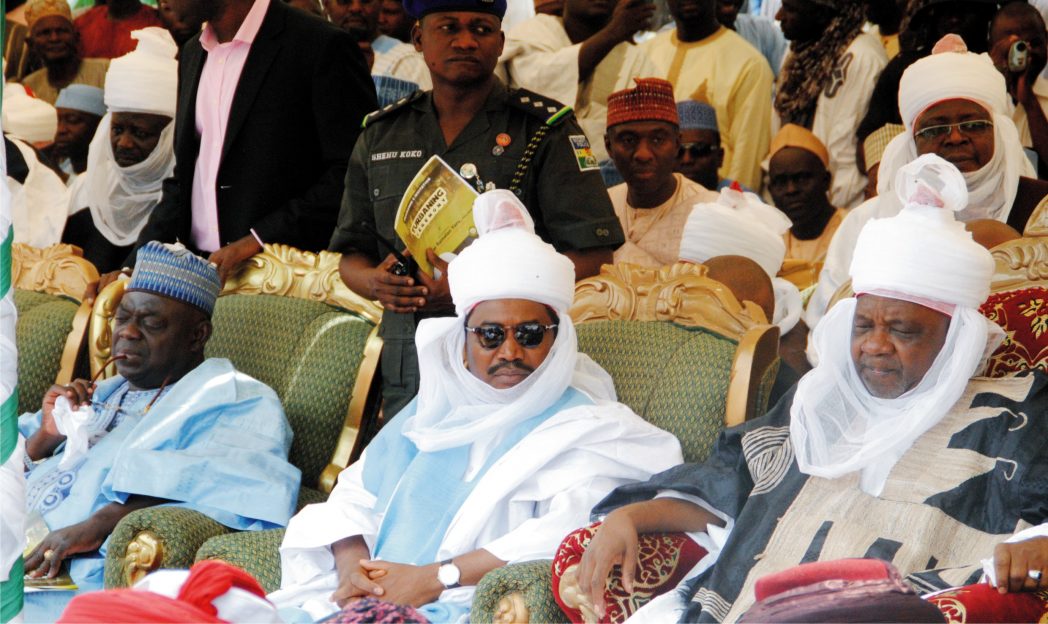
L-R: Governor Babangida Aliyu of Niger State; Governor Ibrahim Shema of Katsina State and Vice-President Namadi Sambo, at the turbaning of Governor Muhtar Yero of Kaduna State as Dallatun Zazzau in Zaria, Kaduna State recently.




The Hydrocarbon Pollution Remediation Project (HYPREP) has commemorated the 15th anniversary of the release of the United Nations Environment Programme (UNEP) Environmental Assessment Report on Ogoniland, reaffirming its commitment to restoring the environment and improving the livelihoods of affected communities.
In a statement signed by the Project Coordinator, Prof Nenibarini Zabbey, to commemorate the anniversary, HYPREP described the anniversary as a significant milestone in Nigeria’s environmental restoration efforts, noting that the project has made remarkable progress in implementing the recommendations of the landmark UNEP report released on August 4, 2011.
The UNEP report had revealed extensive oil pollution across Ogoniland, severe environmental degradation, and serious public health risks resulting from decades of petroleum operations. It also recommended an initial $1 billion fund to commence the cleanup of the affected communities.
According to HYPREP, the Federal Government formally launched the Ogoni clean-up in 2016, while the Project Coordination Office was established in 2017 to drive the implementation of UNEP’s recommendations.
Zabbey said the current administration has continued to prioritise the project under the Renewed Hope Agenda.
Providing an update on the cleanup, the Project Coordinator disclosed that 30 of the 65 contaminated sites identified by UNEP have been fully remediated, while work is ongoing at several medium- and high-risk locations. It also stated that more than 1.5 million mangrove seedlings have been planted as part of what it described as the world’s largest restoration of oil-degraded mangroves, with over 1,000 hectares of shoreline already rehabilitated.
Zabbey further revealed that 49 Ogoni communities have been connected to potable water schemes through multiple water projects and booster stations aimed at providing safe drinking water across the region.
In the health sector, he said the 100-bed Ogoni Specialist Hospital in Kpite and the 43-bed Cottage Hospital in Buan are nearing completion, adding that several existing health facilities have been upgraded with modern medical equipment, while five ambulances have been donated to improve emergency healthcare services. The Project Coordinator also disclosed that a three-year human health biomonitoring study is being conducted in collaboration with the World Health Organization’s International Agency for Research on Cancer (IARC).
On economic empowerment, Zabbey stated that the Project has created more than 8,000 direct jobs and trained thousands of Ogoni youths and women in various vocational and technical skills, including software development, cybersecurity, aviation, commercial diving, seafaring, mechatronics, and creative arts. The project also reported awarding scholarships to more than 1,000 students, providing grants to small businesses, and supporting persons living with special needs through skills acquisition programmes.
The statement further highlighted ongoing legacy projects, including the Ogoni Power Project and the Centre of Excellence for Environmental Restoration, which it said is about 96 per cent complete. HYPREP also welcomed the recent designation of the Ogoni Wetland as a Ramsar Site of International Importance and pledged to continue promoting biodiversity conservation and sustainable management of the ecosystem.
Marking the anniversary, Zabbey said the progress achieved over the past 15 years demonstrates the collective commitment of government, development partners, stakeholders, and local communities to restoring Ogoniland. He called for renewed collaboration to sustain the cleanup effort, promote environmental sustainability, and support the long-term development of the region. 3
-

 News2 days ago
RSG Targets Nine Million Residents in Mosquito Net Distribution Campaign
-

 Oil & Energy2 days ago
Aiyedatiwa Signs New Electricity Bill
-

 Maritime2 days ago
Marine Minister Commends President Tinubu On NPERA Bill Assent
-

 Oil & Energy2 days ago
NLNG Commissions Research And Innovation Centre In RSU
-

 News2 days ago
KenPoly Holds Eight Convocations, August 29
-

 News2 days ago
RMAFC Completes Revenue Sharing Review, Proposes New Pay
-

 News2 days ago
RSG Begins Another Phase of Projects Commissioning Today
-

 Maritime2 days ago
NAGAFF Petitions IGP Over Alleged Maritime Police Harassment