
Business
Association Urges FG To Check Illegal Sand Dredgers

The Dredgers Association of Nigeria has appealed to the relevant Federal Government’s regulatory agencies to curtail the activities of illegal sand dredgers over uneven dept of waterways.
Executive Secretary of the association, Mr Richard Ntang, told newsmen Thursday in Lagos that illegal sand dredgers were dredging the nation’s waterways recklessly.
Ntang said that the call became necessary because irregularity of depths made the waterways dangerous for transportation and aquatic operations.
He urged the National Inland Waterways Agency (NIWA) and Federal Ministry of Solid Minerals to effectively tackle the nefarious activities of the dredgers, especially in Lagos State.
He said, “Unlicensed operators have caused havoc to the even depth of nation’s waterways.
“Unsafe dredging activities pose threat to the safety of lives and the environment because it can cause a canoe or boat to capsize at will”.
He stressed that sand dredging business had become more challenging as most operators found it difficult to pay their bank loans due to proliferation of unlicensed dredgers.
According to Ntang, sand dredging is a capital intensive business; the equipment are costly; we import our spare parts; foreign exchange has gone up due to devaluation of the Naira.
“Wages have increased and cost of diesel is still high. Most of us are working with bank loans which are becoming difficult to service due to recent development.
“Sand now sells for N1,500 per cubic metre from the N2,300 it sold some years ago, but the unlicensed dredgers sell below N1,500 per cubic metre of sand.
“This has made breaking even difficult,” he said.
When contacted, Mr Muazu Sambo, Lagos Area Manager of NIWA, said that the agency would always ensure best practices were maintained through appropriate monitoring.
“We will not support illegality. We will work in conjunction with other regulatory agencies to control the activities of the operators.
“The authority will ensures that issues are tackled within the confines of the law,” Sambo said.
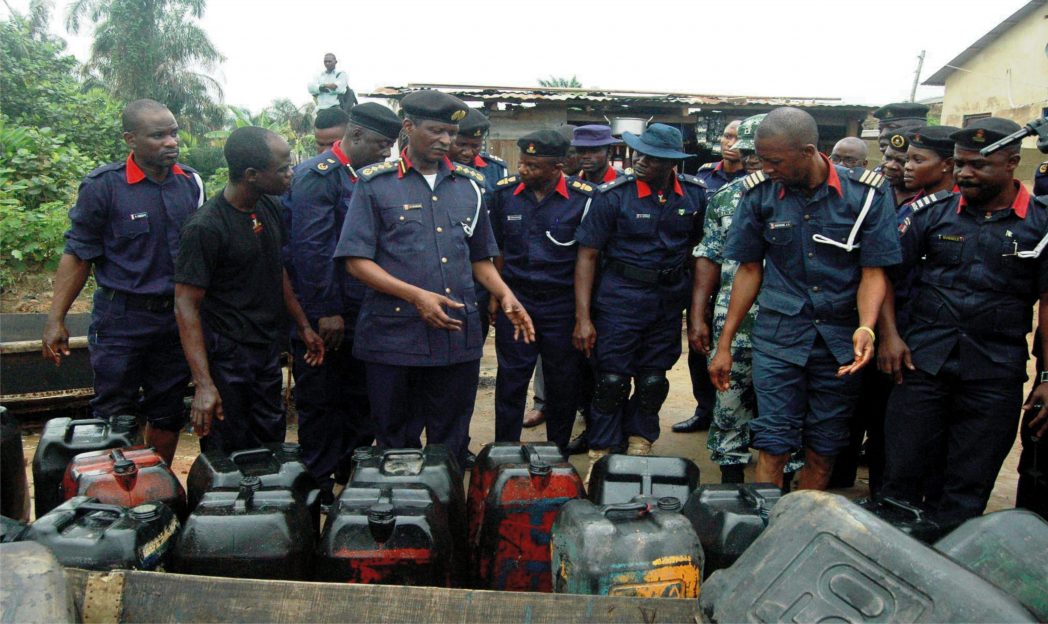
Commander General of Nscdc, Dr Ade Abolurin (3rd left), inspecting seized jerry cans of petrol from vandals during his tour of Oke-oko Isawo in Ikorodu, recently.



-
 Education1 day ago
FCE Yola Graduates 3,555 Teachers , Seeks Upgrade to University
-

 Sports1 day ago
Nigerian Trio Target Titles At PFL Africa Finals
-

 Niger Delta1 day ago
Diri Restates Stance On Lagos-Calabar Coastal Highway
-

 Niger Delta1 day ago
C’River, NUJ Pay Tribute To Late Guardian Editor
-

 News2 days ago
NDLEA Recovers Tons Of Illicit Drug Consignments In Nine States
-

 Opinion1 day ago
Checking Voter Apathy In Nigeria’s Electoral Process
-

 Politics1 day ago
2027: DICKSON’S EX-ALLY VOWS TO WORK AGAINST NDC INTEREST IN BAYELSA
-

 Politics1 day ago
2027: GROUP PLEDGES 40,000 SUPPORTERS FOR COALITION CANDIDATES IN RIVERS