
Connect with us

Business

Firm Awards Scholarship To 58 Students In Rivers

Published

on

An oil firm, Enercon Nigeria Limited, has restated its commitment in the development of its host community.
Chairman of the company, Chief Chris Iheanacho, made this pledge Tuesday during the scholarship at voyage award ceremony. A total of 58 students benefitted from the scholarship grant of N10 million while another cheque valued at N2 million was issued for the administration of the scheme.
The Chairman who was represented by the Business Development Manager of the firm, Mr. Chima Ukoumunne, said the gesture was in fulfilment of its commitment to offer scholarship on an annual basis to members of Nkiken Oka Mba Landlords Association, Ngoke compound, Alode, in Eleme Local Government Area of Rivers State.
He described education as a key ingredient to the growth and empowerment of any given community and charged the recipients to make the best use of the money for the course it was set out to achieve.
The Chairman regretted that work on the project site was delayed because of the challenges in obtaining the Certificate of Occupancy (C of O) from the Rivers State Government which is a requirement by the firm’s technical partners in order to commence the project.
He further promised employment opportunities to jobless youths from the community when the project was completed and appealed for the support and friendly working environment to help the company achieve.
Iheanacho clarified that Christaben Nigeria Limited, the company that entered into the agreement with the host landlords is a subsidiary of Enercon Nigeria Limited.
Responding, the Chairman, Landlords Association, Rev. Canon Ransome Goya Ngoke (JP) commended the company’s management for its gesture and promised a cordial working relationship with the firm.
He, however, urged the firm to be transparent in its dealings and to pay strong attention to the promise of employment to youths of the host community.


Chris Oluoh
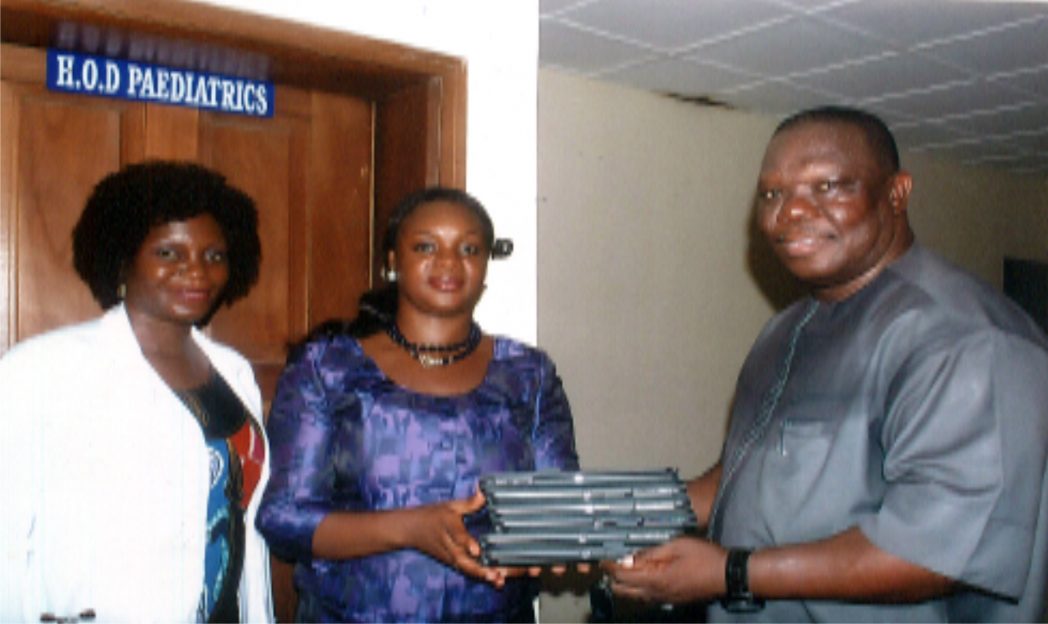
Special Adviser to the Rivers State Governor on ICT, Engr. Goodliffe Nmekini (right) presenting ipads to Head of Department Paediatrics Braith Waite  Memorial Specialist Hospital, Dr Ajibola Alabi (middle). With them are, Dr Josephine Aiyafo during Executive Governor of Rivers State, Rt Hon Rotimi Chibuike Amaechi, inspecting instaled ICT facility by Rivers State ICT Department. Photo: Egberi A. Sampson


Special Adviser to the Rivers State Governor on ICT, Engr. Goodliffe Nmekini (right) presenting ipads to Head of Department Paediatrics Braith Waite Memorial Specialist Hospital, Dr Ajibola Alabi (middle). With them are, Dr Josephine Aiyafo during Executive Governor of Rivers State, Rt Hon Rotimi Chibuike Amaechi, inspecting instaled ICT facility by Rivers State ICT Department. Photo: Egberi A. Sampson

Continue Reading

Business

Association Seeks Intervention to Save Domestic Airlines

Published

on

The Vice Chairman of the Airline Operators of Nigeria (AON) and Chairman of Air Peace, Mr. Allen Onyema, has called on the Federal Government to urgently intervene in the nation’s aviation industry, warning that several domestic airlines may cease operations if the current challenges confronting the sector are not addressed.
Onyema gave the warning  at the public presentation of the book, Pathways, Pilgrimage and Destiny: The Biography of Alhaji Muneer Bankole, held in Lagos and was obtained in Port Harcourt, at the weekend.
He described the aviation industry as being highly capital-intensive with relatively low financial returns, stressing that domestic airline operators are grappling with severe economic pressures that threaten their continued existence.
According to him, the industry has reached a critical stage and requires immediate government intervention to avert the collapse of many indigenous carriers.
Onyema warned that unless decisive measures are taken within the next 30 days, several Nigerian airlines could be forced to shut down their operations due to the harsh operating environment.
He also cautioned aviation labour unions against any planned picketing of airlines over the alleged non-remittance of the five per cent Ticket Sales Charge, saying such action could disrupt flight operations across the country.
The Air Peace Chairman maintained that if any airline was singled out for industrial action, other domestic operators would stand in solidarity, arguing that labour unions should not be used as instruments for resolving debt-related disputes between airlines and government agencies.
He lamented that more than 50 Nigerian airlines had folded over the years despite the success of many of their promoters in other sectors of the economy, attributing the trend to the difficult business environment in the aviation industry.
While reaffirming the commitment of airline operators to support government revenue generation, Onyema stressed that policies capable of crippling airline operations should be reviewed in the interest of the sector.
He noted that a thriving aviation industry remains critical to national economic growth, employment generation and improved connectivity across the country.
The AON Vice Chairman urged the Federal Government to engage relevant stakeholders and adopt sustainable measures that would strengthen the operational capacity and financial stability of indigenous airlines.
He expressed optimism that with timely policy support and constructive engagement between government and industry stakeholders, the nation’s aviation sector would overcome its current challenges and continue to contribute meaningfully to Nigeria’s socio-economic development.
King Onunwor
Continue Reading

Business

CBN Reforms Impact  Consumers As  Dollar Card Spending Limits Rise

Published

on

The Central Bank of Nigeria’s (CBN) foreign exchange reforms are beginning to deliver tangible benefits to consumers, as banks expand international spending limits on naira cards amid improved liquidity in the foreign exchange market.
The new limit represents a sharp increase from the $6,000 quarterly cap introduced in November 2025 and is 20-times higher than the $1,000 quarterly limit announced in July 2025.
The move comes as analysts point to a more liquid foreign exchange market following reforms introduced by the CBN over the past three years.
“This reflects the improved liquidity in the foreign exchange market. It also shows the focus of banks in maximising income from card payments,” said Ayokunle Olubunmi, head of Financial Institutions Ratings at Agusto & Co.
Muda Yusuf, chief executive officer of the Centre for the Promotion of Private Enterprise (CPPE), said the increase in card spending limits reflects the significant improvement in liquidity and confidence in Nigeria’s foreign exchange market.
“It’s an indication that the liquidity in the foreign exchange market has improved significantly and we can see that from the stability of the exchange rate. We can also see that reflected in our foreign reserves. All of these things reflect the level of confidence,” Yusuf said.
According to him, businesses and individuals are no longer under pressure to obtain foreign exchange for legitimate transactions, unlike in the past when access to dollars was constrained.
“It also means that citizens and those who use foreign exchange are no longer desperate about foreign exchange usage. Whether you want to use it through your card or access it for international trade, there is no anxiety, there is no pressure and there is no desperation.
All of these things have arisen because the level of confidence in the foreign exchange market and the outlook for the market have been very reassuring,” he said.
Yusuf added that the adjustment of international spending limits by banks demonstrates growing confidence in the sustainability of the foreign exchange market reforms.
“That is why we are seeing all these positive developments around the use of the naira card abroad and the limits that are now being adjusted by banks. It is a very good development and I hope we can sustain it. I am confident we will.”
The increase follows a series of policy changes by the apex bank aimed at deepening the foreign exchange market and improving access to foreign currency for legitimate transactions.
Under the CBN’s Foreign Exchange Manual, Fourth Edition, the maximum tuition fee remittance for Nigerian students pursuing undergraduate and postgraduate studies abroad was raised to $25,000 per semester, from the previous $15,000.

“Payment of tuition fees for undergraduate/postgraduate studies shall be subject to a maximum limit of $25,000.00 per semester,” the Manual states.

The expansion of international card limits also reflects growing confidence among lenders that foreign exchange liquidity has improved enough to support retail dollar transactions.

Speaking recently at the BusinessDay 14th Annual CEO Forum in Lagos, CBN Olayemi Cardoso, governor of the CBN said buying and selling activities now increasingly determine outcomes in the foreign exchange market, unlike in the past when market participants relied heavily on routine Central Bank interventions.

According to Cardoso, Nigeria’s net foreign exchange reserves have risen from just over $3 billion at the start of the reform programme to more than $40 billion, while gross reserves have climbed to about $52 billion, providing stronger confidence for investors and enabling the Central Bank to reserve interventions for periods of market stress rather than day-to-day liquidity management.

The restoration and expansion of international naira card spending limits are increasingly being seen as one of the clearest signs that the benefits of the CBN’s foreign exchange reforms are beginning to reach households, students and businesses making legitimate cross-border payments.

Continue Reading

Business

WEC: FG Inaugurates Governing Board  … As Nigeria Rejoins Council 

Published

on

Nigeria has rejoined the World Energy Council (WEC) with the inauguration of a National Member Committee and Governing Board to strengthen the country’s participation in global energy policy and investment discussions.

The Secretary-General and Chief Executive Officer, WEC, Dr Angela Wilkinson, disclosed this in a statement, last Thursday.

The Governing Board is chaired by the Chairman of Waltersmith Petroman Oil Ltd., Abdulrazaq Isa, while a former Chief Upstream Investment Officer of NNPC Ltd., Bala Wunti, will serve as the inaugural Chief Executive Officer.
Other members of the board are Prof. Wumi Iledare, Dr Mustapha Abdullahi, Mrs Aisha Farida Katagum, Dr Ainojie Irune, Dr Emmanuel Okon, Dr Victor Ekpenyong and Dr Imamuddeen Talba.
The Secretary-General and Chief Executive Officer, WEC, Dr Angela Wilkinson, who disclosed this in a statement, last Thursday, said the board comprises of experts in energy policy, regulation, investment, operations, research, technology and enterprise development.
Welcoming Nigeria into the council, Wilkinson said the country’s membership would strengthen its contribution to global energy discourse.
Wilkinson noted that “Nigeria has a significant leadership role to play within the global energy community.
“Nigeria has a significant leadership role, and the Member Committee will help bring that expertise and voice onto the world stage at the Riyadh World Energy Congress in April 2027 and beyond.

“Nigeria’s participation comes at a pivotal time as the country seeks to expand energy access, strengthen energy security, accelerate gas development and mobilise the capital required for industrialisation and sustainable economic growth.

“WEC Nigeria will convene leaders from across the energy ecosystem, apply the WEC’s globally recognised Energy Trilemma framework to Nigeria’s unique context, and promote evidence-based dialogue, practical collaboration and informed policymaking.

“It will also ensure that Nigerian and broader African perspectives contribute meaningfully to global energy conversations,” she said.

Wilkinson expressed confidence that Nigeria would play a significant leadership role at the World Energy Congress scheduled for Riyadh in April 2027 and beyond.

The statement also quoted the Chairman of WEC Nigeria, Isa, as describing the country’s participation as an opportunity to deepen national and African leadership within the global energy community through practical solutions tailored to regional development priorities.

He said the platform would promote collaboration across sectors and attract sustainable investments into Nigeria’s energy sector.

The Chief Executive Officer of WEC Nigeria, Wunti, was quoted in the statement as saying that the council would connect leadership, evidence and investment to build a secure, affordable and sustainable energy system.

“This system will be capable of driving economic growth and shared prosperity.”

According to him, the platform will also connect Nigerian institutions and businesses with international knowledge, technology, partnerships and investment opportunities through the World Energy Council’s global network.

Recall that WEC, founded in 1923, is the world’s oldest independent and impartial community of energy leaders and practitioners, advancing informed, collaborative and practical action across the global energy system.

Nigeria has been a member of the council with the Nigerian National Committee originally approved and established on April 6, 1960 before its re-establishment and expansion this year.
The renewed membership would provide an independent, technology-neutral platform bringing together government, industry, academia, finance and civil society to address Nigeria’s energy security, energy equity and environmental sustainability.
Continue Reading

Trending









