
Business
FG Clarifies Management Of External Reserve
The Federal Ministry of Finance has said President Jonathan’s administration did not in anyway squander the national reserve.
This is contained in a statement issued by the ministry in Abuja, on Wednesday.
“ it is absolutely not true that the administration of President Goodluck Jonathan has squandered the nation’s reserves.
“The facts are clear and indisputable. At the end of May 2007, Nigeria’s gross reserves stood at 43.13 billion dollars, comprising the CBN’s external reserves of 31.5 billion dollars, 9.43 billion dollars in the Excess Crude Account (ECA) and 2.18 billion dollars in Federal Government’s savings.
“These figures can be independently verified from the CBN’s records,” it said.
According to the statement, the figure of 67 billion dollars cited in some recent commentary is factually incorrect.
It added that it was a misconception to think that reserves are immutable or cast in stone.
It added that since May 2007, the reserves had fluctuated in line with developments in the international oil market, rising from 43.13 billion dollars at that time, peaking at 62 billion dollars in September 2008 during the Yar’adua and Jonathan’s administration.
It said that then, the oil prices reached a peak of 147 dollars per barrel, and falling subsequently to as low of 31.7 billion dollars in September 2011.
“This fall in reserves was largely a result of the vicissitudes of the global economy and oil market which caused the CBN to intervene, using some of the reserves, to defend the value of the naira.
“ The Excess Crude savings, which it should be noted is a component of the reserves, was largely used to cushion the economy at the height of the global financial crisis in 2008-2009.
“ As a result, Nigeria was one of the few countries in the world that did not seek assistance from international financial institutions at that time.
“ The fiscal stimulus used to shore up the economy during that period was shared by all three-tiers of government.
“Similarly, savings in the ECA were also used to pay for fuel subsidies for the entire nation and that sharing continued after the crisis ended,” he said.
It noted that from 2012, such payments had been published each time they were made.
It blamed the quest by the governors to the depletion of ECA, adding that most of them kicked against continuous building up of the account.
The statement noted that it was on record that states even took the Federal Government to court on this matter, and the case was still pending at the Supreme Court.
It added that the present administration had established the first ever Sovereign Wealth Fund for the nation in which savings were being made for future generations of Nigerians and important infrastructure investments were being supported.
“ It is also a matter of public knowledge that the fund would have generated more savings and investments if the same sort of opposition that blocked savings in the ECA had also not been at work,” it said.
It further explained that the Federal Government and states, had in 2009 in common agreement, took 5.5 billion dollars from the ECA to invest in Independent Power project.
Today, various state governments are shareholders in the projects and hold share certificates confirming their stake in the projects.
It stated that it was not correct to say that the nation’s external reserves were dipped into or misapplied by the administration.
“ Anyone familiar with foreign reserves management will be aware that the Federal Government cannot dip its hands into the external reserves.
“ Like in other countries, the management of external reserves is one of the statutory mandates of the Central Bank of Nigeria (CBN).
Section 2 sub-section (c) of the CBN Act (2007) states that the Bank shall “maintain external reserves to safeguard the international value of the legal tender.
“No President since the democratic dispensation has contravened this Act.
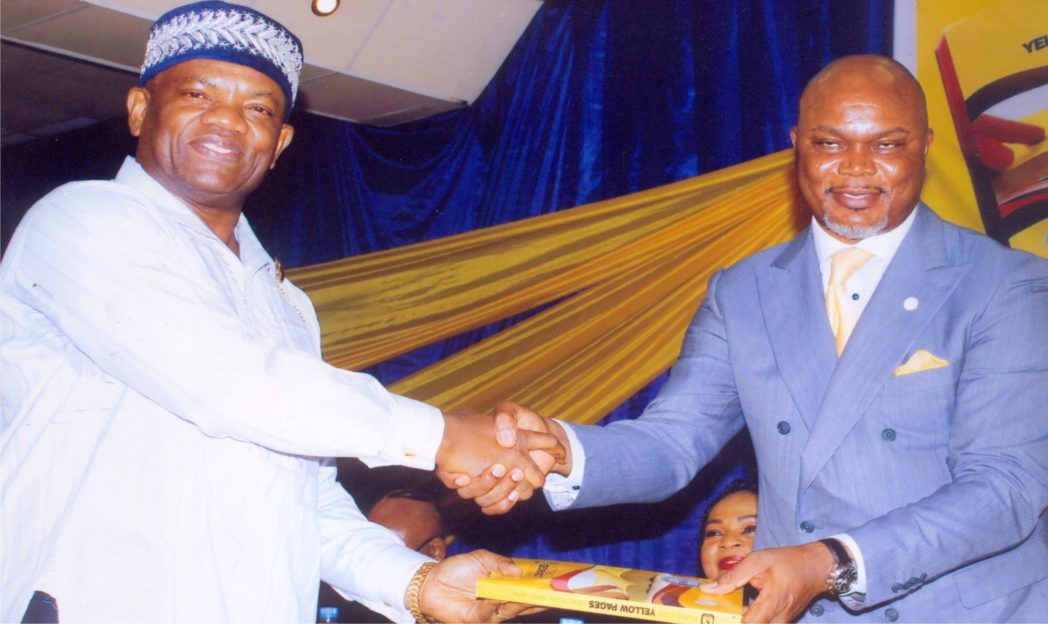
Rivers State Commissioner for Commerce and Industry, Hon. Chuma C. Chinye (right) in handshake with Administrative Director MCC, Mr. Nelson Jaja (left) in the public presentation of the Yellow Pages Directory, orgnaised by Ministry of Commerce and Industry in Port Harcourt recently. Photo: Egberi A. Sampson

Business
UNIPORT, UNIBEN Clinch NCDMB’S Engineering Olympiad Regional Victories
Two universities in the Niger Delta zone (University of Port Harcourt and University of Benin) have emerged winners of the South-South region in the Nigerian Engineering Olympiad (NEO) competition.
The NEO competition which took place at the Nigerian Content Tower(NCT), headquarters of the Nigerian Content Development and Monitoring Board(NCDMB) in Yenagoa, Bayelsa State is a nationwide engineering, innovation and entrepreneurship competition launched in 2025 by a non-profit organization, ‘Enactus Nigeria’, in partnership with NCDMB, Renaissance Africa Energy Company Limited, First Exploration & Petroleum Development Company and the Nigerian Society of Engineers (NSE).
The two Universities teams represented differently by ‘Inovation team PROTRONICS’ and ‘Innovation team VHORDE’, won their counterparts from the Igbinedion University, Okada, Edo State, Federal University of Petroleum Resources (FUPRE), Effurun, Delta State, and the University of Uyo, Uyo, Akwa Ibom State, in the competition showcasing hardware and software prototypes developed to serve as innovative solutions to real-world challenges with specific reference to Nigeria and Africa.
From UNIPORT’s ‘team PROTRONICS’ was an innovation called ‘KEYTRIC’ which the competitors presented as a ‘SMART POWER CONTROL’ that makes electricity usage effortless and automating with the use of an intelligent locking systems.
Team PROTRONICS highlighted high electricity bills, electricity fire risk and expensive smart home and gaps in existing solutions, including costly installation, lack of integration between security and energy, and dependence on the Internet as the reason for their innovative invention.
“Our innovative solution is a smart energy door lock that switches off a user’s electricity supply when they lock to leave the house.
“Our solution saves money on electricity bill, reduces the risk of electric fire accident, and is affordable to everyone”, the Uniport’s team said.
On the other hand, Team VHORDE of the University of Benin presented what it terms Intelligent Real-time Interface(IRIS) which enables visually impaired individuals to gain sight.
They pointed out that there are 4.5 million visually impaired Nigerians who are in some way incapacitated and unable to live life to the fullest.
The students displayed an IRIS pack, consisting sensors, wearable glasses, microphone, camera and Haptic feedback.
On how the IRIS works, the UNIBEN students said the smart glasses, which consist, a camera, depth sensor, and edge Artificial Intelligence(AI) processor, enables a visually impaired person to see and understand the world in real time.
“There’s an AI Compute Unit to be worn at the waist, which runs Convolutional neutral network (CNN) object detection, face recognition, and voice processing on-device”, the team said.
In a section on Business Model and Revenue Streams, the University of Benin competitors indicated production-scale pricing for IRIS Standard as N699,000 one-time purchase.
According to the team, the IRIS standard has the following functions, real-time object and scene identification, familiar face recognition, obstacle and hazard detection (haptic wristbands), natural voice interaction, Edge AI – fully offline core functions, and OTA software updates via Wi-Fi.
In an assessment of the prototypes and demonstrations made, one of the key judges of the competition, Engr. Dokubo Obongo, Manager, Institutional Strengthening, at the NCDMB, described all the presentations as “top-notch”.
He noted that there are solutions that are viable marketwise, relevant to the society and the challenges humans face, explaining that the Engineering Olympiad is a competition targeted at developing home-grown solutions from research and development from Nigerian universities.
“The idea is to see how we can proffer solutions to our own problems which means creating business opportunities”, he said.
Speaking for Enactus Nigeria, the group’s Country Director, Mr. Michael Ajayi, said the two top finalists from the six geopolitical zones would move to a boot camp for further preparation towards the main national championship, and that the best three teams would share N100 million.
He also disclosed that each of the 30 teams that displayed prototype technology in the regional competition would receive N3 million.
Team PROTRONICS of the University of Port Harcourt had as Team Lead Dr. Victor Jinn (Faculty Adviser), while the contestants were Chukwuma Sunday-Odu, Fubara David Otokini, and Ekemini Godwin Akpan, while Team VHORDE of the University of Benin had Anoint Oritsetimeyin Igorki, Oghosa Derick Osarobo, Uti Henry Eworitsewarami, Jada O. Godfrey-Ariavie, Richard O.Enegbuna, Momodu O. Olayemi, and Asemota G. Ayevbosa.
By: Ariwera Ibibo-Howells, Yenagoa
Business
Customs Launches SCADS To Curb Airport Delays
The Nigeria Customs Service (NCS) has officially unveiled the Simplified Customs Advanced Declaration System (SCADS) at the international wing of the Nnamdi Azikiwe International Airport, Abuja.
The move is aimed at improving passenger clearance, compliance and customs operations.
This was contained in a statement by the NCS spokesperson, Abdullahi Maiwada, and made available to Newsmen in Abuja.
Maiwada explained that the platform, designed to simplify baggage declaration for inbound international passengers, aims to reduce manual bottlenecks, improve transparency in revenue assessment and enhance operational efficiency at Nigeria’s international airports.
Speaking at the inauguration ceremony, Deputy Comptroller-General of Customs in charge of ICT/Modernisation, Oluyomi Adebakin, said the deployment of SCADS marked another major step in the service’s digital transformation agenda.
Adebakin said the initiative became necessary to address operational challenges encountered on the service’s previous passenger declaration platform earlier this year.
She explained that rather than allowing the setbacks to slow operations, the service chose to develop a stronger and more efficient alternative.
“When the earlier platform experienced operational challenges, we chose not to see it as a setback.
“We saw it as an opportunity to build something better, stronger and more efficient,” she said.
According to her, the newly introduced SCADS platform allows passengers to declare items before arrival, thereby reducing clearance time while improving compliance and operational integrity.
“For passengers, this system creates the opportunity for advance declaration before arrival. It means faster clearance, easier compliance and smoother movement through our airports,” she added.
Adebakin said that the system would eliminate subjective revenue assessment by ensuring that duties were being automatically generated based on declared items, their quantities and actual values.
“When we talk about revenue collection, it is not about collecting more or less. It is about collecting the right revenue. With this system, assessment will now be more objective, accurate and driven by data,” she said.
Earlier Comptroller Customs Area Controller, FCT Area Command, Victoria Alibo,described the selection of the command for the pilot phase as a vote of confidence in its operational capacity.
Alibo said the new platform integrates passenger baggage and e-commerce declarations into a single digital framework designed to support global Customs best practices.
“SCADS is designed to simplify declarations, reduce clearance time, eliminate manual bottlenecks and align our operations with international standards,” Alibo said.
She said that the pilot phase would run for five days, from May 18 to May 22, during which officers would evaluate the system in a live environment ahead of nationwide deployment.
The event was attended by senior Customs officers, officials of the Federal Airports Authority of Nigeria, partner government agencies, technical teams, and other key stakeholders in Nigeria’s aviation and border management ecosystem.
By: CHINEDU WOSU
Business
Energy Theft, Obsolete Infrastructure Deepen Nigeria’s Electricity Crisis – Expert
Olubiyo, said this in an interview with Newsmen to Monday in Abuja.
He said energy theft occurs at both the consumer and institutional levels across the electricity value chain from generation to transmission and distribution.
According to Olubiyo, at the consumer level electricity theft includes metre bypass, illegal connections and unauthorised access to power without proper billing.
According to him, some customers would dig underground cables directly to their homes or businesses without being metered, while others exploit estimated billing systems to consume electricity without payment.
“Whether through metre bypass or illegal connection, many customers are using electricity for free. That is energy theft,” he said.
He also alleged that institutional energy theft exists within the power sector, particularly through defective, obsolete, or wrongly installed metres used in monitoring electricity generation and distribution.
He said that wholesale metres installed at critical interfaces among generation companies (GenCos), transmission companies, and distribution companies (DisCos) were often out-dated or improperly configured.
He said those could lead to inaccurate readings and inflated subsidy claims.
“If 4,000 megawatts is generated and 7,000 megawatts is recorded, that is energy theft because the excess energy does not get to consumers,” he stated.
The expert further said some operators in the sector allegedly exploit maintenance and repair contracts through inflated contract sums and possible collaboration with vandals.
He also cited the deployment of secure pole-mounted metres in military barracks as an example of how technology can curb metre tampering and unauthorised access.
He, therefore said the sector had to urgently address infrastructure decay, weak regulation, poor investment, and corruption within the value chain.
Otherwise, according to him, Nigeria’s electricity industry will continue to face liquidity challenges, revenue losses and unstable power supply.
-
News1 day agoCourt Sentences Seven To Death Over Murder Of Cleric In Rivers
-
Politics1 day agoAPC PRIMARIES: FUBARA’S WITHDRAWAL, HISTORIC SACRIFICE FOR NATIONAL STABILITY ……. GROUP
-
Sports1 day agoPH Arsenal Community Set For Streets Procession, Saturday
-
Politics1 day agoIPAC Flays INEC Over Election Guidelines Judgement
-
News2 days agoGroup Hails Tinubu, Chinda Emergence
-
Politics1 day agoNDC To Adopt Electronic Voting For Future Primaries
-
Sports1 day agoNPFL: Rivers United Finishes Second, Secures Continental Ticket
-
Sports1 day agoStakeholders Laud GTI On NPFL Partnership











