
Agriculture
FG, Flour Mills Partner On Sugar Production

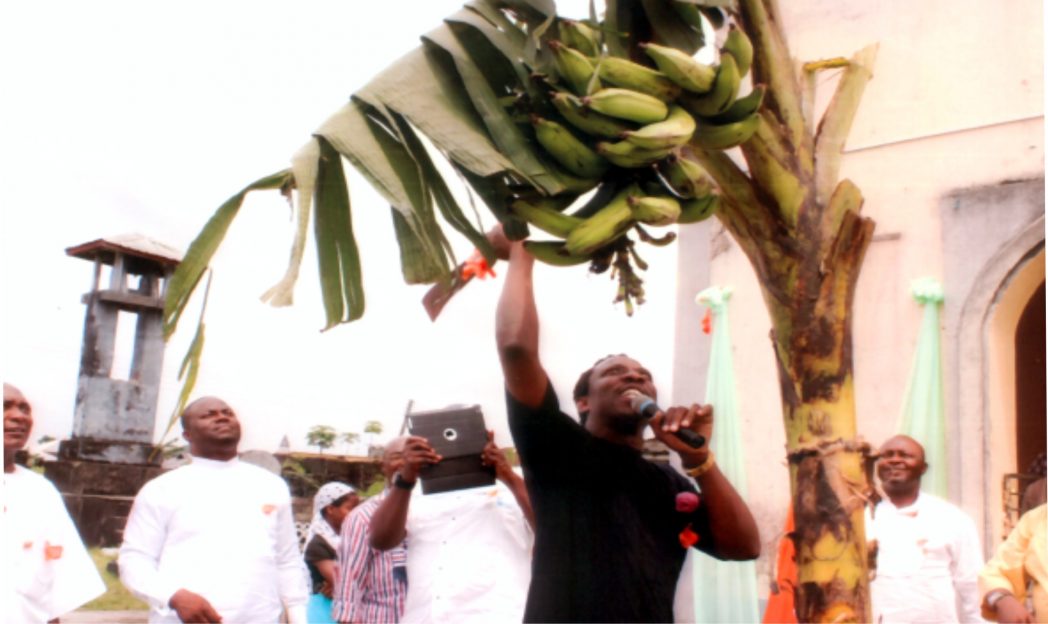
Member, Rivers State House of Assembly and House of Representative aspirant for Degema/Bonny Federal Constituency, Hon Aye Atamah Pepple, representing Rivers State Governor, Rt. Hon. Chibuike Amaechi (middle) harvesting plantain during St. Andrew’s Anglican Church, Bakana, 2014 adult harvest thanksgiving service recently. Photo: Egberi .A. Sampson
The Minister of Trade and
Investment, Olusegun Aganga has inaugurated a N45 billion integrated, state-of-the-art sugar project in Sunti, Niger State.
Speaking during the event,recently at Sunti, the Minister said the accession was a milestone in President Goodluck Joanthan’s transformation agenda.
The project which is wholly owned by the Flour Mills of Nigeria Plc (FMN) comprises a 16,500 hectare sugarcane estate and mill.
The Tide gathered that the project is part of the ministry’s investment’s approved Backward Integration Programme (BIP) for the production of local sugar in line with the provisions of the National Sugar Masterplan (NSMP).
Already, the company has invested N16 billion while the entire project is expected to be completed and commissioned before the end of 2016.
According to the Minister, when completed the project is expected to produce 100,000 metric tones of sugar annually.
He further added that it would also create 15,000 direct and indirect jobs and in addition generate 10 MW of electricity, produce animal feed and fertilizer as by products and save the country over $50 million yearly in foreign exchange.
Aganga noted that the implementation of the NSMP was an integral part of the Nigerian Industrial Revolution Plan (NIRP).
“Today is another historic day as it represents another milestone in the implementation of the National Sugar Master Plan, an integral part of the Nigeria Industrial Revolution plan of Mr President”, he said.
Aganga said that the government as part of the NIRP has developed the plan as one of the sector-specific policies to diversify the Nigerian economy.
“Because we are importing about 97 per cent of the sugar we consume in this country when we can produce sugar from sugar cane, from this process we can produce sugar and generate electricity”, he said.
The chairman Flour Mills Nigeria, plc, John Goumantaros, in his remark, commended the president and minister for initiating and implementing the new sugar policy, even as he said the company would continue to take advantage of the government’s investment friendly environment.


The President of the Capital Market Academics of Nigeria, Prof. Uche Uwaleke, has called for urgent agricultural reforms and stronger support for farmers to improve food security in the country.
Uwaleke made the call in an interview with Newsmen Wednesday while reacting to the United Nations projection that millions of Nigerians could face acute hunger in the coming months.
The United Nations Humanitarian Country Team had warned that about 35 million Nigerians could face acute food insecurity between June and August.
According to the organisation, nearly one in seven Nigerians may experience severe food shortages during the 2026 lean season.
Uwaleke said the projection underscored the urgent need for Nigeria to strengthen its food production systems and address factors driving food insecurity.
“The warning should be taken seriously because it reflects the difficult realities many Nigerians are already experiencing, especially vulnerable households.
“A projection of about 35 million people facing acute hunger is disturbing for a country with enormous agricultural potential,” he said.
He attributed worsening food insecurity to inflation, insecurity in farming communities, climate-related challenges, naira depreciation and high transportation costs.
According to him, the combined effects of fuel subsidy removal and declining purchasing power have further reduced access to food for many Nigerians.
Uwaleke said the situation required immediate and coordinated interventions to prevent a deeper humanitarian crisis.
“The lean season is usually difficult, but the scale being projected by the United Nations suggests the need for urgent action from both government and development partners,” he said.
He acknowledged recent government measures aimed at improving food supply, including food imports and tariff reductions on selected commodities such as rice and palm oil.
He, however, said the interventions might not yield the desired results without stronger investments in local agricultural production and improved security for farmers.
“I believe the government has made efforts to address the situation, particularly through policies aimed at boosting food availability.
However, insecurity continues to disrupt farming activities in major food-producing areas, while inflation and weak purchasing power remain major concerns for ordinary Nigerians,” he said.
Uwaleke urged the Federal Government to increase support for farmers through subsidies on fertilisers, improved seedlings and other agricultural inputs ahead of the peak farming season.
He also stressed the need to improve security in farming communities to enable displaced farmers to return safely to their farms.
According to him, targeted food distribution programmes should be expanded to support vulnerable households across the country
Uwaleke further called for long-term investments in irrigation, mechanisation, storage facilities, rural infrastructure and agricultural research to strengthen food security.
He added that food security should be treated as both an economic and national security priority requiring sustained policy implementation and adequate funding.
Agriculture
Livestock Minister Reaffirms Commitment To Integrating Apiculture Development Into NL-GAS

The Minister made this known in a keynote address at the World Bee Day 2026 celebration, held in Abuja, where he emphasised that the livestock value chain can be significantly transformed through targeted investments, innovation, private sector participation, youth empowerment, and inclusive economic growth.
In her remarks, the Permanent Secretary of the Ministry of Livestock Development, Dr. Chinyere Ijeoma Akujobi, said the Ministry remains committed to strengthening interventions aimed at improving the apiculture subsector, promoting sustainable beekeeping practices, enhancing production standards, expanding market access, and protecting pollinator habitats across the country.
The Director of Ruminants and Monogastric, Mr. Victor Egbon, representshe also commended the Youth for Agriculture Initiative (YFAI) for its sustained partnership and commitment to the annual commemoration of World Bee Day.
In a goodwill message, the representative of the Permanent Secretary, Federal Ministry of Industry, Trade and Investment, Dr. Osas Isokponomu, reaffirmed the Ministry’s commitment to supporting policies and programmes that promote value addition, industrialisation, export competitiveness, and market integration within the framework of the African Continental Free Trade Area (AfCFTA).
Earlier in his opening address, the President of the Youth for Apiculture Initiative (YFAI), Mr. Kingsley Nwagwu, called for the establishment of a National Apiculture Policy as a foundation for unlocking Nigeria’s emerging apiculture economy.
Participants at the event were drawn from relevant Ministries, Departments and Agencies, stakeholders, students, academia, research institutions, and development partners.
According to a statement, President of the AFBTE, Chinedum Okereke, gave the warning during the association’s 47th Annual General Meeting held recently in Lagos.
He stated that the food and beverage industry remained a critical pillar of the Nigerian economy because of its significant contributions to employment, public health, and economic growth, adding that government policies should support the sector rather than weaken it.
Okereke noted that many companies in the industry are struggling with rising operational costs and multiple taxes and charges imposed by government agencies without adequate consultation.
“The food and beverage sector remains a major player in the Nigerian economy in terms of its criticality to the financial and physical health of the nation, as well as the well-being of the people. Government support is therefore imperative,” Okereke said.
He added that the relationship between government institutions and businesses should be driven by collaboration, dialogue, and fairness to create a sustainable business environment.
The AFBTE chief also renewed the association’s opposition to the proposed ban on the packaging and sale of alcoholic drinks in sachets and small PET bottles, warning that the policy could worsen unemployment, reduce investment, and shrink government revenue.
“We are in the age of data and analytics Policies that affect businesses and livelihoods should be evidence-based,” Okereke said.
He noted that the industry had repeatedly demanded empirical evidence and statistical data to justify the proposed ban but claimed relevant authorities had yet to provide such information.
The AFBTE president further appealed to the Federal Government to introduce incentives and relief packages for manufacturers battling rising production costs, foreign exchange challenges and infrastructure deficits.
He also advocated the creation of more Free Trade Zones through the upgrade of existing industrial clusters, especially for long-established companies that have contributed significantly to Nigeria’s economic development but now face disadvantages compared to firms operating within free trade zones.
He observed that the absence of dialogue between the government and the private sector often creates avoidable disputes and weakens investor confidence.
Okereke added that the objectives of the Presidential Enabling Business Environment Council should remain a guiding principle for regulators and government agencies in promoting ease of doing business in the country.
Meanwhile, the Treasurer of AFBTE, Osaro Omogiade, disclosed that the association recorded a total income of N165.45m for the 2025 financial year, representing a 10.13 per cent increase from the N150.24m generated in 2024.
He attributed the increase largely to improved returns on investments in the money market through Stanbic IBTC and United Capital.
Omogiade, however, noted that the association’s expenditure rose by 14.22 per cent to N138.25m due to the increasing cost of running its secretariat, leaving a surplus of N27.21m compared to N29.19m recorded in the previous year.
-

 News2 days ago
RSG Targets Nine Million Residents in Mosquito Net Distribution Campaign
-

 Oil & Energy2 days ago
Aiyedatiwa Signs New Electricity Bill
-

 Oil & Energy2 days ago
NLNG Commissions Research And Innovation Centre In RSU
-

 Maritime2 days ago
Marine Minister Commends President Tinubu On NPERA Bill Assent
-

 News2 days ago
KenPoly Holds Eight Convocations, August 29
-

 News2 days ago
RSG Begins Another Phase of Projects Commissioning Today
-

 News2 days ago
RMAFC Completes Revenue Sharing Review, Proposes New Pay
-

 Maritime2 days ago
NAGAFF Petitions IGP Over Alleged Maritime Police Harassment