
Women
PH Salon Owners Recount Challenges

Any one who gradu
ates from a beauty school would probably think about owning a hair salon one day. The desire is often propelled by dreams of expressing creativity, developing a clientele and raking in profits.
Most housewives and single ladies also feel more at home owning their own hair salon instead of being employees under any one, irrespective of trade. To the later, the joy and comfort of having clients walk in and out of their shop at regular intervals keep them fulfilled.
However, poised by the gap between the operations of today’s hair salons in Port Harcourt and those of 80’s and 90’s during which the hair business boomed and salons stayed longer into the night to meet up the demands of clients, The Tide’s Women’s Desk went into town to unravel the secret behind the obvious dwindling posture of the once active industry.
Guess what!, The first salon of call greeted us with a sleeping worker on a hot weekend, the second salon had its attendant discussing with neighbor outside and same sight seemed to be rplayed in many of the salons visited. Worst still, business environments are not attractive and at night, workers only put light when drying hairs and use candle other times. The regular justification for the situation is “no business.”
Janet Boms a salon owner in Elekahia axis of Port Harcourt, blames the situation on indiscriminant establishment of salons. She said between every pole is a salon, hence many salons within an area compete for few customers.
Caroline Anosike indicts the power providers for her misfortune. For her, their inability to provide power when needed coupled with high cost of fuel, have made many salons lose customers to few who can afford light at all cost.
Many of the salons pointed out unavailability of workers as a major problem as any one secured would indicate interest to further her education in a short time while others would only work briefly only to start their own shop for reasons of poor salary. 90% of salons visited have boards in front of their shops, with the inscription, “Stylist Wanted.”
Amidst these reveries of owning one’s own salon and being one’s own mistress, one would have expected a generation of mush-room salons booming within the environ and seriously competing for the most outstanding recognition. Instead, the picture is that of a gradual disintegration of the already existing ones into oblivion.
The reason is simple. Rarely do these dreams include human resources problems, employee’s theft and payroll tax implication. For ML Corbett of Demand Media, employee turnover remains a serious challenge for hair salon owners.
Corbett alongside other operators view recruitment and employees retention as two biggest problems in salon industry. How does she mean? Most hair stylists leave without notice thereby disrupting staff schedules and clients’ appointment she explains.
According to Corbett, employees high turnover no doubt affects sales and erodes a salon’s reputation, the ease with which stylists leap from one salon to another keeps hair business owners in constant recruiting mode.
Another challenge bothers on employees compensation. Corbett, mentioned that how a hair salon compensates employees dictates cash flow, turnover and taxes. Most salons go by commission method with probably a 60-40 split in the salon’s favour. However, stylists and nail technicians who increase the salon’s clientele soon request a 50-50 split. In this case, the salon owner gets the short end of the deal because rent, utilities and cost of goods sold are paid from the owners 50 per cent. The owner must raise prices to counter the increase in compensation or accept reduced revenue.
Some salons choose to pay salary to minimize the impact that commissions have on profits.
However, Mrs Catherine Okedu-Kamalu owner of Relic and Heritage beauty and hair salon in Rumudomaya, Port Harcourt, has an entirely different view. For her, a major challenge of the local hair salon is non-regulated standard. This scenario by her explanations, throws the door of hair salon business open to “whosoever wills,” which ought not to be so. According to her, the mentality of owning a beauty salon because one has sufficient money to do so, can braide, wash or set hair makes sustenance difficult because such are not well grounded to withstand the storm of the business.
She emphasized the need for professionalism in the hair beautification industry, stating that it takes a professional to know which product to use on specific hairs to avoid hair damage or loss. In her words; “the ordinary customer depends on the hair dresser for direction and where the expectations are not met, disappointment sets in, a loss of confidence and eventual loss of patronage becomes the outcome.”
“When patronage gradually begins to dwindle without any explanations, the conclusion is that there is “bad market,” perhaps the next option might be a relocation of business site or out-right closure of such business for lack of fund.
Mrs Okedu-Kamalu signaled the need for a standard umbrella body for members in the hair industry which would serve as a regulatory organization for etiques and standards, the lack of which she maintained has rendered the industry unorganized. She explained that such organisation exists in the northern part of Nigeria, regulating prices as well as giving members a sense of responsibility. “The indiscriminant charges obtainable in this place, induce members to compromise standard to remain afloat, a situation that would have been checked by the organization,” she said.
Catherine observed that the presence of an unbrella body for members would at regular intervals, afford members the privilege of updating their knowledge of the hair business to meet the taste of time, but where this is lacking, members remain stagnated except a few that could explore the internet for more and current knowledge about hair management,” she added.
Though not quite old in the city, Catherine still believes she could be highlighted by adopting peculiar approaches to make her services unique and retain her clients. Xraying her potentials she said in a short while, she would come up with initiatives that are capable of returning the industry to its lost glory in Port Harcourt.
To the layman, what differentiates the medical doctor, the hair dresser and the cobbler, is just the definition of their workplaces and areas of specialization. Suffice it to say that what the medical doctor is to human’s health, is what the hair dresser is to the hairs’ health and what the cobbler is to shoes’ well being.
If that be the case, it means that the trio operate clinics in their respective domains.
However, it is obvious that the local salon has reneged in its duty as an hair clinic and manager and only an over haul of the industry would bring back the lost glory and return it back to its original status of hair clinic.
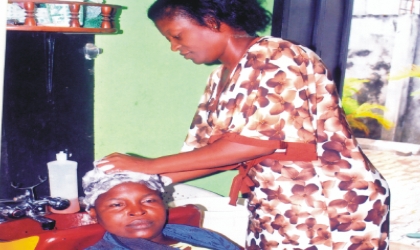
Hair dresser on duty
Sylvia ThankGod-Amadi


As Nigeria’s political arena thickens ahead of the January / February 2027 elections , the women folk stand on their resolve to remain a force to reckon with .
Not just in mobilisation as before but right there on the ballot papers . Rivers women this time , more than ever are determined to shake the space .
Through the creeks of Opobo, the bustling markets of Mile One in Port Harcourt, and the political wards stretching from Ogoni to Ahoada, Rivers women sought flags for political posts across the parties.
The story is that for the forthcoming January and February 2027 general elections, the women are undeniable the engine room of political mobilisation across the Treasure Base of the Nation.
Filling every campaign arena coordinating ward-to-ward voter drives, and sustaining the grassroots coalitions that determine who occupies Government House and the legislative chambers but their numerical strength still couldn’t translate to equivalent number of tickets granted them .The Final list of the Independent National Electoral Commission (INEC) unveiled , a familiar paradox. While women constitute the backbone of Rivers State’s electorate and party structures, their names on the actual ballot paper remain hard-won exceptions rather than the rule.
Against the backdrop of complex political realignments—most notably the reconciliatory Rainbow Coalition uniting allies of Governor Siminalayi Fubara and Federal Capital Territory Minister Nyesom Wike behind President Bola Tinubu’s re-election bid, a select group of determined women has stepped forward to claim space on the 2027 ballots.
In the female squad; the faces defining women’s quest for power in Rivers State in 2027 parades a lone female governorship contender challenging 18 men to seasoned labour leaders, lawyers, and grassroots strategists vying for legislative seats, The lone woman in the Brick House Race, to succeed Governor Siminalayi Fubarra among 19 governorship hopefuls, is West Ivy standard-bearer of the African Action Congress (AAC).
At 47, West Ivy is no stranger to the rough-and-tumble of Rivers politics. A lawyer holding multiple academic and legal credentials (including an LL.B, BL, and LL.M), she previously ran as the AAC’s deputy governorship candidate during the 2023 general elections.
West Ivy has anchored her 2027 campaign on ideological consistency and independence from political godfathers.
“I did not switch parties or sides. I kept faith with you, and I am back to lead,” she declared on the campaign trail, framing her candidacy around peace, job creation, and human dignity. Crucially, she has placed gender inclusion at the heart of her governance blueprint, pledging to reserve at least 35 percent of executive cabinet positions for women alongside signing a 13-point Citizens’ Charter. Running alongside her as deputy is Eletuo Ezekiel Ijendu, At the Deputy Governorship corridor, six women appear on the ballot as deputy governorship candidates across diverse party platforms:
Davies Joy Jebba Ikubogh ; and Running mate to Chibuzor Israel Rain on the Accord (A) ticket.
John-Woke Geraldine ; Running mate to Idoniboye-Obu Omangima of the All Progressives Grand Alliance (APGA).
Badom Zaavalo ; Running mate to Whyte Churchill Dagogo of the Allied Peoples Movement (APM).
Jumbo Jessica Robert ; Running mate to Labour Party (LP) candidate Boms Chima Ernest.
Ehuwa Pirinye Kabaka an accountant paired with Peoples Democratic Party (PDP) flag bearer Samuel Soni Ejekwu.
Membere Ibigbeye Deborah ; Running mate to Peoples Redemption Party (PRP) candidate Kieghe Nature Dumale.
The presence of women on the deputy tickets of legacy parties like the PDP and major opposition platforms like the Labour Party reflects an enduring tradition in Rivers politics following in the footsteps of amiable Dr. Ipalibo Harry Banigo, who broke the glass ceiling in 2015 as the state’s first female deputy governor.
Then the Law makers Zone ; battles for the Red Chamber: Women in the Senate Races: . In Rivers State, seven women are contesting across the three senatorial districts, bringing varied backgrounds in labour activism, law, business, and community organising to the January 16 National Assembly polls: Rivers East Senatorial District:Two women are vying to represent the state’s most populous senatorial zone. Leading the charge is Beatrice Itubo. of the Labour Party (LP). A veteran trade unionist and former chairperson of the Rivers State chapter of the Nigeria Labour Congress (NLC), Itubo was the Labour Party’s governorship candidate in 2023.
She is joined on the Rivers East ballot by Wokekoro Beauty Dike Chinonso of the Action Peoples Party (APP).
Rivers South-East Senatorial District: Lessi Naasi Susan flies the flag for the Social Democratic Party (SDP), carrying the banner for female representation in the Ogoni and Opobo/Nkoro axis.
Rivers West Senatorial District This riverine and upland district features the highest concentration of female senatorial contenders in the state, with four women on the ballot: *Ololube Charity Chizhim of the Action Alliance (AA), Abusi Tammy C. of the Action Democratic Party (ADP), Opoli Aneni Inyamoyio* of the Democratic Leadership Alliance (DLA), and *Sokari George Georgina* of the New Nigeria Peoples Party (NNPP).
Yet, the Rivers West race is also defined by the loud absence of Incumbent Senator *Distinguished Senator Ipalibo Harry Banigo, the former deputy governor who won the seat in 2023, and currently Chairs the Health Committee of the Senate . She couldn’t scale through at the primaries of the All Progressives Congress (APC) .
Her exit from the major-party ticket speaks loud of the vulnerablity of even high-ranking, experienced female politicians even with their huge grassroots popularity.
The House of Representatives and State Assembly Contests
In the lower chamber of the National Assembly and the Rivers State House of Assembly INEC’s final list( for the House of Representatives,) has women such as *Victor Igeh Happiness* (contesting the Abua-Odual/Ahoada East Federal Constituency on the Action Alliance platform), alongside candidates under the ADC, NDC, SDP, ZLP, and APM banners, are pushing to break male dominance in federal constituencies.
At the state legislative level —scheduled for February 6, 2027—women across local government areas from Tai to Abua/Odual women had many battles and are still battling internal party intrigues and post-primary litigation. It’s common seeing some female aspirants who clinched party tickets loose their victories immediately in court contests with male contenders Behind the faces on the Ballot are Mobilisers shaping the outcome. Let’s talk about them !
In Rivers State, electoral outcomes are frequently decided by powerful women-led mobilisation networks operating inside the major coalitions.
As the Rivers Rainbow Coalition bridging the political structures of Governor Fubara and Minister Wike under the APC and PDP umbrellas— women leaders have been central to translating high-level political truces into ward-level votes:
Hon. Tonye Briggs-Oniyide, a former two-term Commissioner for Culture and Tourism and Rivers State Coordinator of the Renewed Hope Initiative, has played a pivotal role in linking federal women-empowerment interventions with grassroots political mobilisation.
Barr. Onyii Ile; State Coordinator of the Simplified Grassroots Ladies (SGL), commands one of the most visible female political networks in the state, rallying women across the 23 local government areas behind Governor Fubara’s political alignments.
Prof. Adaeze Chidinma Oreh former Commissioner for Health, continues to bridge public health advocacy and community engagement, resonating strongly with female voters and professional networks.
Amb. Dr. Ruth Davies Ibiamu; Chairperson of the Rivers State chapter of the Nigeria League of Women Voters (NILOWV), leads non-partisan civic education, pushing for peaceful polls and encouraging women to vote beyond material inducements.
Rivers Women in Politics still have lots of hurdles to pull off.
Rivers state with all her dynamic, politically astute women still see men occupy over 90 percent of the top slots on the 2027 ballot.
Women folk; Rivers Women there’s every need to discuss the following barriers : The Patronage and Godfather System,, Prohibitive Campaign High Costs ,Political Volatility and Intimidation: Looking Ahead to January and February 2027 ballots our Women flag bearers have a dual burden. They are competing to win seats in a fiercely contested political environment, while simultaneously keeping the door open for the next generation of female leaders.
I believe through West Ivy’s bold solo run for Government House, Beatrice Itubo’s labour-backed push for the Senate, and the six women standing a heartbeat away from the governorship as running mates, Rivers women are fast going beyond mobilisation figures, aso – ebi wearers or mere spectators in Politics .True democratic representation in Rivers State will remain incomplete until the women who deliver the votes are equally entrusted with the power to govern.
Nneka Amaechi-Nnadi
Women
Hearty Cheers To Nigeria’s Flamingos …Kudos To All Nigerian Women Who Chose To Excel In Male Turfs

For ages, football and soccer pitch in Nigeria were literally identified as areas specifically meant for the menfolk, in line with the societal expectation that physical dominance belongs exclusively to men. Our pitches and the likes were formerly mapped out as men’s domain!
As years rolled by, a new generation of daughters arose. The barriers were broken. Our women and girls graced the pitches and took solid grounds. Not, just to watch and not just to participate, but to conquer.
Nigeria’s female national football teams have consistently flown the country’s flag high, serving as absolute power houses on the African continent and earning immense global respect.
The year 2026 will forever be etched in gold. In Nigeria, and African football history as the year Nigeria’s U-17 women’s national team, the Flamingos took over the male turf, rewrote the global script at the FIFA U-17 Women’s World Cup in Morocco, emerging the first African female Team to conquer the World and bring home the World Cup.
The journey through the seven matches were clearly tough and rough but the Nigerian teenage Queens defied all odds , faced the global big hooves , beat them in their games and made Africa; Nigeria proud . They broke all barriers and won their six matches. They conquered football behemoths like Brazil in the semi-finals with a stellar 3-1 victory, and stood face-to-face with multi-time global champions, Japan in the grand finale in Rabat. When the final whistle blew, sealing a tense 2-1 victory over Japan, the Flamingos achieved the unthinkable: they became the first African nation in history (male or female) to lift the FIFA U-17 World Cup trophy. .
I hail the Midfielder, Oluebube Umejiaku , who ignited the pitch and tamed the world former bests, clinching the prestigious ” FIFA Golden Ball as “ “Player of the Tournament.” Under the tactical brilliance of Head Coach Akeem Busari, the young Nigerian girls stood firm and displayed “what they got”
They did not just win; they dismantled barriers. After an initial setback, they surged forward with six consecutive victories.
As the African Queens landed home amidst thunderous ovations, the Presidency and the Senate took turns to celebrate the Young World Conquerors. Tuesday, the Senate, following the prayers of a Motion on the Flamingos glorious outing sponsored by Distinguished Senator Abdul Ningi applauded the U-17 World best. The World record attained by the players gave room for off politics deliberations in the Red Chamber as all Senators united in commendations over this national feat. The lawmakers took turns to eulogise the female players and splashed the team with cash sum of one hundred million naira.
Senate President Godwill Akpabio, speaking on behalf of his colleagues said, “I want to commend the Flamingos, the U-17 youth team of Nigeria, for defeating major countries such as Brazil and Japan to win the Under-17 World Cup for Africa for the first time and for Nigeria.”
He also appealed to the Federal Government and corporate Nigeria to adequately reward the players and invest in the foundational development of women’s sports. The lawmakers also commended the National Sports Commission (NSC) under Mallam Shehu Dikko for his good work which yielded the world trophy to Nigeria.
Wednesday, the Senate, President and his colleagues continued the shower of praises as they hosted the Flamingos in the National Assembly.
Same day, the team was hosted at the Presidential Villa by the First Lady, Senator Oluremi Tinubu. The players at the Villa received gifts of One hundred million Naira each from President Bola Ahmed Tinubu .
From the women’s world, the victory of the Flamingos speaks volumes. It is women breaking boundaries, venturing into male – dominated terrains not just to be seen but to excel not minding systemic hurdles.
Looking back, it is already established that soccer, the field of men had expanded. No longer a male preserve but a shared terrain where Nigeria’s female teams shake the world.
Before now, the Super Falcons (Senior Women’s National Team; undisputed Queens of Africa, dominated the Women’s Africa Cup of Nations (WAFCON) with multiple continental titles and historic triumphs. They qualified for every single edition of the FIFA Women’s World Cup since its inception in 1991. The Super Falcons maintained Continental Dominance and Rankings.
The Falconets, Nigeria’s U-20 Women’s National Team in turn carved their names in gold over the years as they consistently terrified traditional superpowers at the FIFA U-20 Women’s World Cup. They have a history of reaching deep into the tournament, famously securing runners-up position (Silver medals) at the FIFA U-20 Women’s World Cup on multiple occasions, fiercely challenging powerhouses like Germany and the USA. Maintaining African Supremacy, they routinely swept the African qualifiers, proving to be the ultimate conveyor belt of talent feeding straight into the senior Super Falcons squad.
Cheers to all Nigerian Women! Our Teams are the best!
Nneka Amaechi-Nnadi
-
News4 days ago
Bayelsa Boat Mishap: Tinubu Donates N250m As Death Toll Hits 29
-
News4 days ago
Odu Pays Tribute To Late Chinwah, Describes Him As Courageous, Selfless Academic
-
 Maritime4 days ago
Nigeria, Russia Customs Sign MOU To Trade Facilitations
-
 Sports4 days ago
World marathon champion gets three-year doping ban
-
 Maritime4 days ago
South-South Governors Urges To Shake Off Collective Lethargic To Embrace Blue Economy
-
 Maritime4 days ago
Oyetola Woos Investors With Nigeria’s Seabed Resources, Marine Biotechnology
-

 Business4 days ago
Moniepoint MfB transaction volume hits 1trn daily — CEO
-

 Oil & Energy4 days ago
Global Oil Market May Witness Supply Surplus Before The End Of 2026 …… Report