
Business
Investor Advocates Legislation Against Power Vandalism

The Managing Director of 4Power Consortium Limited, Mr Matthew Edevbie, has called for a strong anti-theft legislation that would curb vandalism and theft in the power sector.
Edevbie made the appeal when he received members of the House of Representatives Committee on Privatisation who were on a nationwide oversight tour to all successor power companies on Wednesday.
Edevbie, whose consortium is the core investor in the Port Harcourt Electricity Distribution Company (PHEDC), explained that workers and equipment should be protected in the industry.
He said that the law would go a long way to protect power workers that were constantly being attacked in the course of their duty.
“The PHEDC, among other critical achievements since taking over the DISCO in November 2013, has undertaken the construction of new 33KV lines at Trans Amadi Industrial area.
“Okrika 11KV feeder for Joinkrama Communities in Ahaoda West was re-conducted.
“Also the NIPP 1 x 15MVA 33/11KV Injection Substation at Ikot-Abasi was inaugurated and general maintenance carried out on other stations,’’ he said.
He decried the condition of the network his company inherited, saying it was worse than it anticipated before it took over the PHEDC.
In her remarks, the Chairman of the committee, Mrs Khadija Abba-Ibrahim, said the oversight tour was to assess the performance of the company.
According to her, the house is interested in the performance of the company since the acquisition of the 60 per cent equity in the enterprises.
“The visit is to ascertain the level of compliance to the post acquisition development plans submitted to BPE by the core investors, challenges in implementing the Share Sale Agreement.
“We also want to partner with investors to make recommendations for appropriate legislation that will help in resolving the challenges and stabilising power generation, distribution and transmission across the country,’’ she said.
Abba-Ibrahim commended the management of the company for its concerted efforts and well-articulated plans to expand its network.
She urged the company not to relent in its efforts at making the company a success.
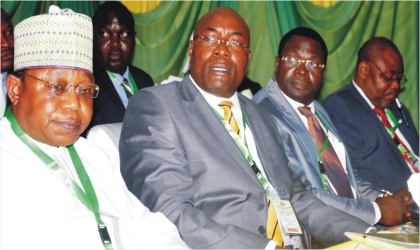
L-R: National President, Association of Non-Bank Micro-Finance Institutions of Nigeria (ANMFIN), Mr Hamid-Giwa Afolabi, National President, Co-operative Financing Agency of Nigeria (CFA), Mr Adebola Orolugbagbe, Vice Chairman, African Confederation of Co-operative Saving and Credit Association, Mr Bless-Kwame Darkey and Executive Director, Retail Banking, Unity Bank, Mr Ahmed Yusuf, at the National Co-operative Financing Agency of Nigeria Co-operatives summit and leadership forum in Abuja, recently.



Business
Jonathan, Diri, Others Laud Firm’s Milestone in Bayelsa …Says Project Will Drive Industrialisation, Create Jobs



-

 News2 days ago
RSG Targets Nine Million Residents in Mosquito Net Distribution Campaign
-

 Oil & Energy2 days ago
Aiyedatiwa Signs New Electricity Bill
-

 Maritime2 days ago
Marine Minister Commends President Tinubu On NPERA Bill Assent
-

 Oil & Energy2 days ago
NLNG Commissions Research And Innovation Centre In RSU
-

 News2 days ago
KenPoly Holds Eight Convocations, August 29
-

 News2 days ago
RSG Begins Another Phase of Projects Commissioning Today
-

 News2 days ago
RMAFC Completes Revenue Sharing Review, Proposes New Pay
-

 Maritime2 days ago
NAGAFF Petitions IGP Over Alleged Maritime Police Harassment