
Business
Finance Experts Meet To End Capital Flight

African Finance Ministers and Central Bank Governors met on Wednesday to discuss policies required to stop the excessive illegal flow of capital from Africa to tax havens around the world.
Financial experts said Africa lost 1.7 trillion dollars in capital flight between 1970 and 2010 through tax cheats.
According to the experts it stage-managed financial returns by multinational oil firms and funds spent on foreign universities and healthcare.
Prof. Leonce Ndikumana of the University of Massachusetts in the U.S., said the beneficiaries of Africa’s massive capital flight were mostly tax havens and regulators of the global financial system.
“In real terms, 39 African countries lost 1.3 trillion dollars but, together with interest earned over this period, the combined loss comes to 1.7 trillion dollars,” Prof. Ndikumana told The Tide source.
He said the huge amount of money lost by African countries through the illicit transactions had severe economic effects on the continent.
“These amounts reduce private investment, loss of tax revenue to finance public investment and they undermine governance by sending a negative message to the citizens,” the economics professor said.
Nairobi-based think-tank, the African Economic Research Consortium, convened the meeting to give the top finance sector policymakers an overview of the state of capital flight and explore ways to stop it.
“We have no time to lose. A sense of urgency is needed so as to make sure this time around; Africa is not waiting for better times.
“We have to build the better times now,” Carlos Lopes, Executive Secretary of the UN Economic Commission for Africa, said in opening remarks.
Lopes said measures, including coordination across boundaries within Africa and worldwide, were required to stop the outflow of cash from Africa.
He pointed out that most of the funds escaped through transactions conducted by a third country under the cover of financial secrecy before landing into a tax haven, beyond the reach of local financial regulators.
“Individual responses to capital flight is not adequate, not even the most developed countries with full fledge security systems,” the UN official said.

L-R: Lagos State Deputy Governor, Mrs Adejoke Orelope-Adefulire, Gov. Ibikunle Amosun of Ogun State, Gov. Babatunde Fashola of Lagos State, Former President of Georgia, Mr Mikheil Saakashvill, Chief Executive Officer, Standard Chartered Bank, Mrs Bola Adesola and Lagos State Commissioner for Budget and Economic Planning, Mr Ben Akabueze at the 7th Lagos Economic Summit Tagged ‘ehingbeti 2014’ in Lagos last Tuesday. Photo: NAN



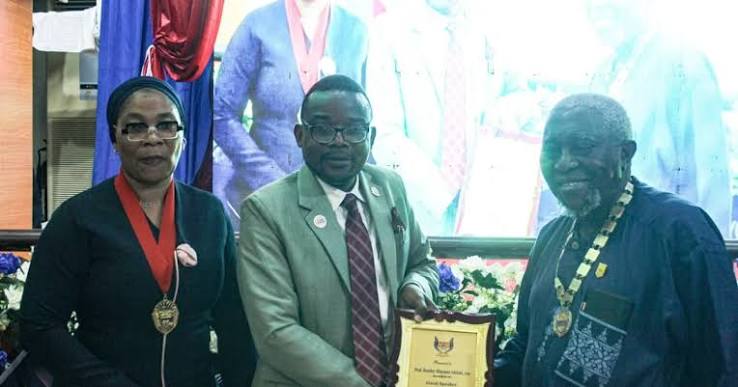
The NIM president also identified integrity, accountability, probity, honesty and efficiency as essential principles that needed to be strengthened in Nigeria’s workplaces and economy.
He argued that management failures extended beyond businesses to households and the wider society, making the promotion of sound management practices increasingly important.
Mustapha also renewed the institute’s call on the Federal Government to recognise 19 November as National Management Day, saying such recognition could strengthen its campaign for the United Nations to declare the date International Management Day.
The institute adopted 19 November for its annual celebration in 2016 to coincide with the birthday of Peter Drucker, widely regarded as the father of modern management.
Mustapha said the institute believed that official recognition by the Federal Government would strengthen its appeal to the United Nations to establish an international observance dedicated to the management profession.
The lecture featured Executive Director of the University of Lagos Business School, Prof. Sunday Adebisi, as guest speaker.
Other attendees included the Registrar and Chief Executive of NIM, Taiwo Olusesi, and a former president of the institute, Akinbayo Adenubi.

The Chief Executive Officer (CEO) of Moniepoint Microfinance Bank Babatunde Olofin, says transaction volume of the bank has hit one trillion naira daily.
Olofin said this at the unveiling of the bank’s North Central office in Abuja on Friday.
He said the bank also served a customer base of about 21 million and provided more than one million jobs in the country.
”Moniepoint is proudly Nigerian, owned by a Nigerian and managed by Nigerians.
?”With ?????????????????????our solid technologies and tailored-made products for businesses in Nigeria and retail customers as well, we are the bank to reckon with,” he said.
The CEO said the bank might be considering upgrade to a full-fledged commercial bank if the business required so.
According to him, this is a strategic decision which if the business requires it, we will communicate.
Fielding questions from newsmen, Edidiong Uwemakpan, the Vice-President Corporate Affairs of the bank, said the bank had been supporting agricultural activities to impact households.
”Moniepoint has always been hyper local and if you look at how we scaled our business, we understood how much Nigerians wanted to be able to interact with humans.
”From the very beginning, we built this distribution network of people that can be trusted, I think this is just an extension of our hyper-local strategy, getting closer to people,” she said.

-
News4 days ago
Parents Protest Scholarship Scheme Suspension At PAMO Varsity
-
 News4 days ago
US Hails Nigerian Military For Rescuing 125 Kidnap Victims
-
News1 day ago
Bayelsa Boat Mishap: Tinubu Donates N250m As Death Toll Hits 29
-
News1 day ago
Odu Pays Tribute To Late Chinwah, Describes Him As Courageous, Selfless Academic
-
Business4 days ago
Reps Raise Alarm Over N2trn Agricultural Loan Diversion
-

 Featured4 days ago
Presidents Xi, Trump, Putin Commit To Global Stability, Denuclearisation
-
Politics4 days ago
ADC Faults INEC’s Alleged Limited Capacity To Upload Election Result On IREV
-
Politics4 days ago
Tinubu Expands 2027 Campaign Tour To 19 States