
Nation
THE STATES

FCT
The President of Nigeria Union of Journalists
(NUJ), Mr Mohammed Garba, has called for improved funding of government owned media organisations.
Garba made the appeal when he paid a courtesy call on the Managing Director of the News Agency of Nigeria (NAN) Mr Ima Niboro.
He said adequate funding was necessary for the media to discharge their functions effectively, especially as the country prepared for the 2015 general elections.
According to him, proper funding of the organisations is also needed for balanced reportage.
Jigawa
The Village Head of Chai-chai community in Dutse
Local Government Area, of Jigawa State has commended the Education Sector Support Programme in Nigeria (ESSPIN), an NGO, for constructing borehole and classrooms in the area.
Muhammad made the commendation at the inauguration of the projects in the Community Primary school in Chai-Chai, Dutse.
He said that the provision of the borehole would enhance access to safe drinking water among people of the area.
He said that both the pupils and members of the community would benefit from the facility.
Kaduna
The Kaduna State Government, said it has awarded
contract valued at N100.9 million for the upgrade of electricity infrastructure at the Kaduna Dry Port.
The Commissioner for Rural and Community Development, Alhaji Abdullahi Ahmad, stated this in Kaduna at a ceremony marking the commencement of the project.
The project involves the construction of a 300KVA-Transformer sub-station, procurement of a 250KVA generator and construction of a generator house.
Ahmad also said that the money would be used to upgrade street lights in the port located at the Inland Containers Terminal, Kaduna.
Kano
The Kano State policing outfit, Hisba Board, said it had arrested 52 young women and men for allegedly engaging in prostitution and other immoral acts in Kano metropolis.
The board’s Director-General, Dr Abba Sufi, made the disclosure in an interview with newsmen in Kano.
He said those arrested were made up of 27 females and 25 males, adding that they were apprehended at the railway station and behind Magwan Water Restaurant in Kano metropolis.
The arrest was made following a raid by members of the board, he noted.
Kebbi
UNICEF has commended Kebbi State government for
paying its N158 million counterpart funding to curb malnutrition in the state in two years.
The UNICEF officer in-charge of malnutrition, Mr Stanley Okechukwu, made the commendation when he visited Gov. Saidu Dakingari of Kebbi State in Birnin Kebbi recently.
He also commended the state government for ensuring the treatment of 100,000 malnourished children and enabling the treatment of 600,000 more children against child killer diseases within the period.
Okechukwu described the efforts to fight such diseases as highly commendable and assured that UNICEF would sustain its support to the state.
Kwara
A housewife, Yetunde Afolabi of Osere area of
Ilorin, has prayed an Ilorin Area Court to dissolve her five-year-old marriage with Kunle Afolabi, because he publicly humiliated her.
Yetunde, 30, told the court that her husband was fond of tearing her clothes, making her naked before beating her in public, just to humiliate her.
She told the court that her husband was also fond of calling her names like “prostitute, dirty pig, and shameless person” in public.
“My husband has ridiculed me and soiled my personality to the extent that I am ashamed of moving freely in my neighbourhood,” she said.
Nasarawa
Governor Umaru Al-Makura of Nasarawa State
has said that in spite of his Deputy, Mr Damishi Luka, defecting to PDP, he will accord him his right as enshrined in the Nigerian Constitution.
Al-Makura made the statement in Lafia when commissioners in his cabinet paid him a solidarity visit at the Government House.
“Damishi Luka remains my Deputy and I am duty bound by the constitution to accord his office all its dues and entitlements,” Al-Makura said.
He, however, described “the defection as a tip of the iceberg of an onslaught orchestrated against the present administration in the state.’’
Niger
The Northern States Governors’ Forum has en
joined Christian faithful to use the Lenten season to pray to God for solutions to the socioeconomic and security challenges confronting the nation.
The Chairman of the Forum, Governor Babangida Aliyu of Niger, made the call on behalf of the group in Minna, in a statement signed by his Chief Press Secretary, Malam Danladi Ndayebo.
Aliyu urged Christian faithful to conduct themselves well during the season in order to maximise the spiritual and physical benefits inherent in the season.
He said that good intentions, prayers and firmness of purpose in the pursuit of good deeds were pre-requisites for reaping the benefits of the holy season.
Ondo
To achieve the 35 percent affirmative action on fe-
male representation in governance, the Ondo State Government has urged women to participate actively in politics.
The Ondo State Commissioner for Woman Affairs and Social Development, Yemi Mahmud-Fasanmi, made the call in an interview with newsmen in Akure.
“I urge the woman folk to come out; they should not fold their arms and be expecting good turnout in terms of their participation in politics.
Osun
The Osun State government said that it would spend
N2.6 billion on the ongoing rehabilitation of its water works at Ede town.
The General Manager of the Water Corporation, Mr Gbenga Owojuyigbe, disclosed the amount when the House of Assembly Committee on Water, Environment and Sanitation visited the corporation in Ede.
Owojuyigbe said the government had earlier spent N424 million during the first phase of the emergency rehabilitation of the water works.
Plateau
The Industrial Training Fund (ITF) has been charged
to create a curriculum that would help the youth think ‘outside the box’ instead of looking for paid jobs.
The charge was made in Jos by Sen. Musiliu Obanikoro, Chairman of ITF Governing Council, and Minster of State for Defence, at the 2013 Merit Award ceremony of the Governing Council.
“What we need is creativity; we, in the ITF must create a Nigerian dream that everybody will latch onto,” he said.
He said that President Goodluck Jonathan had already provided the right platform for creativity, adding that the Fund needed to be known internationally.
Sokoto
Sokoto State Zakkat and Endowment Committee has
facilitated the treatment of 526 mentally-ill persons at the Federal Neuropsychiatry Hospital, Kware, in February.
The Chairman of the committee, Alhaji Lawal Maidoki, who disclosed this while disbursing N56.5 million as donations to physically challenged persons in Sokoto, said N914,000 was spent on their treatment.
He said only 16 of the patients were admitted at the psychiatric hospital while the rest were out-patients coming for drug administration and counselling.
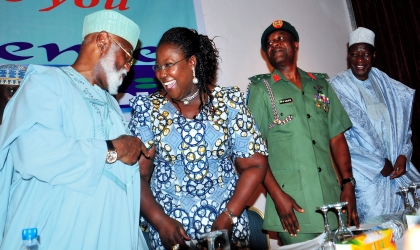
L-R: Chairman of the occasion, Gen. Abdulsalami Abubakar, representative of the governor of Rivers State, Mrs Ibim Semenitari, representative of Chief of Army Staff, Brig.-Gen. Olajide Lalaye and Chairman, Board of Peoples Media Limited, Malam Wada Maida, at the Peoples Media Limited conference in Abuja, last Thursday. Photo: NAN.




The Hydrocarbon Pollution Remediation Project (HYPREP) has commemorated the 15th anniversary of the release of the United Nations Environment Programme (UNEP) Environmental Assessment Report on Ogoniland, reaffirming its commitment to restoring the environment and improving the livelihoods of affected communities.
In a statement signed by the Project Coordinator, Prof Nenibarini Zabbey, to commemorate the anniversary, HYPREP described the anniversary as a significant milestone in Nigeria’s environmental restoration efforts, noting that the project has made remarkable progress in implementing the recommendations of the landmark UNEP report released on August 4, 2011.
The UNEP report had revealed extensive oil pollution across Ogoniland, severe environmental degradation, and serious public health risks resulting from decades of petroleum operations. It also recommended an initial $1 billion fund to commence the cleanup of the affected communities.
According to HYPREP, the Federal Government formally launched the Ogoni clean-up in 2016, while the Project Coordination Office was established in 2017 to drive the implementation of UNEP’s recommendations.
Zabbey said the current administration has continued to prioritise the project under the Renewed Hope Agenda.
Providing an update on the cleanup, the Project Coordinator disclosed that 30 of the 65 contaminated sites identified by UNEP have been fully remediated, while work is ongoing at several medium- and high-risk locations. It also stated that more than 1.5 million mangrove seedlings have been planted as part of what it described as the world’s largest restoration of oil-degraded mangroves, with over 1,000 hectares of shoreline already rehabilitated.
Zabbey further revealed that 49 Ogoni communities have been connected to potable water schemes through multiple water projects and booster stations aimed at providing safe drinking water across the region.
In the health sector, he said the 100-bed Ogoni Specialist Hospital in Kpite and the 43-bed Cottage Hospital in Buan are nearing completion, adding that several existing health facilities have been upgraded with modern medical equipment, while five ambulances have been donated to improve emergency healthcare services. The Project Coordinator also disclosed that a three-year human health biomonitoring study is being conducted in collaboration with the World Health Organization’s International Agency for Research on Cancer (IARC).
On economic empowerment, Zabbey stated that the Project has created more than 8,000 direct jobs and trained thousands of Ogoni youths and women in various vocational and technical skills, including software development, cybersecurity, aviation, commercial diving, seafaring, mechatronics, and creative arts. The project also reported awarding scholarships to more than 1,000 students, providing grants to small businesses, and supporting persons living with special needs through skills acquisition programmes.
The statement further highlighted ongoing legacy projects, including the Ogoni Power Project and the Centre of Excellence for Environmental Restoration, which it said is about 96 per cent complete. HYPREP also welcomed the recent designation of the Ogoni Wetland as a Ramsar Site of International Importance and pledged to continue promoting biodiversity conservation and sustainable management of the ecosystem.
Marking the anniversary, Zabbey said the progress achieved over the past 15 years demonstrates the collective commitment of government, development partners, stakeholders, and local communities to restoring Ogoniland. He called for renewed collaboration to sustain the cleanup effort, promote environmental sustainability, and support the long-term development of the region. 3
-

 News2 days ago
RSG Targets Nine Million Residents in Mosquito Net Distribution Campaign
-

 Oil & Energy2 days ago
Aiyedatiwa Signs New Electricity Bill
-

 Oil & Energy2 days ago
NLNG Commissions Research And Innovation Centre In RSU
-

 Maritime2 days ago
Marine Minister Commends President Tinubu On NPERA Bill Assent
-

 News2 days ago
KenPoly Holds Eight Convocations, August 29
-

 News2 days ago
RSG Begins Another Phase of Projects Commissioning Today
-

 News2 days ago
RMAFC Completes Revenue Sharing Review, Proposes New Pay
-

 Maritime2 days ago
NAGAFF Petitions IGP Over Alleged Maritime Police Harassment