
Politics
Sanusi And Politics Of Removal

Penultimate Thursday, the
unthinkable happened. The cerebral governor of the Central Bank of Nigeria (CBN), Mallam Sanusi Lamido Sanusi was suspended by President Goodluck Jonathan.
Sanusi who learnt of his suspension in Niamey, Niger Republic while attending a conference of the West African Currency Zone with other governors of the Central Banks in West Africa received the news of his suspension with a rude shock, just like many other Nigerians. He immediately returned to Lagos only to have his international passport seized by the officials of the Directorate of State Security Service (SSS). He has however, challenged his suspension in the court “to establish once and for all if the president has the powers to do what he had done.”
Sanusi told the cable news network, CNBN in Niamey that,“It has never been my desire to hold on to a job. However, I believe if the CBN governor cannot be removed from office, then he cannot be suspended. He can be qurried, but the exercise of the arbitrary decision to remove him must be challenged.
“If it is not challenged, then from now, the next CBN governor cannot be independent. He can be suspended for any reason, and the independence of the CBN would be totally undermined. It is important to establish the point legally whether this can happen. I do plan to ask the court to confirm if indeed, that authority exists. I will challenge it”.
The apex bank boss, according to the Special Adviser to the President on Media and Publicity, Dr Reuben Abati, was suspended because of his alleged financial infractions and recklessness as well as multiple cases of fraudulent practices. The CBN under Sanusi’s watch, was also accused of not maintaining proper book of accounts as prescribed by the International Financial Reporting Standards (IFRS). All these charges were based on the 2012 audit report prepared by the Financial Reporting Council of Nigeria (FRCN), whose existence is becoming known to millions of Nigerians for the first time.
The FRC’s report, which came to the public domain two days after Sanusi’s suspension, further recommended the sack of the CBN governor and his deputies to the President.
Although, the President was careful not to cite any constitutional provision in suspending Sanusi, perhaps knowing fully well that no such provision existed either in the constitution or the CBN Act to back his action, he nonetheless gave indications that his action did not infringe the law.
“There is absolute power by the president to suspend the CBN governor,” he said during a presidential chat last week.
Section 11(7) of the CBN Act, 2007 gives the president powers to remove the CBN Governor, but with a proviso that such removal must enjoy two-third majority approval of the Senate. The Act does not however, contemplate suspension.
Although the President has denied the allegations of political witch-hunt against the CBN governor, the suspension, coming at a time when Sanusi’s weighty allegations against the Nigerian National Petroleum Corporation (NNPC) are still being investigated may likely taint whatever reasons the President adduced for his action.
Sanusi had written to the President accusing the NNPC of not remitting $49.8billion (about three times the nation’s annual budget) to the Federation Account. He, however, later told the Senate Committee investigating the allegations that the unremitted amount was actually $20billion and not $49.8billion earlier mentioned, blaming the CBN’s Reserve Department for misleading him.
Sanusi’s whistle-blowing and his sustained public attacks on the NNPC, widely seen as a conduit pipe and the epicenter of corruption in Africa’s top oil producer, has earned him powerful enemies within government circle.
The unprecedented nature of the CBN governor’s suspension, in the history of Nigeria and perhaps that of most countries of the world, has however, divided the nation along its main fault lines-political, ethnic and religious lines, with the former (politics) appears to be playing a dominating factor.
While government apologists, made up of mostly members of the ruling Peoples Democratic Party (PDP) supported Sanusi’s suspension and argued that only few government would have tolerated Sanusi’s arrogant personality and the ‘defiance’ he applied to his brief as CBN governor; critics of Jonathan’s administration, especially the main opposition party- the All Progressives Congress (APC) dismissed the suspension as a political malice, saying it was sheer disrespect to the rule of law and a show of impunity and ingratitude that a person who has brought about sweeping revolution in the banking industry and who should have been commended for exposing the rot in the oil industry could be so vilified.
The House of Representatives fired the first salvo and perhaps set a stage for what has become a political mudslinging among the nation’s major political players.
Shortly after the news of Sanusi’s suspension hit the air waves, the House of Representatives rejected the suspension. Apparently embittered by what the legislators perceived as selective implementation or non-compliance with its resolution against some public officers over corrupt practices, the House mandated its committees on Justice, and Legislative Compliances to compile all resolutions that have indicted any public officer for which President Jonathan had refused to act on, and therefore requested the President to act on them with immediate effect.
The decision which was taken after adopting a motion moved by the Minority Whip, Samson Osagie, was however, preceded by sharp division between APC and PDP members in the House. While the PDP members were in support of the suspension, their counterparts in the APC described the suspension as unconstitutional and antithetical to the nation’s economy more so at a time when the CBN governor raised some concerns about missing funds.
Similar scenario played out at the Senate with the PDP members which constituted the majority voting in support of the suspension and the APC members rejecting the measure.
Acting on an already set stage by their members, the two leading parties in the country toed the party lines in their separate responses to the suspension.
The APC accused the presidency of campaigning to malign Sanusi, using the report of “obscure” Financial Reporting Council (FRC). It also accused President Jonathan of seeking to use the suspension to divert attention and thereby sweeping the alleged $20billion NNPC missing funds under the carpet and punishing Sanusi for daring to expose the alleged fraud.
In a statement issued by the APC Interim National Publicity Secretary, Alhaji Lai Muhammed, the party said, “Irrespective of the tepid and unconvincing denial by the presidency, it is clear that the main reason the presidency moved against Sanusi is because he blew the lid on the $20 billion funds, which the NNPC allegedly failed t o remit to the Federation Account.
“Fortunately, discerning Nigerians are not hoodwinked by the presidency’s choreographed mudslinging against a whistle blower, and the sponsored campaign that amounts to shooting the messenger just because his message is not palatable”.
The PDP in its own reactions, described Sanusi’s suspension as long overdue. It justified both the suspension and the President’s powers to do so, saying he who hires has the power to fire.
The same political mudslinging dominated the reactions of the two factions of the Nigeria’s Governor Forum. While the faction led by the Rivers State governor, Chibuike Amaechi and made up of mostly APC governors, condemned the suspension and called for the forensic audit of NNPC’s account as a way of confirming or refuting Sanusi’s allegations, the Jonah Jang’s faction comprising mainly of PDP governors and Jonathan’s loyalists, lent its support to Sanusi’s suspension, and accused Amaechi’s NGF of playing out APC’s script.
Meanwhile, the Kano Emirate Council, in a statement signed by the Galadima Kano, Alhaji Tijani Hahim, believed Sanusi’s suspension was a deliberate attempt to witch hunt a whistle blower who exposed a monumental fraud in the NNPC.
“As the President has suspended the governor without the recourse to the rule of law, we believed it was a deliberate attempt to witch-hunt him. It is a desperation and impunity at the highest level by the Federal Government,” the council said.
On its own, the Arewa Consultative Forum (ACF) at the end of its emergency meeting last week, cautioned the Jonathan’s government against any harm befalling Sanusi.
Although the presidency wears Sanusi’s sack the gown of a suspension, everything surrounding the suspension indicates the dismissive tone of a sack. In a similar guise of suspension, Justice Ayo Salami (retired) was removed as the President of the Appeal Court by President Jonathan and was not reinstated despite the reinstatement order by the National Judicial Council (NJC).
As a newspaper columnist, Idowu Akinlotan noted recently, “not only was the former CBN boss removed, his temporary and permanent replacements were hastily named with temerity that reeked of political insensitivity and unconstitutionality, and with such absolute lack of grace and class that leaves one wondering how it was possible for Dr Jonathan to demean the Nigerian presidency to such level of pettiness.”
Many questions are however, begging for answers regarding Sanusi’s suspension. Notwithstanding that the presidency hanged the suspension on FRC’s report which indicted the CBN boss of financial misconduct, why did the presidency take this long to fire Sanusi, when the FRC’s report had been submitted to the President since June, last year, if truly the suspension was not connected with the president’s exasperation, arising from the disquieting concern Sanusi raised about financial improprietness in the NNPC? And why did the President spare the NNPC Group Managing Director, Andrew Yakubu and Minister of Petroleum Resources, Diezani Alison-Madueke whose agency and ministry are also under investigation? Why didn’t the President also suspend the CBN deputy governors who were also recommended for sack by the FRC? Why did the President not implement several other reports that called for the removal of certain officials of government that were indicted?
While it may take Sanusi more than a mere judicial discharge and acquital to convince his traducers that his integrity is not sullied by any financial impropriety and brashness, it will also take President Jonathan more than a FRC’s report to justify that Sanusi’s suspension was not due to his poking a finger in the President’s eye in the course of allegations against NNPC.
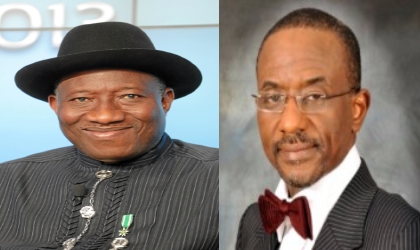
President Jonathan and Sanusi Lamido Sanusi
Boye Salau




The Independent National Electoral Commission (INEC) has extended the deadline for political parties to submit the list of candidates for the 2027 governorship and state Houses of Assembly elections from Saturday, August 8, to Tuesday, August 11, 2026.
The commission announced the extension in a statement issued on Saturday and signed by the National Commissioner and Chairman of its Information and Voter Education Committee, Mohammed Haruna.
According to INEC, the decision followed appeals by political parties for additional time to complete the submission process through the dedicated online portal.
“The submission window, which according to the revised Timetable and Schedule of Activities for the General Election was originally scheduled to close on Saturday, 8th August, 2026, has been extended to Tuesday, 11th August, 2026,” the commission said.
In a a related development, INEC announced the suspension of PVC collection in Osun State ahead of the August 15 governorship election.
The commission said voters who applied for replacement of lost, damaged or defaced Permanent Voter Cards would have until midnight on Sunday, August 9, to print downloadable copies of their cards.
The electoral body explained that the deadline was necessary to enable it compile data on downloaded PVCs and produce final statistics on the total number of cards collected ahead of the election.
INEC said PVC collection in Osun commenced at the Registration Area level from July 22 to 28, 2026, but was extended to July 31 following complaints about large crowds and difficulties experienced by voters at collection centres.
The exercise subsequently moved to the local government level and ran from August 1 to 7.
The commission also disclosed that replacement downloadable PVCs had been made available to voters in Odo-Otin and Ife Central Local Government Areas following the theft of cards during attacks on the two collection centres.
It stressed that the stolen cards could not be used to vote.
INEC reassured Osun residents of its preparedness for the August 15 governorship election.
“The commission reiterates that the stolen cards cannot be used to vote.
“INEC reassures the people of Osun State of its readiness to conduct a free, fair, credible and inclusive governorship election on 15th August, 2026,” the statement said.
The commission said the deadline, initially set for Saturday, 8 August, has been extended to Tuesday, 11 August 2026, following appeals from political parties for more time.
INEC also announced that the window for voters who applied to replace lost, damaged or defaced PVCs to download their replacement cards will close at midnight on Sunday, 9 August.
The move is to enable the commission compile final PVC collection figures ahead of the 15 August Osun governorship election.
INEC said replacement downloadable PVCs have also been provided to affected voters in Odo-Otin and Ife Central Local Government Areas after hoodlums carted away cards from two collection centres, stressing that the stolen cards cannot be used to vote.
The commission reaffirmed its readiness to conduct a free, fair, credible and inclusive election in Osun State.
Gov. Kefas made the remarks over the weekend at the Federal Medical Centre (FMC), Jalingo, during the flag-off of the second phase of the Renewed Hope Medical Outreach in Taraba State, organised as part of activities marking Prof. Yilwatda’s 58th birthday.
The governor commended Prof. Yilwatda for choosing to mark his birthday by providing medical care to people in need.
“What Professor Nentawe did is a powerful demonstration of what leadership should be,” Gov. Kefas said.
He assured that his administration would continue to support initiatives that complement government efforts to improve healthcare delivery and the wellbeing of residents.
Speaking at the event, Prof. Yilwatda called on Nigerian leaders to embrace the culture of giving and use their positions to touch the lives of the less privileged.
He said his decision to celebrate his 58th birthday in Taraba State was deliberate and informed by the needs of underserved communities, particularly people who face difficulties accessing healthcare because of distance and financial constraints.
According to him, the intervention followed a needs assessment and was extended across the three senatorial districts of the state.
He said the exercise commenced on August 3 at Takum General Hospital and covered the Federal University Teaching Hospital, Wukari; First Referral Hospital, Sunkani, Ardo-Kola Local Government Area; General Hospital, Bali; General Hospital, Gembu; and FMC Jalingo.
Prof. Yilwatda said the intervention provided medical services to thousands of beneficiaries, including people who required surgical procedures.
He said sustainable national development could only be achieved when strong institutions placed Nigerians at the centre of development.
“Leadership is about service,” he said, urging political and public leaders to make giving back to society an important part of their responsibilities.
He reaffirmed his commitment to serving Nigeria and its people, saying his personal vision was to make every day of his life useful to humanity.
“Every day that I live, the vision is: let it be useful to humanity,” he said.
The Taraba State Commissioner for Health, Dr. Bordiya Buma, commended the initiative, saying it was consistent with the Renewed Hope agenda and efforts to strengthen healthcare delivery in the state.
Dr Buma said the second phase followed the successful completion of the first phase, which was conducted simultaneously in six local government areas, with two LGAs selected from each of the three senatorial districts.
According to him, more than 10,000 patients were attended to during the first phase, including people with medical and surgical conditions.
He disclosed that 327 general surgeries, 71 eye surgeries and 575 dental procedures were carried out during the exercise.
The commissioner expressed appreciation to President Bola Tinubu for the Renewed Hope Medical Outreach and thanked Prof. Yilwatda for supporting the initiative and choosing Taraba State as a beneficiary.
The Minister of Health and Social Welfare, Prof. Muhammad Ali Pate, also commended Prof. Yilwatda for choosing Taraba State to mark his 58th birthday through a medical outreach.
Prof. Pate said making healthcare the centrepiece of the birthday celebration was significant because health affects everyone.
-

 News2 days ago
RSG Targets Nine Million Residents in Mosquito Net Distribution Campaign
-

 Oil & Energy2 days ago
Aiyedatiwa Signs New Electricity Bill
-

 Maritime2 days ago
Marine Minister Commends President Tinubu On NPERA Bill Assent
-

 Oil & Energy2 days ago
NLNG Commissions Research And Innovation Centre In RSU
-

 News2 days ago
KenPoly Holds Eight Convocations, August 29
-

 News2 days ago
RSG Begins Another Phase of Projects Commissioning Today
-

 News2 days ago
RMAFC Completes Revenue Sharing Review, Proposes New Pay
-

 Maritime2 days ago
NAGAFF Petitions IGP Over Alleged Maritime Police Harassment