
Connect with us

Women

Whither The Family Values?

Published

on

Children are the future
leaders of any soceity,” therefore, a broken soceity traces its decay to the family.
The family as the strength and pillar of every society is known for good moral which is usually inculcated from one generation to another through the children and even to the children unborn. It is the primary responsibility of every parent to ensure cultural values of societies do not go  extinct. The family is highly regarded because character and societal value are molded from infancy. Morals and good values are passed on to the children through their parents and such trait is maintained  in building a habitable society.
Today, the rate of moral decadence is so alarming that one begins to wonder where the family is heading for.
In Nigeria, each ethnic group is known for their peculiarities which is not devoid of respect, good ethics, holding of  cultural values in high esteem, hospitality, respect for elders, loyalty to authorities, adherence to parents’ training, exemplary living, obedience to parents decissions, adherence to societal rules and regulations.
Disappointedly, twenty-first century families have witnessed pains in homes, different levels of immoralities, disrespect to elders, and disobedience to societal laws. This is simply becaus the family has failed in its core role of molding lives and values. Everything is shifted to the ¢hurch as the quest for wealth acquisition, education, career building, politics, has replaced the importance placed on family values in Nigeria.
However, we are today faced with a society where family values are irrelevant, culture is no longer vital, internet has replaced every importance of  cultural inclination that is imbibed in people as they grow and receive training from their family starting from the cradle. We are now battling with the devastating negative influence brought to us by popular culture not only that the magnitude and approach employed the cable stations is encouraging the popular culture in strengthening their channels by capturing our airspace, dictating for us and our families what food we should eat, what:we should wear as in being trendy (fashion) , what language we should speak what our manners should look like, how we analyse issues of importance and things like that.
It is disheartening to note that with all the decadence going on, no attention or measure is put in.place to check the situation.
As each.day passes by, we are faced with more and more decay which springs from the lapses the family has created, degenerating into the larger socicty thereby resulting in high crime rate and corruption in all sectors of our economy and government.
Instead of sitting back to strategise ways of curbing our dilemma, we abandon it for more wealth pursuit while we fold our arms and watch the crime rate escalate in a geometric progression on daily basis.
It is no longer news that children cannot speak their dialect, even those leaving in state capitals of their own states cannot speak their own dialect fluently and one may begin to wonder, what will become of this nation Nigeria in 20years to come if parents still treat this decadence with laxity?
The twenty first century generation needs to be called back to order and the ball is in the court of the family to repair the damage done already. The family is the smallest group out of the larger society and if things are not properly done; we would keep suffering the crime which is usually the resultant effect of family negligence which spreads to the society at large.
We need to restructure our homes by having consistent family meetings starting from the nuclear families of just the father, mother and the children, to the larger family.
There is an urgent need to bring order and sanity to our homes. We all have a part to play if we must enjoy our old age. If we ignore these family values the way it was passed to us by our own parents, grand-parents, when men treasured culture and family values, posterity will definitely ask us and certainly, we will be held responsible for whatever harm our laxity causes in the future.
Moreso, if we keep quiet and feel it’s not our business  we will be like Eli, of the Bible story, who reaped the consequence of his children’s misbehaviours simply because he kept quiet where he was supposed to and ofcourse the resultant effect was more damaging than anticipated.
In looking at this repair of family values, we must understand that children learn by example. We only make impact if we can make out time to stay with them regularly to instruct, teach and correct, not leaving them in the hands of house helps just because our work do not permit us spend quality time with them. We must choose which is more essential to us, our children or our jobs and career?
We can only make huge sacrifice if we see the need to be responsible for our families individually and collectively as a society. We will never cease to appreciate our parents who had many children and, yet they were able to nurse, carter and stand by us, made themselves avaialble at all times.
Perpahs we need to imagine what would have become of us if they had abandoned us the same way we are handling our own children today.
To all and sundry, espeically thos that are hoping to have family they would call their own it is a clarion call to  note  that family does not just end with marriage to a heartthrob or to the love of one’s life as we proclaim, it does not also end in producing children because one is fertile and productive. it does not end at having the money to take care of a woman and do the necessary traditional rites.
Marriage is a full responsibility that everyone who ventures into is held bound to make it work by seeing that the society which is the identity of every individual does not fail because of craze and quest for money and career.
All hands must be on deck to ensure we build a better future for our soceity. It is pertinent, therefore, to fight the raging negative influence popular culture now has on us.
The harm of cultural decadence is numerous. The incessant increase in co-habitation among young people especially in our tertiary institutions cannot be over emphasized. Parents lose their children quarterly to the young boys who impregnate them.
No  child who receives proper home training would think of living with a boy or even a man who has not paid her bride prize, but, the lapse has been created by popular culture and young people now see this trend as a norm to live together without the knowledge of their parents on campuses, even in cities like Lagos, Portharcourt and every other major city in our country Nigeria.
Parents may not understand the magnitude of co-habitation in our campuses, but the truth is that it has become a trend that when anyone of both sexes says he or she doesn’t have a boy friend among their peers, they make mockery and caricature of such one whereas, where values are cherished and upheld, such can never be any issue of contention because, children raised in a family with good values always have at the back of their mind that it is not in any way allowed or permitted to live with anyone, man or woman where all the necessary traditional rites are not conducted and completed.
Personal hygiene is an aspect that is totally lacking in this generation of children. This is simply because, parents surround their children with numerous house helps, some families have as many as six maids and house chores are shared among them and the children just fold their hands on their laptops, keep surfing the net, pinging, browsing from one social media to the other and watching all manner of nude pictures and all manner of horror films, at the end, we see where rape, incest has become a life style in homes with or without the parents idea.
Parents have refused to monitor their children because of the free hand and internet access available at their disposal.
However, we can still revive our family values if we see the need to take up certain jobs that can allow us stay close to our children like teaching and entrepreneurship. The media also has a huge role to play in re-orientating people especially, the electronic media through play-lets, dramas as were seen in the days of Zebudiya. There is the need to create programmes that are family value – oriented for a better society and schools from primary school should review their curriculum and programme in such a way that various channels should be used to impact on the lives of these young ones.

Njoku resides in Port Harcourt
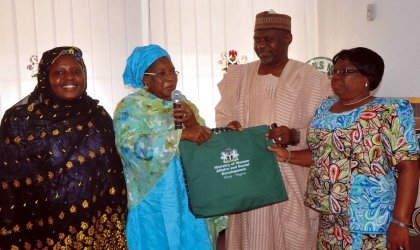
 

L-R: Permanent Secretary, Ministry Of Women Affairs, Hajiya Habiba Lawal; Minister of Women Affairs, and Social Development, Hajiya Zainab Maina; Head of The Civil Service of The Federation, Alhaji Bukar Goni-aji And Permanent Secretary, Ministry Of Tourism, Culture And National Orientation, Mrs Nkechi Ejele, During A Courtesy Visit By The Head of Service To The Minister Of Women Affairs In Abuja, yesterday.

L-R: Permanent Secretary, Ministry Of Women Affairs, Hajiya Habiba Lawal; Minister of Women Affairs, and Social Development, Hajiya Zainab Maina; Head of The Civil Service of The Federation, Alhaji Bukar Goni-aji And Permanent Secretary, Ministry Of Tourism, Culture And National Orientation, Mrs Nkechi Ejele, During A Courtesy Visit By The Head of Service To The Minister Of Women Affairs In Abuja, yesterday.

Chidima Njoku

Continue Reading

Women

Nigerian Women And Dividends Of Democracy

Published

on

 Recently a gathering of women from all parts of Nigeria took place at Moshood  Abiola National Stadium in Lagos geared towards advancing women’s empowerment.
It was tagged: “10 Million Women Empowerment Mega Rally 2026”. It was a historic event.
 There was a full-capacity attendance at the rally, with not less than 100 participants from each of the 36 states of the federation, despite the significant logistical challenges and costs involved.
The theme was:  “10 Million Women, One Movement, One Voice, One Goal,” and was described by stakeholders as an unprecedented gathering in Nigeria’s history. The event marked a strategic shift from symbolic participation to substantive empowerment and representation of women at all levels.
During that event, the First Lady and wife of the Governor of Rivers State, Her Excellency, Lady Valerie Fubara’s dedication to women’s empowerment was rooted in a clear vision: to strengthen women’s economic independence, educational advancement, and leadership capacity, ensuring that no woman was left behind.
Her consistent display of compassion, humility and service to humanity, particularly to women at the grassroots, has set a benchmark for first ladies across the country.
The rally stood as a testament to the power of collective female mobilization.  She was described as a pillar of support for the advancement of peace, progress, and development among women.
The rally was to make a national impact and to have a strategic vision for Nigerian women.
In a keynote address at the rally, the National Convener of the  10 Million women empowerment mega rally initiative and Honourable Minister of Women Affairs, Hajia Imaam Sulaiman-Ibrahim, described the rally as a “defining moment”for Nigerian women and a transition from mere political participation to active leadership and influence.
The Minister outlined the initiative’s core objectives to include: Presentation of the Women’s Charter for National Development, to promote increased political and economic inclusion of women, Grassroots Integration Framework, to connect women’s groups across all 9,410 wards in Nigeria and tangible empowerment programmes, including the symbolic distribution of tricycles, hair dryers, and sewing machines to beneficiaries.
She reaffirmed the federal government’s commitment to placing economic resources directly in the hands of women through targeted interventions that create jobs, provide business support, and expand access to skills training.
The Minister also expressed appreciation to Nigeria’s First Lady, Senator Oluremi Tinubu, for her maternal leadership and unwavering support for the initiative, as well as to the wives of state governors whose contributions were instrumental to the programme’s success.
The 10 Million Women Empowerment Mega Rally 2026 signalled a new era where Nigerian women are not only participants in national development but active shapers of policy and progress.
That rally for me was not a mere one. I think that that rally may have been a kind of reminder to both the women and all stakeholders that women are prepared to get involved in politics when given the opportunity.
Such rally could also have served as an avenue to let the women know that they can.
During the  former President Olusegun Obasanjo’s tenure, women were represented in governance. Dr. Ngozi Okonjo-Iweala was the coordinating minister and minister of Finance and later served as minister of foreign affairs,  Dr. Obi Ezekwesili was minister of education. Late Dora Akunyili served as minister of information after serving as chair of National Agency for Food, Drugs Administration and Control (NAFDAC).
Boma Jack, a Rivers daughter, was the minister of culture and tourism under that administration.
Dr. Kema Chikwe was appointed minister of transport, minister of Aviation and Aerospace and later, National Women Leader of a political party, Peoples Democratic Party (PDP).
Rivers State has produced two powerful and qualified deputy governors, Dr. Ipalibo Harry-Banigo, who is currently representing Rivers South West Senatorial District. Another is Prof. Ngozi Nma Odu, the deputy governor of Rivers State.
Prior the 2015 electioneering period, the former First Lady of Nigeria, Dame Patience Jonathan, PhD, during each gathering of women would always go by their slogan: “Can we?” And women would say:”Yes we can”.
She championed the course of women attaining the 35% affirmative action. To a large extent, it was realistic. Women all over Nigeria were carried along in politics. Many states of the federation had female deputy governors.
There was a particular rally that brought women from every part of the country as they converged on Abuja. That rally had the likes of Prof Dora Akunyili  of blessed memory, Josephine Aneni, just to mention but a few.
I remember when late Akunyili said:”if a man is the chairman of a local government, a woman should be the vice. If a man is a governor, the woman should be the deputy, and so on. Their message then was clear. They clamoured for creation of appointive and elective positions for women in Nigeria.
Of course women can. Those who at one time or the other were given opportunity to vie for elective positions and or appointed into positions of authority have done well.
Many women became deputy governors, vice chairmen, some were elected into state Houses of Assembly, House of Representatives and the Senate.
Nkeiruka Onyejocha represented Isuikwuato/Umunneochi Federal Constituency of Abia State in the House of Representatives and  currently, Minister of State for Labour and Employment.
Uche Ekwunife was a member of House of Representatives and later represented and recently a Senator representing the people of Anambra Central Senatorial District.
Hon Blessing Onyeche Onuh was elected and is representing Otukpo/Ohimini Federal Constituency of Benue State in the House of Representatives.
Senator Natasha Apoti-Uduaghan,  represents Kogi Central Senatorial District. Her performance in representing her people is second to none. In fact, what she has done is worthy of emulation.
These and many are interested in participating in politics despite the knocks they receive from their counterparts.
Some stakeholders have come to say that Nigerian women at this time in history deserve full inclusion in politics rather than agitation for special seats in the National Assembly.
During the Pan Niger Delta Forum  (PANDEF) women conference that held in Yenagoa, recently,  women from the Niger Delta region were asked to demand total freedom to participate in politics because they do not deserve to be treated as second-class citizens.
What happens in other countries of the world can also happen in Nigeria as regards women.
Reports have it that women in Britain do not have special seats in parliament as well as America. Their own  system flows and recognises them, and women participate fully in politics. Nobody talks about special seats or women being under-privileged there. It can be done in Nigeria.
Nigerian women are very intelligent and are active in politics. They are also very active in their various professions. So, why are they asking for special seats?
Women across the world participate and become members of parliament, governors and presidents. Nigeria should not be an exception.  The system should cover women.
As elections are coming next year, efforts to get more women integrated in politics in Nigeria should be intensified.
 Bring in more women into governance either in the state executive, the state Houses of Assembly, House of Representatives and the Senate.
In  previous elections, there were situations where about 10 women would contest in various positions in some states, be it states or national assembly, but less than five of them would emerge winners.  Most of those positions are dominated by the males.
A lot of problems are hindering Nigerian women from full participation in politics. Some of the problems range from competition from the opposite gender since it is assumed that women are weaker in nature.
Sometimes, the problem is even coming from fellow women. Nigerian women need full  support and encouragement from their folks.
Family pressure is also one of the problems affecting women from participating fully in politics.
The quest for women’s participation in politics clearly means that women’s education does not end in kitchen.
As Nigeria marks 27 years in her return to democracy, it should be noted that women’s involvement and contribution can never be overemphasized.
Eunice Choko-Kayode
Continue Reading

Women

Rivers Women And Democracy 

Published

on

Since the return of democracy in Nigeria, in 1999, women have really been carried along in politics. Although their involvement may not have been enough, but it has gone a long way to showcase their intellectual ability towards the socio-political development of the various states and Nigeria at large.
Women were carried along during the President Olusegun Obasanjo’s tenure when his late wife, Stella Obasanjo championed the course of Nigerian women.
Within a very short time in office, the wife of late President Musa Yara’dua also contributed to the welfare of women.
Contribution made by Mrs Patience Jonathan, who became the First Lady of Nigeria went a long way to empower women who have done well. She advocated for 35 Affirmative Action for women during her husband, former President of Nigeria, Dr. Goodluck Jonathan’s tenure, since then, women have got more appointive and elective positions especially in Rivers State.
As a Rivers daughter, her contribution towards the emancipation of women in Rivers State was enormous as well as Nigeria in general.
Indeed, as governance continued, various state government including Rivers heeded the call of involving more women in governance.When you talk about how well Rivers State has done since its creation 58 years ago in relation to women, I can say that it has produced capable persons who have served and are still rendering quality services wherever they found themselves.Since its creation on May 27th, 1967, the role of women in the development of the state can never be over-emphasized.
The story of politics, governance and democracy in Rivers State cannot be complete without recalling the impact of women.
Rivers has produced Justice Mary Odili, a retired Supreme Court Justice. She is an eminent jurist. She was the deputy chairman of the National Judicial Council (NJC) and served as deputy to the chairman (Chief Justice of the Federation) at the nations apex judicial commission.Justice Odili was also President of the National Association of Women Judges (NAWJN) and chairperson of the Body of Benchers, where she led the pioneering reforms such as retooling the legal practitioners Disciplinary Committee by constituting three panels, thus expediting their processes and ensuring efficiency and reviving the body of benchers mentoring programmes for all young lawyers.
She is being celebrated to day not just for her outstanding achievements in her calling but especially for her work in uplifting the down trodden and providing succour to the needy.
During the administration of Governor Peter Odili in Rivers state, Justice Mary Odili’s gesture in terms of community development programmes AND RELIEF EFFORTS WERE SECOND TO NONE. As the First Lady then, she initiated programmes that have direct bearing on youths and women. One of them was The Adolescent Project (TAP), where education, health improvement, social rehabilitation and empowerment services to vulnerable ADOLESCENT GIRLS were advanced.Over 500,000 citizens were directly impacted and which went on to win the Global Health Council Award for Safe Motherhood in Washington DC in May 2001. In fact, she is an esteemed jurist.
She was the Pro-Chancellor and chairman of council of Rivers State university.
Rivers State government became women-friendly to the extent that it got a woman as a Deputy Governor.
The return of democracy in Nigeria in general and Rivers State in particular, brought good news to women. A lot of women formed and made up the cabinets in many states. Women were elected and appointed into various levels of governance.
Dr Ipalibo Harry-Banigo, a distinguished Senator of the Federal Republic of Nigeria, was a civil servant in the Rivers State Civil Service. She was the Secretary to Rivers State Government (SSG)/ Head of Service during the military era. When the two positions were separated, during Dr Peter Odili’s government, she served as the Secretary to the State Government (SSG).
For us in Rivers State, it was a new dawn when the first female Deputy Governor was elected in 2015, since the creation of the state. After the general election In 2015, the medical doctor by profession was elected the first female deputy governor of the state. This was one of the signs of the dividends of 35% Affirmative Action championed by Nigerian women. It was a testament that women have really been liberated. It was also a sign that women’s education does not and can never end in kitchen.
Dr. Banigo successfully served as deputy governor of Rivers State from May 29, 2015 till May 29, 2023 under the administration of Governor Nyesom Wike.
In 2023 general election, she was elected into the Senate to represent Rivers West Senatorial District. This is laudable as a female from Rivers State is in the Red Chambers to speak for the interest of her people.Dr. Harry-Banigo is the chairman, Senate Committee on Health.
History was made as another female deputy governor was elected into office in Rivers State, because of course, the first performed well. Professor Ngozi Nma Odu, is the second female deputy governor Rivers State has produced. What some states have been yearning for without success. A seasoned administrator, she has been a pillar to the current administration. Her support to the current administration of the state governor, Sir Siminalayi Fubara, is what citizens of Rivers State deserve.
Rivers women are proud to have such personality as it is one of the best things that has happened in the history of Rivers state, women are optimistic that her wealth of experience will be brought to bear. Prof. Ngozi Nma Odu, a university don, assumed duty as Deputy Governor of the State, from May 29, 2023. Expectations are high as she will bring her wealth of experience into governance.
Prof. Odu is not new in the political development of Rivers State. She had served as Commissioner for Education during which her contributions to the development of education were second to none. In an agency that protects the rights and interests of women nationwide, she was the president of National Council of Women Societies (NCWS.
As Nigeria and indeed, Rivers State mark another year of democratic dispensation, the contribution of women in the development of the state can never be over-emphasised.Rivers women have made tremendous efforts in contributing in various fields of endeavour and their contributions have led to the rapid growth through politics, sports, education, judiciary, social, economic, medicare and engineering, just to mention but a few.
Indeed, since the creation of the state, it has not been a male dominated issue, women too have been given the opportunity to play key roles in their own little way.
Today, one cannot talk about women who made impact in the history of the state without mentioning Hon Justice Mary Odili, who served in Rivera State as a Judge. She also served in the Appeal Court. She rose to the peak of her profession in the Judiciary as the Justice of the Supreme Court (JSC).
Daisy Okocha served as Chief Judge of the state. Since the creation of Rivers State, she was the seventh judge and a woman to serve in that capacity.
Elsie Nwanwuri Thompson was a Judge of the High Court of Rivers State and Deputy Vice President of the International Federation of Women Lawyers (FIDA). She was the first Nigerian to be elected to the African Court on Human and People’s Rights.
A landmark in the educational sector of Rivers State cannot be complete without looking at the contribution of the pioneer Vice Chancellor of Ignatius Ajuru University of Education, Prof. Rosemund Dieye Green-Osaghogulu (blessed memory).It was under her supervision that the official approval of the institution, Rivers State College of Education (COE), was renamed Ignatius Ajuru University of Education (IAUOE).
In the administration of Old Rivers State, the first female commissioner, Constance Sarowinyo was appointed to oversee the affairs of higher education and later appointed as commissioner for economic development and planning. During her time at the helm of affairs of Information ministry in the state, the three arms of government media organisations, Rivers State Television (RSTV), Radio Rivers and Rivers State Newspaper Corporation (RSNC) got the best.
As Rivers State continued to grow after its creation, more women were given the opportunity to serve in various capacities.
 Medline Ngo Tador was appointed Commissioner for Information and Culture under Captain Sam Ewang. She also served as Commissioner for Women Affairs and Social Development between 1997and 1999.Mrs Julie Wika was appointed Commissioner for Women Affairs and Social Development.
Under Dr. Peter Odili’s administration as governor of Rivers State, Mrs Tolu Ofili was appointed Commissioner for Women Affairs in 2003 after serving as Senior Special Assistant, special duties, in charge of social services in 2000.
Another woman who was in that cabinet was Ms Gloria Fiofori. She served as Commissioner for Women and Youth Affairs. Her resume became richer as she served as the Director, National Orientation Agency, NOA. For the first time in the history of Rivers State, a female was appointed Commissioner for Works, which is termed to be a male-dominated ministry. She is in the person of Okpete Ovai. She obtained an MSC in Mechanical Engineering.
An erudite scholar and academic, Prof. Mildred Amakiri was appointed Commissioner for Higher Education during Dr. Peter Odili’s administration. One of Rivers daughters who served for a long time in the development of Rivers State was Prof Roseline Konya. She served as chairman, Civil Service Commission. One of the impacts she made was re-instating of 200 civil servants whose appointments were erroneously terminated at that time. A university don, she also served as Commissioner for Environment in which her contribution helped in sanitising the state of environmental hazards as a result of activities of illegal refining of crude oil in Rivers State.
Still under Dr Odili’s administration, a woman was appointed Attorney-General and Commissioner for Justice. She was Dame Aleruchi Cookey-Gam. She also served as Secretary to the State Government. She was appointed the Sole Administrator, Greater Port Harcourt Development Authority. Dame Alice Lawrence Nemi, a lawyer, became Commissioner for Education.
Mrs Joeba West was for Women Affairs and Patricia Simeon Hart for Water Resources, Mrs Emmanuela Izunwa were all female commissioners in Rivers State and their impacts were greatly felt by women.
One- time Commissioner for Information and Communication was Mrs Ibim Semenitari and later was appointed Acting Managing Director, Niger Delta Development Commission (NDDC).
In the political history of Rivers State, such name as Betty Apiafi cannot be left out as she was the first female member elected from Rivers State into the Federal House of Representatives. She represented Abua-Odual/Ahoada East Federal Constituency at the Green Chambers. Also an elected woman who represented Port Harcourt Federal Constituency in the Green Chambers was Hon. Blessing Nsiegbe and was re-elected.
Talking about Rivers State House of Assembly, the likes of Mrs Anthonia Membere, blessed memory, Mrs Linda Stewart, Hon. Felicia Tane, Irene Inimgba as well as Victoria Nyeche, have made valuable contributions to their constituencies and remarkable growth of Rivers State in their various endeavours.
Before now, women were appointed caretaker committee chairmen of local government areas of Rivers State.
As from the Governor Nyesom Wike’s administration, the vice chairmen of the 23 local government areas of Rivers State were women. That shows how important the roles of women in socio-political development of any state and indeed the nation are.
Currently, Mrs Blessing Chigeru Amadi is representing Port Harcourt Federal Constituency II in the 10th National Assembly, House of Representatives.
Also, Hon Boma Goodhead is representing Asari-Toru Federal Constituency in the Nigerian Green Chamber.
Under Governor Siminalayi Fubara administration, in the 10th Rivers Assembly, such women as, Hon. Linda Somiari-Stewart, Queen Williams, Justina Emeji, Barile Nwakoh, Nkemuika Nkemjika-Ezekwe and Emilia Lucky Amadi.
In Governor Siminalayi Fubara’s administration, Dr Roseline Uranta was the commissioner for Women Affairs.
A Rivers daughter, Dr Adaeze Chidinma Oreh was the Commissioner for Health. A lot of reforms were put in place in the health sector in Rivers State. She was a round peg in a round hole. The determinants of health issues are women and she used her experience as a female medical doctor to proffer solutions to problems associated with maternal and infant mortality.
Of course, no society, state or nation can develop without women.There is no doubt that women who have contributed and are still contributing to the growth of the state are all educated.
 When a woman does not acquire formal education, she will not be at the helm of affairs. Women need to be trained in the areas of Medicine, Engineering, Law etc so as to represent themselves.For the women to move higher in the future, they need to be assisted financially, in terms of scholarships, because some want to acquire formal education but may not have anybody for sponsorship. Some end up as housewives once they get married.
When they are encouraged to go to school, definitely they will use the knowledge acquired from school to contribute more to their families and society at large. It is high time women supported their fellow women during elections if we want more women at the top. The women mentioned here did. Ot come out from their farms or rural dwellings to the positions they occupy but they are informed.
Decades ago, governance and policy making were dominated by the opposite sex but nowadays, the space between the men and women is becoming narrower as more women have become more aware on how to participate in politics.Women are important in decision-making especially in things that concern them as well as the children. Nothing should be a barrier to their full participation in politics in Rivers State. There should be policies and programmes in place to encourage the advancement of women in the political arena.
 As we celebrate 2026 Democracy Day, it is important to look at where women are coming from and how far they have gone. Women need full inclusion in politics not reserved seats.
They are as beautiful as flowers. They add glamour to political programmes as they dress in different beautiful attires singing and dancing to entertain political gatherings both in the urban and at the grassroot level. Like Oliver Twist, women are asking for more political and elective positions in governance.
Eunice Choko-Kayode
Continue Reading

Women

How to Tackle Child Rape

Published

on

Child rape is a profound human rights violation that inflicts lasting physical, emotional, and psychological scars on its victims.
Among the most vulnerable groups, girl children face a disproportionate amount of sexual abuse globally, reflecting deep-rooted societal, cultural, and systemic failures.
Despite international laws and local measures aimed at protecting children, rape and sexual violence against girl children remain a pervasive problem in many parts of the world.  The rape of girl children is alarmingly prevalent worldwide.
According to data from the World Health Organization (WHO), one in four girls experiences some form of sexual abuse before the age of 18. This abuse occurs across all socio-economic, cultural, and geographical divides. The underreporting of sexual violence against children, fueled by fear, stigma, and victim-blaming, makes it difficult to grasp the true scale of the problem.
Reports from organizations like UNICEF and Human Rights Watch highlight that in some regions, girl children are specifically targeted due to the belief that they are “pure” or “virgin,” making them more vulnerable to cultural myths that suggest intercourse with a virgin can cure diseases like HIV/AIDS. These deeply harmful beliefs exacerbate the risk for young girls, particularly in countries where educational and legal protections are weak.
A range of factors contributes to the high incidence of rape against girl children, many of which are embedded in patriarchal and misogynistic beliefs. In some cultures, girls are viewed as inferior or subservient to males, making them easy targets for exploitation. The normalization of gender-based violence in some communities means that abuse often goes unnoticed, unreported, or unpunished.
Child marriages, which remain prevalent in some parts of Africa, Asia, and the Middle East, are another contributing factor. When girls are married off as children, they are often exposed to sexual violence under the guise of marital relations. These young brides, who are typically powerless in these situations, often endure repeated sexual abuse from their significantly older husbands.
Additionally, in conflict zones, girl children are disproportionately affected by sexual violence, used as tools of war by armed groups to terrorize communities. Such exploitation results in severe trauma and long-lasting consequences for victims.
Rape and sexual abuse leave devastating effects on a girl child, both physically and mentally. Physically, young girls are not developed enough to handle sexual intercourse, leading to severe injuries, infections, and even death in extreme cases. Many victims also face long-term reproductive health issues, including infertility, sexually transmitted infections (STIs), and complications in future pregnancies.
The psychological toll is equally profound. Victims often suffer from depression, anxiety, post-traumatic stress disorder (PTSD), and other mental health conditions. The stigma associated with sexual violence further isolates them from their families and communities, leaving them vulnerable to further exploitation or abuse.
The educational consequences are also significant. Many victims drop out of school due to the trauma, fear of facing their abusers, or the stigma attached to rape. This creates a cycle of poverty and dependence, further reducing their life chances.
Access to justice for child rape victims is often fraught with challenges. In many countries, laws around sexual violence are outdated, under-enforced, or not well understood. Law enforcement agencies frequently lack the training or resources to handle cases of child sexual abuse appropriately, leading to further victimization during investigations.
In some cases, cultural practices such as “settling” rape cases between families, or forcing victims to marry their rapists, prevent victims from receiving the justice they deserve. This not only robs the victim of agency but perpetuates a culture of impunity where perpetrators feel empowered to commit further acts of violence.
Additionally, the social stigma surrounding rape prevents many girl children from coming forward. Fear of blame, retaliation, or being ostracized by their communities often keeps victims silent, allowing abusers to continue their crimes unchecked.
Internationally, the United Nations Convention on the Rights of the Child (UNCRC) and the Sustainable Development Goals (SDGs) both call for an end to all forms of violence against children, including sexual abuse. Organizations such as UNICEF, Plan International, and Save the Children have been instrumental in raising awareness, supporting survivors, and lobbying for stronger laws and protections.
On a national level, many countries have taken steps to strengthen legal frameworks to protect children from sexual violence. Child protection laws, survivor-centered legal reforms, and harsher penalties for offenders have been introduced in several countries. However, effective implementation remains a challenge in many places due to corruption, weak legal systems, and deep-seated cultural barriers.
To truly address the epidemic of child rape, a multi-faceted approach is needed that tackles the root causes of the problem.
 Education and Empowerment of girl-children can go a long way in preventing rape cases in the society.  Educating girls about their rights, providing them with life skills, and empowering them to speak out against violence are crucial steps in preventing abuse. Equally important is educating boys and men about consent, respect, and gender equality to shift harmful patriarchal norms.
Girls and women need stronger legal protection to escape some the rape cases that occur regularly. Governments must prioritize the implementation of robust child protection laws, ensuring that law enforcement agents are  well-trained and sensitized to handle cases of child rape. Special courts for handling cases involving children, victim support services, and protective measures should be readily available to survivors.
If we have to curb child rape menace, community engagement must be included in the process. Engaging communities to change attitudes toward girl-children and dismantling harmful gender norms is essential. Community leaders, religious figures, and educators can play a pivotal role in shifting mindsets and promoting zero tolerance for violence against children.
Furthermore, there is the need for support for survivours of rape. Comprehensive support systems for survivors are critical for the rest of their lives. These include access to psychological counselling, medical care, legal aid, and safe spaces where victims can heal and rebuild their lives. Schools should also provide supportive environments to help victims continue their education without fear of stigma or discrimination.
 Global Advocacy and Accountability from World Health Organisation (WHO), UNICEF, and other relevant agencies should as a matter of fact continue to create more awareness  and sensitization on the need to save the girl-child.  International organizations and governments must continue to advocate for the protection of children’s rights, ensuring that perpetrators are held accountable. Monitoring mechanisms, transparency in legal proceedings, and collaboration between countries are key to fighting transnational issues like child trafficking for sexual exploitation.
It is worrisome to note in this 21st century, as the world is a global village, fully digitalized, when the girl-children should be allowed to showcase their potentials, instead they are trafficked to do jobs that will harm their lives.
Parents particularly, should have the number of children they can cater for.  They should also pay attention to the ones they have.
Moreso,  the boy-children and the men should be sensitized on the need to stop the menace.
Rape and sexual violence against girl-children is one of the gravest injustices of our time, robbing millions of their childhoods and futures. While progress has been made, there is still much work to be done to protect the most vulnerable among us. It is only through collective action, from governments, communities, families, and international organizations, that we can create a world where girl- children are safe, empowered, and free from violence.
Perpetual  Oluchi Izuegbunam
Continue Reading

Trending








