
Nation
THE STATES

Benue
The former Commissioner for Environment in Benue State,
Dr Eugene Aliegba, says for meaningful economic growth to be achieved, the state should invest in agro-allied industries.
Aliegba said this last Saturday in Makurdi, at a news conference to announce his disengagement from the services of Benue State to pursue his governorship ambition in 2015.
Aliegba said if given the opportunity to serve the state at higher level, he would attract foreign investments into agriculture especially in the fields of processing.
Aliegba, an associate Professor of Political Science, said he had acquired enough experience both as an academician and as a politician to proffer solution to issues confronting the state.
Borno
The Borno State government has commended the mili
tary for the professional manner it had handled the security challenges facing the state.
State Governor, Alhaji Kashim Shettima, made the commendation when he visited the newly established 81 battalion of the Nigerian Army in Gashigar town of Mobbar Local Government Area of the state.
He reiterated his administration’s commitment to the fight against terrorism, promising to support the military and presented a cash gift to the battalion in appreciation of the efforts of officers and men.
Responding, the commander of the battalion, Lt.-Col. Musa Mohammed, said that the unit was created after last month’s suspected terrorism attack, which claimed some lives and property in the area.
FCT
The Minister of Power, Prof. Chinedu Nebo, said gov
ernment would fast track the process of connecting Nigerians in the rural areas to the national grid.
Nebo stated this while rounding off the 6th Power Summit/Civil Society Forum in Abuja last Saturday.
Nebo restated that the power sector reform was to ensure sustainable energy delivery to Nigerians through increased power generation, transmission and distribution.
The minister held that with the successful sale of government owned distribution and generation companies, the ministry was almost getting to the end of the power reform process.
According to him, Federal Government’s privatisation of the power sector has been globally adjudged as very transparent and pledged to continue to ensure that the new owners provided effective service to Nigerians.
Jigawa
Fire last Saturday burnt students’ hostel in the Federal
Government College (FGC), Kazaure, in Jigawa State.
Commandant of the Nigeria Security and Civil Corps (NSCDC) in Jigawa State, Mr Muhammad Gidado, told newsmen that the inferno razed down the hostel completely.
Although he did not adduce any reason for the fire outbreak, the commandant said it took fire men more than one hour to put it out so that it did not spread to other buildings.
“It took more than one hour for the NSCDC, police, fire fighters and staff of the college to put out the fire and rescue the students’’, he said.
Gidado advised people to be extra careful when using fire.
Kaduna
An Islamic cleric, Malam Musa Mai-Shawi, last Sunday
cautioned people against reprisal attack, following the assassination of Sheik Muhammad Albani, a popular Islamic scholar in Zaria.
Speaking in Zaria during late Albani’s funeral prayer, Mai-Shawi said the plea became necessary in view of the tension caused by the sudden death of the popular cleric.
Mai-Shawi, who is the chief Imam of “Darul Hadith”, a school established by the deceased, said that although the death of Albani was painful, everything should be left to God.
Kano
The All Progressives Congress (APC), Kano State chap
ter, last Saturday appointed a caretaker committee to oversee its affairs.
The committee was announced after a meeting of the party elders held at the Government House, Kano State, and presided over by Governor Rabi’u Kwankwaso last Friday night.
Those appointed included a former Deputy Governor of the state, Alhaji Abdullahi Gwarzo, as Chairman, and Alhaji Adamu Sumaila as Secretary, Alhaji Abbas Sani, Assistant Secretary; Mr Bashir Karaye, Public Relations Officer (PRO); Alhaji Salisu Abba, Treasurer, and Alhaji Murtala Garo as Organising Secretary.
Others were Alhaji Rabi’u Bako, Youth Leader; Hajiya Maryam Kofar-mata; Woman Leader, and Alhaji Sa’adu Hassan, Ex-officio member.
Speaking after the meeting, Kwankwaso urged the party members to give the caretaker officials the necessary support and cooperation to enable the party succeed in the state and the country at large.
Kebbi
The National Drug Law Enforcement Agency (NDLEA),
said on Saturday that it impounded 392.06 kilogrammes of cannabis and diazepam in 2013 in Kebbi State.
The agency’s Commandant in the state, Mr Okon Ulo, said in Birnin Kebbi State that 108 persons were convicted while 17 suspects were awaiting tial.
According to the statement, 25 per cent of hard drug abusers and traffickers were youths, stressing that the agency and stakeholders would reverse the trend.
It said NDLEA had established drug treatment and counseling centres in Birnin Kebbi and Zuru where patients were trained to acquire skills adding that the Zuru Treatment Centre had collapsed due to lack of facilities.
Kwara
Some members of Ifedawapo community in Ita-Alamu, a
suburb of Ilorin, the Kwara State capital, last Saturday threatened to stop paying their monthly electricity bills until the power supply was improved in the area.
The placard-carrying protesters with different inscriptions, including “NEPA give us light regularly”, went to a divisional office of the Ibadan Electricity Distribution Company (IBEDC) in the area where they registered their grievances over the state of power supply in the community.
The Chairman of the community, Alhaji Lateef Lawal,said that the community had been grappling with erratic power supply for the past four months adding that several complaints made on the issue had yet to bear fruit.
The chairman said the people were not in the organisation’s office to unleash violence but make their problems known to the authorities, urging the power company to adjust in its supply and distribution.
Lagos
The Bishop of the Diocese of Lagos West, Anglican
Communion, Rev. James Odedeji, last Sunday urged clerics to be humble and diligent in their service to God.
Odedeji gave the advice at the installation of a new Dean and six Canons of the church at the Archbishop Vinning Memorial Anglican Church, Ikeja, Lagos.
The cleric urged the ordained Dean and Cannons to work as evangelists adding as ministers of the gospel, you must beware and be watchful, anybody can afford to do anything but you are expected to make lots of differences.
There are so many distractions in the church; beware of derailment. A lot of priests have fallen because they were not watchful. “God rewards good and faithful servants,” he said.
Oyo
The Oyo State Government will on February 14 and
February 15 hold the second edition of “Samodun Festival’’ to showcase the diversity of Yoruba culture.
The Commissioner for Culture and Tourism, Mrs Adetutu Adeyemi, said yesterday in Ibadan that the festival was aimed at promoting unity across the South-West states.
The commissioner said that the festival, with the theme: “Asa Parapo’’ was geared toward utilising culture as platform to reawaken business, tourism development, entrepreneurship and youths development in the state.
Highlights of the event, she added, would include a cultural festival parade, youths talent in culture, cultural displays and food tourism by the governor’s wife, Mrs Florence Ajimobi.
Sokoto
Former Secretary to the Zamfara State Government,
Alhaji Ibrahim Birnin-Tsaba, said the proposed National Conference would help Nigerians to understand and accommodate their differences.
Ibrahim said in Sokoto State last Saturday that it was necessary to discuss with each other so as to appreciate mutual differences and seek out ways to live with them.
“Nigerians come from diverse backgrounds – religion, culture and ethnicity. We should come together, understand these differences and accommodate them’’, he said.
He held that the unity of the nation should never be compromised during and after the conference.
The former SSG described the conference as a welcome development, and stressed that it would make Nigeria stronger and better.
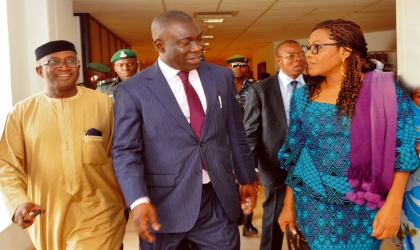
L-R: Senate Leader, Senator Victor Ndoma-Egba, Deputy Senate President, Senator Ike Ekweremadu and member, Senate Committee on Defence and Army, Senator Chris Anyanwu, after plenary in Abuja, yesterday. Photo: NAN




The Hydrocarbon Pollution Remediation Project (HYPREP) has commemorated the 15th anniversary of the release of the United Nations Environment Programme (UNEP) Environmental Assessment Report on Ogoniland, reaffirming its commitment to restoring the environment and improving the livelihoods of affected communities.
In a statement signed by the Project Coordinator, Prof Nenibarini Zabbey, to commemorate the anniversary, HYPREP described the anniversary as a significant milestone in Nigeria’s environmental restoration efforts, noting that the project has made remarkable progress in implementing the recommendations of the landmark UNEP report released on August 4, 2011.
The UNEP report had revealed extensive oil pollution across Ogoniland, severe environmental degradation, and serious public health risks resulting from decades of petroleum operations. It also recommended an initial $1 billion fund to commence the cleanup of the affected communities.
According to HYPREP, the Federal Government formally launched the Ogoni clean-up in 2016, while the Project Coordination Office was established in 2017 to drive the implementation of UNEP’s recommendations.
Zabbey said the current administration has continued to prioritise the project under the Renewed Hope Agenda.
Providing an update on the cleanup, the Project Coordinator disclosed that 30 of the 65 contaminated sites identified by UNEP have been fully remediated, while work is ongoing at several medium- and high-risk locations. It also stated that more than 1.5 million mangrove seedlings have been planted as part of what it described as the world’s largest restoration of oil-degraded mangroves, with over 1,000 hectares of shoreline already rehabilitated.
Zabbey further revealed that 49 Ogoni communities have been connected to potable water schemes through multiple water projects and booster stations aimed at providing safe drinking water across the region.
In the health sector, he said the 100-bed Ogoni Specialist Hospital in Kpite and the 43-bed Cottage Hospital in Buan are nearing completion, adding that several existing health facilities have been upgraded with modern medical equipment, while five ambulances have been donated to improve emergency healthcare services. The Project Coordinator also disclosed that a three-year human health biomonitoring study is being conducted in collaboration with the World Health Organization’s International Agency for Research on Cancer (IARC).
On economic empowerment, Zabbey stated that the Project has created more than 8,000 direct jobs and trained thousands of Ogoni youths and women in various vocational and technical skills, including software development, cybersecurity, aviation, commercial diving, seafaring, mechatronics, and creative arts. The project also reported awarding scholarships to more than 1,000 students, providing grants to small businesses, and supporting persons living with special needs through skills acquisition programmes.
The statement further highlighted ongoing legacy projects, including the Ogoni Power Project and the Centre of Excellence for Environmental Restoration, which it said is about 96 per cent complete. HYPREP also welcomed the recent designation of the Ogoni Wetland as a Ramsar Site of International Importance and pledged to continue promoting biodiversity conservation and sustainable management of the ecosystem.
Marking the anniversary, Zabbey said the progress achieved over the past 15 years demonstrates the collective commitment of government, development partners, stakeholders, and local communities to restoring Ogoniland. He called for renewed collaboration to sustain the cleanup effort, promote environmental sustainability, and support the long-term development of the region. 3
-

 News2 days ago
RSG Targets Nine Million Residents in Mosquito Net Distribution Campaign
-

 Oil & Energy1 day ago
Aiyedatiwa Signs New Electricity Bill
-

 Oil & Energy1 day ago
NLNG Commissions Research And Innovation Centre In RSU
-

 Maritime1 day ago
Marine Minister Commends President Tinubu On NPERA Bill Assent
-

 News2 days ago
KenPoly Holds Eight Convocations, August 29
-

 News2 days ago
RSG Begins Another Phase of Projects Commissioning Today
-

 News2 days ago
RMAFC Completes Revenue Sharing Review, Proposes New Pay
-

 Maritime1 day ago
NAGAFF Petitions IGP Over Alleged Maritime Police Harassment