
Business
Oil, Gas Polytechnic Ready In June – PTDF

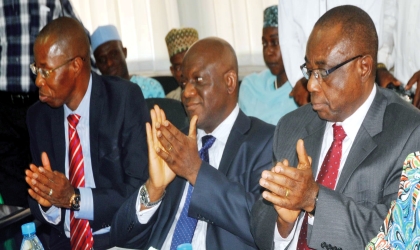
L-R: Permanent Secretary, Ministry of Environment, Mr Taiye Haruna, Permanent Secretary, Ministry of Transport, Mr Nebolisa Emodi and Permanent Secretary, Police Service Commission, Mr George Ossi, during the peer review mechanism of Permanent Secretaries in the Federal Civil Service in Abuja last Thursday. Photo: NAN
Work on the multimillion naira Federal Polytechnic of Oil and Gas Structure, Ekowe, in Bayelsa, will be completed before June this year, the Petroleum Technology Development Fund (PTDF) has said.
The Head of Press and External Relations of PTDF, Mr Kalu Otisi, who disclosed this in Abuja last Monday, said the polytechnic was one of the special projects being implemented by the agency in the Niger Delta.
Otisi told newsmen that arrangement was being made for President Goodluck Jonathan to inaugurate the project before the next academic session.
He explained that the project was conceived to provide specialised oil and gas training for the development of middle-level manpower requirement of the petroleum sector.
He declined to disclose the cost of the project but said that it was located in the Niger Delta area “for proximity to oil exploration and exploitation in upstream and downstream operations.
“The mission of PTDF is to use education and training to build and enhance the skills and capacities of Nigerians to play effective roles in all aspects of the petroleum industry in Nigeria,” he said.
He explained that PTDF undertook the polytechnic project because it realised that overseas scholarship scheme had great financial implication on the economy.
According to Otisi, the development of the polytechnic would reduce the amount spent on overseas scholarships by the government.
He said that when operational, the polytechnic would train most of the needed oil industry manpower locally.
“This will not only save cost and the scarce foreign exchange requirement but also add value to the world-class institutions and facilities being developed and upgraded by the Fund.
“In addition, more Nigerian graduates will benefit from the scholarship scheme as we have realised that the amount spent on one scholar’s training abroad can train 5 scholars in our local universities,” he said.
The spokesman said the polytechnic was sited at the former Government Science and Technical School, adding that the Federal Polytechnic, Bonny, Rivers State, was another project under PTDF’s educational intervention programmes.
Other intervention projects by the Fund, Otisi said, included the comprehensive infrastructural and faculty upgrading at the Petroleum Training Institute, Effurun in Delta and the National Centre for Skills Development and Training in Port Harcourt.
“We are also establishing an oil and gas research centre and museum in Oloibiri, Bayelsa to uplift the status of the community where oil was first discovered in commercial quantity in Nigeria and bring it to international recognition.
“It will serve as a learning centre for technology application and research as well as a museum to preserve the historical artifacts in the evolution of the Nigerian petroleum industry,” he added.
Outside the Niger Delta, he said the PTDF was building and upgrading other oil and gas institutions and facilities, including the National Institute for Petroleum Policy and Strategy, Kaduna.
“We are upgrading to international standards, oil and gas related departments and faculties in 26 universities across the country.



Business
Jonathan, Diri, Others Laud Firm’s Milestone in Bayelsa …Says Project Will Drive Industrialisation, Create Jobs



-

 News4 days ago
RSG Targets Nine Million Residents in Mosquito Net Distribution Campaign
-

 Oil & Energy3 days ago
Aiyedatiwa Signs New Electricity Bill
-

 Oil & Energy3 days ago
NLNG Commissions Research And Innovation Centre In RSU
-

 Maritime3 days ago
Marine Minister Commends President Tinubu On NPERA Bill Assent
-

 News4 days ago
KenPoly Holds Eight Convocations, August 29
-

 News4 days ago
RSG Begins Another Phase of Projects Commissioning Today
-

 News4 days ago
RMAFC Completes Revenue Sharing Review, Proposes New Pay
-

 Maritime3 days ago
NAGAFF Petitions IGP Over Alleged Maritime Police Harassment