Connect with us

Oil & Energy

Oil Theft, Hindrance To National Economy -Dickson

Published

on

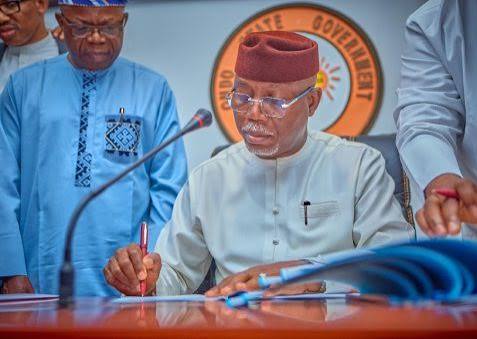
Bayelsa State Governor, Hon. Seriake Dickson says the activities of oil thieves pose a great threat not only to the economy but also to national security.
Governor Dickson stated this when he received the new Flag Officer Commanding, Central Naval Command, Yenagoa, Rear Admiral Sidi-Ali Usman in Government House, Yenagoa.
Expressing concern over the rate of illegal OIL bunkering, sea piracy and pipeline vandalisATION. The governor linked the proliferation of small and light weapons to such activities in the littoral states.
According to Governor Dickson, the criminals have been able to sustain their operations over the years through the proceeds from illegal bunkering activities.
In his words: “What is going on is more of a threat to national security than even the loss of revenue that everybody is shouting about. Let me tell you that all the violence, brigandage and criminality that we experience in the Niger Delta states particularly Bayelsa where I know more, have their roots in the activities in the creeks.
“It is from there they have easy funds to recruit followers; it is from crude oil theft and illegal refining that people are able to sustain such large numbers of youths and put them into various cult groups.
“What is going on has a direct effect on the proliferation of small and light weapons because they need an army of youths to protect their territories to be able to withstand the onslaught of legitimate security personnel.
The Governor warned those who have rebuffed the olive branch extended to cultists by the state government to have a change of heart, as his administration would not hesitate to bring them to justice.
“For those who have defied the Cultism Proscription law, in spite of the olive branch we have put forward and arrangement for their renunciation and eventual integration but still want to go ahead with cult activities, I am sounding a clear note of warning that this government will not succumb to blackmail or propaganda. This government will work with security agencies in this state to ensure that those who violate the laws of this state and country will be brought to book.”
Consequently, he called for maximum cooperation from the security operatives especially the Nigerian Navy to achieve the present administration’s policy of zero tolerance to violence and crime.
Describing the establishment of the Central Naval Command in the state as significant, Governor Dickson said considering the maritime nature of the state, the Navy has a crucial role to play in policing its waterways.
While commending the out gone Flag Officer Commanding, Rear Admiral Olutoyin Johnson for serving the state creditably, he assured the new FOC of government’s continued support.
Commenting on his posting to the Command, the Flag Officer Commanding, Central Naval Command, Rear Admiral Sidi-Ali Usman, said he assumed duties about 3 weeks ago and has already gone on a familiarization tour of the formations under his command.
Rear Admiral Usman expressed determination to combat oil theft and other criminal activities in line with federal government’s mandate.


Continue Reading

Oil & Energy

Rivers PETROAN Elects 12-Member Executive 

Published

on

The Petroleum Products Retail Owners Association of Nigeria (PETROAN), Rivers State Branch, has elected a 12 – member executive to steer the affairs of the association for the next four years.
The executive, elected during the Annual General Meeting (AGM) of the association, at it’s secretariat in Port Harcourt, and sworn in immediately after the election, was mandated to, among other things, tackle the adulteration of petroleum products as well as address irregularities in meter readings across the state.
The newly elected executive include, Pastor Ezekiel I. Eletuo  as  Chairman,  Kanu Addeson C. as Vice Chairman , Dr. Ejike Jonathan Nnbuihe as Secretary,  Fidelis A.Inaku as Treasurer and Lady C. N. Ekejiuba as Financial Secretary.
Others are Anaenye Anthony as Publicity Secretary, Arc. Kingsley O. Anyino as Organising Secretary, Nze Peter Ezenwa as Chief Whip, and Sunny Williams as Auditor.
Other members of the executive included Chidiebere Ronel Akwara as Welfare Officer, Ibe Chimaobi C. as Legal Adviser, and Emetoh Chizoba as Assistant Secretary.
Inaugurating the new leadership, PETROAN Zonal Chairman, High Chief Sunny G. Nkpe, charged the team to build on the achievements of the outgoing executive.
He urged them to collaborate with stakeholders in the petroleum sector to ensure industry stability and address issues of multiple taxation.
Nkpe who emphasized the need for transparency, accountability, and an open-door policy in administering the union, insisted these principles remained crucial in advancing the association’s objectives and improving members’ welfare.
The zonal chairman also commended the outgoing executive for their accomplishments during their tenure and for conducting a smooth transition process.
He further described their efforts as instrumental in strengthening the union’s standing in the state.
In his acceptance speech, the new Chairman, Pastor Ezekiel I. Eletuo, thanked members for their confidence and pledged to improve on the foundations laid by the previous administration.
He promised his leadership would be guided by transparency, accountability, fairness, unity, and integrity.
Eletuo called on all members to support the new executive in its efforts to elevate the association.
Also speaking, the immediate past Chairman, of the association, Sir Chilam Francis Dimkpa, expressed appreciation to members for their support during his administration and stressed the need for them to extend the same cooperation to the new leadership.
Dimkpa highlighted key achievements of his tenure to include capacity building for members, increased union visibility through media advocacy, and the establishment of stronger ties with stakeholders, corporate organisations, and individuals.
He also acknowledged the support of the state government, the Police, the Department of State Services (DSS) and the Nigeria Security and Civil Defence Corps (NSCDC).
Stakeholders present at the event also delivered their goodwill messages.
Highlights of the event included  administration of oath of office to the new executive and the presentation of certificates of return by the zonal chairman.    .
By: Amadi Akujobi
Continue Reading

Oil & Energy

FG Intensifies Efforts To Reposition Tourism Sector 

Published

on

The Federal Government has intensified efforts towards reposition Nigeria’s hospitality and tourism industry for global competitiveness, aimed at strengthening regulation, professionalism and workforce standards across the sector.
This was made known last week when the National Institute for Hospitality and Tourism (NIHOTOUR) conferred  fellowships, inducted professionals and inaugurated the governing boards of the Hospitality and Tourism Sector Skills Council of Nigeria (HTSSCN) in Abuja.
The high-profile event, held at Merit House, Maitama, drew senior government officials, regulators, tourism operators, cultural institutions, hospitality investors and development partners in what stakeholders described as a major institutional shift .
Government also formally inducted registered practitioners into various professional categories while also inaugurating the Board of Trustees and Board of Directors of the HTSSCN, an employer-led platform designed to align workforce competencies with industry expectations.
Speaking at the event, the Minister of Art, Culture, Tourism and the Creative Economy, Hannatu Musa Musawa, said the initiative represented a strategic intervention to strengthen accountability, standards and institutional coordination within Nigeria’s tourism and hospitality ecosystem.
According to the minister, Nigeria’s vast cultural assets, tourism destinations and creative talents can only translate into sustainable economic value through professionalism, regulation and globally accepted operational standards.
She noted that tourism and hospitality industry remains one of the fastest-growing sectors globally, contributing significantly to employment generation, foreign exchange earnings and cultural diplomacy.
Musawa explained  that NIHOTOUR Establishment Act has expanded the institute’s mandate beyond training, positioning it as a regulatory and certification authority for hospitality, tourism and travel practitioners in the country.
“No sector can attain sustainable growth without structure, standards, institutional coordination and skilled professionals,” she said, stressing the need for stronger collaboration between government agencies, operators, training institutions and private sector stakeholders.
In his keynote address, the Director-General and Chief Executive Officer of NIHOTOUR, Abisoye Fagade, described the event as a historic turning point in the formalisation of Nigeria’s tourism and hospitality industry.
Fagade said the induction of practitioners, conferment of fellowships and inauguration of the HTSSCN governing boards marked the beginning of a new era of institutional governance, professional recognition and sector-wide coordination.
“Regulation and standardisation are no longer optional; they are economic necessities if Nigeria truly intends to compete globally,” he stated.
By:  Nkpemenyie Mcdominic, Lagos
Continue Reading

Oil & Energy

Big Oil Reconsiders Previously Unattractive Destinations

Published

on

The Middle Eastern crisis has prompted a reprioritization among international oil companies. Previously unattractive drilling destinations are suddenly looking quite attractive—even Alaska.
The oldest oil and gas producing part of the United States has for years been out of the spotlight as the industry moves to cheaper and faster-growing locations. The only news of any substance about Alaska recently was the Biden administration’s approval of the Willow project, led by ConocoPhillips, which was set to boost the state’s oil output by 160,000 barrels daily, and Australian Santos’ Pikka project, set to start commercial production this year. That was years ago. Now, Big Oil is eager to drill in Alaska.
Earlier this month, a lease sale in the National Petroleum Reserve in Alaska attracted record bids, worth a total $163 million. Among the bidders were Exxon, Shell, and Repsol, with the latter already partnering with Santos on the Pikka development. And this may be just the beginning.
Related: Saudi Aramco Looks to Raise $10 Billion from Real Estate Asset Deal
The Bureau of Land Management offered 625 tracts across about 5.5 million acres for bid in the sale, revived at the end of last year by the Trump administration. No lease sales were held in the National Petroleum Reserve in Alaska under President Biden. Yet under Trump’s One Big Beautiful Bill, there will be a total of five lease sales in Alaska over the next ten years.
“With the imminent start-up of the Pikka project on the North Slope, the reversal in the decline of oil production in the great state of Alaska is going to help put more oil in the Pacific area at an important moment,” Repsol’s head of upstream operations, Francisco Gea, said as quoted by the Financial Times. Gea called Alaska “a fantastic opportunity”. The Pikka project, which has a price tag of $4.5 billion, will produce up to 80,000 barrels daily.
It is indeed a fantastic opportunity, at the very least because it is nowhere near the Middle East and as such is a highly secure energy exploration destination. Canada is in a similar position, by the way: the head of the International Energy Agency earlier this month told an industry event Canada had a golden opportunity to step in as a secure energy supplier in a world that’s currently 14 million barrels daily short on supply because of the Middle Eastern crisis.
Security, then, is what has prompted Big Oil to return to the North—even Shell, which left in 2015 after writing off as much as $7 billion on an unsuccessful drilling campaign hampered, among other things, by strong environmentalist opposition. According to the Financial Times, the supermajor’s decision to partake in the latest Alaska lease sale was surprising for analysts.
However, according to chief executive Wael Sawan, the lease sale concerns a different part of the state. “It is a very, very, very different part of Alaska that we have gone to,” he told the Financial Times. “This is an onshore exploration opportunity in a very well-established basin that has been producing for some time… So this is not offshore Alaska where we have had the challenges in the past.”
Crude oil is not the only thing drawing the energy industry to Alaska in these times of oil and gas trouble. Gas is also a magnet—in this case, in the form of the Alaska LNG project. Interest in the Alaska LNG export project has spiked since the war in the Middle East choked 20% of global LNG supply and sent Asian buyers scrambling for expensive spot cargoes.
Glenfarne Group, the majority owner and developer of the facility, aims to sign binding offtake agreements with buyers soon and advance final investment decisions to later in 2026 and early 2027, company executives told media earlier this year on the sidelines of an energy conference in Tokyo.
“There’s a real interest, particularly with everything happening in the Middle East right now. Everyone would like to get those (preliminary deals) turned into long-term agreements,” Adam Prestidge, president of Glenfarne Alaska LNG, told Reuters in March.
Alaska LNG is designed to deliver North Slope natural gas to Alaskans and export LNG to U.S. allies across the Pacific. An 800-mile pipeline is planned to transport the gas from the production centers in the North Slope to south-central Alaska for exports. In addition, multiple gas interconnection points will ensure meeting in-state gas demand.
The latest Alaska developments show clearly how the Middle East war has put energy security back in the spotlight, making previously challenging locations desirable again. With an estimated 1 billion barrels of oil supply wiped out of markets since the war began, according to Aramco’s Amin Nasser, alternative supply sources have become urgently needed, and not just for the short term. Even if the Strait of Hormuz reopens soon—which at the moment seems unlikely—energy security will in all probability remain a top priority both for energy producers and for consumers.
By Irina Slav for Oilprice.com
Continue Reading

Trending