
City Crime
I’ll Hunt Down Osama Bin Laden …Obama’s Promise To Americans As Democratic Flag-Bearera

Full Text of Sen. Barack Obama’s Speech Accepting Nomination as Presidential Candidate at the Democratic National Convention, Denver 2008.
With profound gratitude and great humility, I accept your nomination for the presidency of the United States.
Let me express my thanks to the historic slate of candidates who accompanied me on this journey, and especially the one who traveled the farthest – a champion for working Americans and an inspiration to my daughters and to yours Hillary Rodham Clinton. To President Clinton, who last night made the case for change as only he can make it; to Ted Kennedy, who embodies the spirit of service; and to the next Vice President of the United States, Joe Biden, I thank you. I am grateful to finish this journey with one of the finest statesmen of time, a man at ease with everyone from world leaders to the conductors on the Amtrak train he still takes home every night.
To the love of my life, our next First Lady, Michelle Obama, and to Sasha and Malia – I love you so much, and I’m so proud of all of you.
Four years ago, I stood before you and told you my story – of the brief union between a young man from Kenya and a young woman from Kansas who weren’t well-off or well known, but shared a belief that in America, their son could achieve whatever he put his mind to.
It is that promise that has always set this country apart that through hard work and sacrifice, each of us can pursue individual dreams but still come together as one American family, to ensure that the next generation can pursue their dreams as well.
That’s why I stand here tonight. Because for two hundred and thirty two years, at each moment when that promise was in jeopardy, ordinary men and women – students and soldiers, farmers and teachers, nurses and janitors – found the courage to keep it alive.
We meet at one of those defining moments – a moment when our nation is at war, our economy is in tumoil, and the American promise has been threatened once more.
Tonight, more Americans are out of work and more are working harder for less. More of you have lost your homes and even more are watching your home values plummet. More a you have cars you can’t afford to drive, credit card bills you can’t afford to pay, and tuition that’s beyond your reach.
These challenges are not all of government’s making. Bu the failure to respond is a direct result of a broken politics in Washington and the failed policies of George W. Bush.
America, we are better than these last eight years. We are better country than this.
This country is more decent than one where a woman in Ohio, on the brink of retirement, finds herself one illness away from disaster after a lifetime of hard work.
This country is more generous than one where a man in Indiana has to pack up the equipment he’s worked on for twenty years and watch it shipped off to China, and the chokes up as he explains how he felt like a failure when he went home to tell his family the news.
We are more compassionate than a government that lets veterans sleep on our streets and families slide into poverty that sits on its hands while a major American city drowns before our eyes.
Tonight, I say to the American people, to Democrats and Republicans and Independents across this great land enough! This moment – this election – is our chance 1will keep, in the 21st century, the American promise alive. Be cause next week, in Minnesota, the same party that brought you two terms of George Bush and Dick Cheney will ask this country for a third. And we are here because we love this country too much to let the next four years look like the last eight. On November 4th, we must stand up and say: “Eight enough.”
Now let there be no doubt. The Republican nominee, John McCain, has worn the uniform of our country with bravery and distinction, and for that we owe him our gratitude and respect. And next week, we’ll also hear about those occasions when he’s broken with his party as evidence that he can deliver the change that we need.
But the record is clear: John McCain has voted with George Bush ninety percent of the time. Senator McCain likes to talk about judgment, but really, what does it say about your judgment when you think George Bush has been right more than, ninety percent of the time? I don’t know about you, but I’m not ready to take a ten percent chance on change.
The truth is, on issue after issue that would make a difference in your lives – on health care and education and the economy – Senator McCain has been anything but independent. He said that our economy has made “great progress” under this President. He said that the fundamentals of the economy are strong. And when one of his chief advisors- the man who wrote his economic plan – was talking about the anxiety Americans are feeling, he said that we were just suffering from a “mental recession,” and that we’ve become, and I quote, “a nation of whiners.”
A nation of whiners? Tell that to the proud auto workers at a Michigan plant who, after they found out it was closing, kept showing up every day and working as hard as ever, because they knew there were people who counted on the brakes that they made. Tell that to the military families who shoulder their burdens silently as they watch their loved ones , leave for their third or fourth or fifth tour of duty. These are not whiners. They work hard and give back and keep going without complaint. These are the Americans that I know.
Now, I don’t believe that Senator McCain doesn’t care what’s going on in the lives of Americans. I just think he doesn’t know. Why else would he define middle-class as someone making under five million dollars a year? How else could he propose hundreds of billions in tax breaks for big corporations and oil companies but not one penny of tax relief to more than one hundred million Americans? How else could he offer a health care plan that would actually tax people’s benefits, or an education plan that would do nothing to help families pay for college, or a plan that would privatize Social Security and gamble your retirement?
It’s not because John McCain doesn’t care. It’s because John McCain doesn’t get it.
For over two decades, he’s subscribed to that old, discredited Republican philosophy – give more and more to those with the most and hope that prosperity trickles down to everyone else. In Washington, they call this the Ownership Society, but what it really means is – you’re on your own. Out of work? Tough luck. No health care? The market will fix it. Born into poverty? Pull yourself up by your own bootstraps – even if you don’t have boots. You’re on your own.
Well it’s time for them to own their failure. It’s time for us to change America.
You see, we Democrats have a very different measure of what constitutes progress in this country.
We measure progress by how many people can find a job that pays the mortgage; whether you can put a little extra money away at the end of each month so you can someday watch your child receive her college diploma. We measure progress in the 23 million new jobs that were created when Bill Clinton was President – when the average American family saw its income go up $7,500 instead of down $2,000 like it has, under George Bush.
We measure the strength of our economy not by the number of billionaires we have or the profits of the Fortune 500, but by whether someone with a good idea can take a risk and start a new business, or whether the waitress who lives on tips can take a day off to look after a sick kid without losing her job – an economy that honors the dignity of work.
The fundamentals we use to measure economic strength are whether we are living up to that fundamental promise that has made this country great -a promise that is the only reason 1 am standing here tonight.
Because in the faces of those young veterans who come back from Iraq and Afghanistan, I see my grandfather, who signed up after Pearl Harbor, marched in Patton’s Army, and was rewarded by a grateful nation with the chance to go to college on the GI Bill.
In the face of that young student who sleeps just three hours before working the night shift, I think about my mom, who raised my sister and me on her own while she worked and earned her degree; who once turned to food stamps but was still able to send us to the best schools in the country with the help of student loans and scholarships.
When I listen to another worker tell me that his factory has shut down, I remember all those men and women on the South Side of Chicago who I stood by and fought for two decades ago after the local steel plant closed.
And when I hear a woman talk about the difficulties of starting her own business, I think about my grandmother, who worked her way up from the secretarial pool to middle-management, despite years of being passed over for promotions because she was a woman. She’s the one who taught me about hard work. She’s the one who put off buying a new car or a new dress for herself so that I could have a better life. She poured everything she had into me. And although she can no longer travel, I know that she’s watching tonight, and that tonight is her night as well.
I don’t know what kind of lives John McCain thinks that celebrities lead, but this has been mine. These are my heroes. Theirs are the stories that shaped me. And it is on their behalf that I intend to win this election and keep our promise alive as President of the United States.
What is that promise?
It’s a promise that says each of us has the freedom to make of our own lives what we will, but that we also have the obligation to treat each other with dignity and respect.
It’s a promise that says the market should reward drive and innovation and generate growth, but that businesses should live up to their responsibilities to create American jobs, look out for American workers, and play by the rules of the road.
Ours is a promise that says government cannot solve all our problems, but what it should do is that which we cannot do for ourselves – protect us from harm and provide every child a decent education; keep our water clean and our toys safe; invest in new schools and new roads and new science and technology.
Our government should work for us, not against us. It should help us, not hurt us. It should ensure opportunity not just for those with the most money and influence, but for every American who’s willing to work.
To be continued



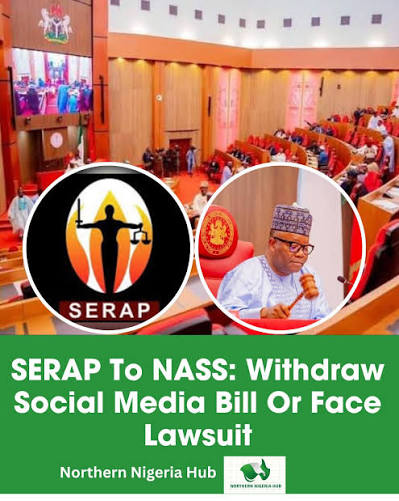
The Socio-Economic Rights and Accountability Project has asked the National Assembly to immediately withdraw the proposed Nigeria Data Protection (Amendment) Bill, 2026, describing it as a backdoor attempt to regulate social media and expand government control over online expression.
SERAP warned that it would institute legal action if the bill is passed in its current or substantially similar form.
The bill, sponsored by Senator Ned Nwoko (APC, Delta North), seeks to compel social media platforms, data controllers and data processors operating in Nigeria to establish physical offices in the country.
It also empowers the Nigeria Data Protection Commission to shut down or prohibit the operations of any entity that fails to comply within 30 days.
In a letter dated July 18, 2026, and addressed to Senate President Godswill Akpabio and Speaker of the House of Representatives Tajudeen Abbas, SERAP said the proposed amendment posed a threat to constitutionally guaranteed rights.
The letter, signed by SERAP Deputy Director Kolawole Oluwadare and issued on Sunday, read in part, “Requirements compelling technology companies to establish local offices would increase government leverage over platforms, facilitate political pressure, make censorship demands easier and expose local employees to retaliation.
“The Bill would create sweeping powers capable of shutting down or excluding social media platforms from the Nigerian market and expose millions of Nigerians to serious violations of their constitutionally and internationally guaranteed human rights.”
SERAP argued that the bill revives previous attempts to regulate social media that attracted widespread public opposition.
“The current Bill revives substantially similar proposals previously introduced by Senator Nwoko, raising renewed concerns that localisation requirements are being used as a vehicle for expanding governmental control over digital platforms and online expression,” it said.
The organisation warned that it would challenge the legislation in court if enacted.
“Should the Bill be enacted into law in its current or substantially similar form, SERAP shall promptly take all appropriate legal actions to challenge its legality in the public interest and to ensure that Nigerians’ fundamental rights are fully protected,” the letter stated.
According to SERAP, the proposed legislation would give the Nigeria Data Protection Commission excessive powers to block digital platforms without adequate procedural safeguards.
“The Bill constitutes a backdoor attempt to regulate social media and increase governmental control over online expression through corporate localisation requirements rather than through transparent and constitutionally permissible regulation,” it said.
The group argued that the bill lacks provisions for prior judicial authorisation, meaningful opportunities for compliance beyond the proposed 30-day period, and safeguards to protect the rights of millions of Nigerians who rely on digital platforms.
SERAP also cited the judgment of the ECOWAS Court of Justice on Nigeria’s suspension of Twitter, arguing that the proposed amendment could produce similar consequences by indirectly excluding social media platforms from operating in the country.
“The Bill also risks recreating the very dangers previously condemned by the ECOWAS Court of Justice. In SERAP and Others v. Federal Republic of Nigeria, the Court held that the suspension of Twitter violated the rights to freedom of expression, access to information and media freedom protected under the African Charter.
“Although the present Bill differs from the Twitter suspension in form, it creates the possibility of achieving the same result indirectly by empowering regulators to prohibit digital platforms from operating in Nigeria.
“The National Assembly should not enact legislation capable of producing, through indirect regulatory means, the very restrictions on fundamental rights that regional human rights law prohibits,” the organisation said.
It maintained that while governments have a legitimate interest in regulating digital platforms, such measures must comply with constitutional guarantees and international human rights standards.
The organisation further warned that mandatory localisation requirements would increase compliance costs for technology companies, startups, educational institutions and artificial intelligence developers.
“The proposed amendment conflicts directly with the objectives of the Nigeria Startup Act 2022 and the National Digital Economy Policy and Strategy.
“Mandatory localisation requirements substantially increase compliance costs, particularly for startups, open-source projects, educational institutions, research organisations, AI developers and smaller technology companies, while reducing Nigeria’s attractiveness as a destination for innovation and investment.
“No major democratic jurisdiction requires every social media platform to establish a physical office as a blanket precondition for providing services.”
SERAP added, “The National Assembly should immediately reject and withdraw the Bill, as it is manifestly incompatible with the Nigerian Constitution and Nigeria’s obligations under the African Charter on Human and Peoples’ Rights and the International Covenant on Civil and Political Rights.”
England and Chelsea legend John Terry has expressed disappointment over Nigeria’s absence from the 2026 FIFA World Cup, admitting that the Super Eagles will be sorely missed as the tournament started yesterday Tidesports source reports.
Eric Chelle’s side finished second in Group C of the CAF World Cup qualifiers behind South Africa, who secured one of the automatic qualification spots for the tournament.
The Super Eagles kept their hopes alive by defeating Gabon in the playoff semi-finals but saw their dreams shattered after losing to the Democratic Republic of Congo on penalties in the decisive playoff final.
The defeat condemned Nigeria to a second successive absence from the World Cup, having also failed to qualify for the 2022 tournament in Qatar. The Nigeria Football Federation later challenged DR Congo’s qualification, alleging the use of ineligible players during the campaign. However, the appeal was dismissed, ending any hopes of a late reprieve.
Nigeria will be a big miss. This is a World Cup for participants who haven’t had the opportunity to play in the tournament. I would have loved to see a top team like Nigeria there because they’ve got some great individuals. They’re a great nation. So, yeah, they fall under that category for me.
“I think they are a big miss because Nigeria probably would have gone further in the competition, but unfortunately, one side’s loss is another’s gain.
“I know Mikel Obi is very upset that they’re not there. It means he can’t do more commentating on the World Cup. That’s why he was upset.”
The 2026 World Cup officially begins with co-hosts Mexico.
The historic clash, set to take place at the iconic Estadio Azteca, rekindles memories of the opening match of the 2010 FIFA World Cup, which ended 1-1. South Africa took the lead through Siphiwe Tshabalala’s stunning strike before Rafael Márquez salvaged a draw for Mexico with a 79th-minute equaliser.
-

 News5 days ago
Rivers NUJ Seeks Recruitment Into State Media Houses …Urges Govt To Reposition Public Service
-
 News5 days ago
Family Seeks Police Help As Woman Goes Missing After Fleeing Female Circumcision Threat
-
 News4 days ago
NDLEA Intercepts 1.63m Tramadol Pills, Arrests 80-Year-Old Suspect
-
 News5 days ago
Tinubu, Fubara Condole Amaechi Over Mother’s Death
-
 Oil & Energy4 days ago
NCDMB Partner Renaissance To Train 300 Youths On oil, gas Skills
-
 News5 days ago
Nigeria Hosts World Public Relations Forum Sept …As Experts Seek Inclusion Of PR In Decision Making
-
 Oil & Energy4 days ago
Abia Secures $145m Investment Commitment To Establish Solar Manufacturing Plant
-
 Oil & Energy4 days ago
Local Crude Shortage Crippling Nigerian Refineries – MAN