
Business
No Accurate Data For Nigeria’s Oil Theft – Shell

Nigeria, world seventh largest oil producing nation, is yet to have an accurate data for number of oil theft after half a century exploration, which commenced at Oloibiri in 1956.
Although, staggering figures by foreign agencies quoted over $40 billion as annual financial losses to the economic sabotage, oil giant, Royal Dutch Shell whose partnership made the first crude discovery in the country said: “How much oil is stolen (in Nigeria) is difficult to estimate and varies according to sources”.
The agency saddled with the responsibility to keep statistics, the National Extractives Industries Transparency Initiatives (NEITI), had earlier owned up that there are still many areas of leakages in the Nigeria’s multi-billion dollars oil and gas industry but Shell said at the weekend that, only 2008, “there were 87 incidents of crude oil theft (known locally as illegal bunkering) from just the SPDC facilities. Incidents of malicious damage and pipe-line theft increased by 48 per cent”.
Authorities, the company said in its May 2009 edition of its in-house statement, “arrested a total of 82 people, and seized 43 tankers, 17 vehicles and 11 barges”, insisting that these “almost certainly represents a small fraction of the true scale of the problem”.
It continued in a statement entitled, “The operating environment” that in early 2006, “a series of attacks forced SPDC to shut down all operations in the western delta. As a result of this and other attacks, Nigeria has lost around in quarter of its oil production”.
NEITI had blamed the bad record keeping in the country’s oil business on regulators maintaining that differences still exist in lifted volumes of crude between the terminal operators and the companies making the lifting.
Chairman of the National Stakeholders Working Group (NSWG), of NEITI, Prof. Assisi Asobie, stated this at the flag-off of a public debate on the report submitted by its consultants, the Hart Group, to it.
Noting that the amounts involved in some of these areas of ‘possible loss’ were very significant, Asobie put the possible shortfall in the payments of royalty and petroleum profit tax resulting from anomaly in the interpretation and application of the Memorandum of Understanding (MoU) clauses and the clause of the relevant laws at US$242.9 million and US $309.9 million respectively.
He had stressed that the “companies estimated that the NNPC owed the Federation Account the sum of N654 billion; NNPC claims it owed N651.583 billion, but added that the sum of N222. 387 billion was being withheld as part of subsidy payments due to it from the federal government”.



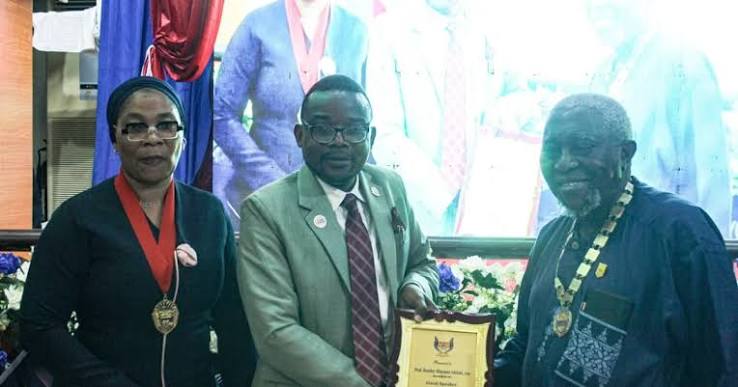
The NIM president also identified integrity, accountability, probity, honesty and efficiency as essential principles that needed to be strengthened in Nigeria’s workplaces and economy.
He argued that management failures extended beyond businesses to households and the wider society, making the promotion of sound management practices increasingly important.
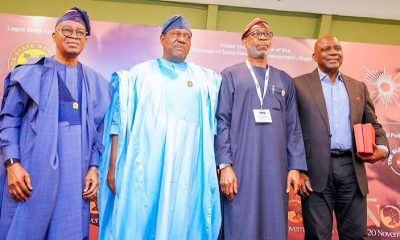
Mustapha also renewed the institute’s call on the Federal Government to recognise 19 November as National Management Day, saying such recognition could strengthen its campaign for the United Nations to declare the date International Management Day.
The institute adopted 19 November for its annual celebration in 2016 to coincide with the birthday of Peter Drucker, widely regarded as the father of modern management.
Mustapha said the institute believed that official recognition by the Federal Government would strengthen its appeal to the United Nations to establish an international observance dedicated to the management profession.
The lecture featured Executive Director of the University of Lagos Business School, Prof. Sunday Adebisi, as guest speaker.
Other attendees included the Registrar and Chief Executive of NIM, Taiwo Olusesi, and a former president of the institute, Akinbayo Adenubi.

The Chief Executive Officer (CEO) of Moniepoint Microfinance Bank Babatunde Olofin, says transaction volume of the bank has hit one trillion naira daily.
Olofin said this at the unveiling of the bank’s North Central office in Abuja on Friday.
He said the bank also served a customer base of about 21 million and provided more than one million jobs in the country.
”Moniepoint is proudly Nigerian, owned by a Nigerian and managed by Nigerians.
?”With ?????????????????????our solid technologies and tailored-made products for businesses in Nigeria and retail customers as well, we are the bank to reckon with,” he said.
The CEO said the bank might be considering upgrade to a full-fledged commercial bank if the business required so.
According to him, this is a strategic decision which if the business requires it, we will communicate.
Fielding questions from newsmen, Edidiong Uwemakpan, the Vice-President Corporate Affairs of the bank, said the bank had been supporting agricultural activities to impact households.
”Moniepoint has always been hyper local and if you look at how we scaled our business, we understood how much Nigerians wanted to be able to interact with humans.
”From the very beginning, we built this distribution network of people that can be trusted, I think this is just an extension of our hyper-local strategy, getting closer to people,” she said.
-
News3 days ago
Bayelsa Boat Mishap: Tinubu Donates N250m As Death Toll Hits 29
-
News3 days ago
Odu Pays Tribute To Late Chinwah, Describes Him As Courageous, Selfless Academic
-
 Maritime3 days ago
Nigeria, Russia Customs Sign MOU To Trade Facilitations
-

 Sports3 days ago
World marathon champion gets three-year doping ban
-
 Maritime3 days ago
South-South Governors Urges To Shake Off Collective Lethargic To Embrace Blue Economy
-
 Maritime3 days ago
Oyetola Woos Investors With Nigeria’s Seabed Resources, Marine Biotechnology
-

 Business3 days ago
Moniepoint MfB transaction volume hits 1trn daily — CEO
-

 Oil & Energy3 days ago
Global Oil Market May Witness Supply Surplus Before The End Of 2026 …… Report