
News
Apex Court Probes Invasion Of Justice Odili’s Residence …Assault On Odili, Plot To Compromise 2023 Polls -PDP

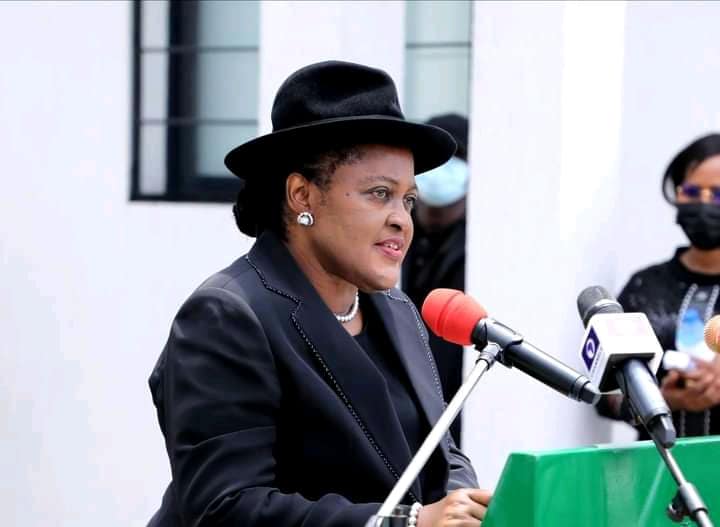
The Supreme Court, yesterday, described the invasion of Justice Mary Odili’s residence by unknown security operatives as impunity taken too far.
This is as the Peoples Democratic Party (PDP) has said the recent onslaught on the residence of Supreme Court judge, Justice Mary Odili was part of a grand design by the ruling All Progressives Congress (APC) to hijack the 2023 elections “as it did in 2019.”
It said it has commenced a full-scale independent investigation to unravel the true masquerades behind the mystery as well as the real motives behind the whole incident.
The apex court, in a statement by its Director of Press and Information, Dr. Akande Festus, said that the attack was uncivilised and a shameful show of primitive force on an innocent judicial officer.
The court warned that the Judiciary should not be misconstrued by any individual or institution of government as the whipping child among the three arms of government.
The statement, read in part: “We are alarmed by the news of the unwarranted and despicable raid on the official residence of one of our senior justices in the Supreme Court, Hon. Justice Mary Peter Odili, on Friday, 29th October, 2021, in a Gestapo manner.
“The attack unfortunately depicted a gory picture of war by some armed persons suspected to be security operatives representing different agencies of government who seemed to have come to kill and maim their target under the guise of undertaking a search whose warrant was questionable and baseless.
“We are deeply saddened and taken aback by this uncivilised and shameful show of force on an innocent judicial officer that has spent several years of her productive life serving the country she calls her own.
“This incident brought back, rather painfully, the ugly memory of the October 2016 midnight invasion of the homes of our respected justices with no satisfactory explanations as to the true motive behind such brazen assault on our collective sensibility.
“We wish to make it abundantly clear that the Nigerian Judiciary is the third arm of the government of the Federal Republic of Nigeria and should be respected and treated as such.
“We have had a full dosage of this fusillade of unwarranted and unprovoked attacks on our judicial officers, and even our facilities across the country, and we say, enough is enough.
“The Judiciary should never be construed by any individual or institution of government as the arm of government that must always be chastised and ridiculed into silence because of our conservative disposition.
“Though there have emerged discordant tunes from the various security agencies that allegedly participated in the dastardly act, we are not lying low on this dehumanizing treatment meted out to one of our own.
“We have commenced a full-scale independent investigation to unravel the true masquerades behind the mystery as well as the real motives behind the whole incident.”
He equally called on the Inspector-General of Police of the Federal Republic of Nigeria to rise up to the occasion by carrying out a discreet investigation and to make his findings known to the Nigerian public with a view to bringing the perpetrators to justice as quickly as possible.
Meanwhile, the Peoples Democratic Party (PDP) has said the recent onslaught on the residence of Supreme Court judge, Justice Mary Odili was part of a grand design by the ruling All Progressives Congress (APC) to hijack the 2023 elections “as it did in 2019.”
This is even as the party described the attack on Justice Odili as “horrendous, rascally, irresponsible, completely unjustified and should not be swept under the carpet on the guise of misleading whistleblower operation.”
In a statement, yesterday, signed by spokesman, Kola Ologbondiyan, the PDP noted that the paw prints of the APC “are visible in the incident, in its desperation to cow the Judiciary and subvert the cause of justice ahead of the 2023 elections.”
The statement read: “It is clear that the attack on Justice Odili is part of a renewed script by the APC. Nigerians will recall how, ahead of the 2019 election, former Chief Justice of Nigeria (CJN), Justice Walter Onnoghen, was clandestinely yanked off from his hallowed chamber, preparatory to the massive rigging that characterized the 2019 Presidential election.
“Nigerians can equally recall how respected judges were assaulted by the APC administration through obnoxious sting operations in a bid to arm-twist the Judiciary and set the stage for the endorsement of a culture of impunity that characterised the 2019 elections.
“The PDP, however, cautions the APC and its Presidency apparatchik to know that times have changed. Nigerians are not ready to stomach a repeat of APC’s coordinated assault on our institutions of democracy, but will firmly resist them with every means available within the ambit of the law.
“The party also urges the Judiciary to remain firm and not be deterred by the suppressive proclivities of the fizzling APC that has since been rejected by Nigerians.
“The PDP calls on Nigerians to stand in defence of our democracy by continuing in their demand that the real perpetrators of the attack on Justice Mary Odili be exposed and brought to book.”



The State Coordinator of the forum, Archbishop Lucky Aroh, made this known during a breakfast and thanksgiving meeting held in Port Harcourt, where leaders gathered to pray for the stability of the party and the safety of its candidates ahead of the 2027 general elections.According to him, the meeting was convened to seek divine intervention for peace, unity, and security among APC candidates across Rivers State.
“Today we are praying for APC stability in Rivers State and the security of our candidates that have been elected to contest the 2027 elections. It is a breakfast meeting,” Aroh said.
He further expressed optimism that the party’s candidates would not disappoint the people if entrusted with leadership responsibilities.
“They will not fail when elected into office. We are here as fathers of the land to let them know, and I must tell you the truth that these are the authentic people that will do well in Rivers State,” he added.
Speaking earlier, the National Chairman of the forum, Professor Olanrewaju Abraham, commended the Rivers State chapter for organizing the programme, noting that the national body of the forum believes strongly in the power of prayer.
He stated that political leadership provides an opportunity to influence society positively, including advancing moral and spiritual values, while expressing confidence that APC candidates at all levels would emerge victorious in the upcoming elections.
Also speaking, the Rivers State Women Leader of the APC, Hon. Darling Amadi, praised the forum for its commitment to prayers for peace, stability, and the protection of party candidates.
Represented by the Deputy Women Leader of the party in the state, she described the initiative as commendable and urged other political and support groups within the party to emulate the gesture in promoting unity and stability.
By: John Bibor, Menebe Emmanuel & Fortune Paibi
The colourful celebration took place at the Port Harcourt Golf Club, where friends, associates, and well-wishers converged to pay tribute to the revered elder statesman.
Chairman of the occasion, High Chief (Dr.) Ikenna Okafor, described the celebrant as a detribalised Nigerian whose generosity, humility, and commitment to humanity have earned him admiration across different communities and backgrounds.
According to Dr. Okafor, Pa Osagwe-Ogo’s impact on society and the development of his community remains unparalleled. He noted that members of the golfing community are proud to be associated with a father figure who consistently promotes the welfare and well-being of those around him.
He further stated that the history and growth of the Port Harcourt Golf Club cannot be told without acknowledging the significant role played by the celebrant, whose wisdom, encouragement, and leadership have helped sustain the club over the years.
“We are here to celebrate a man who has impacted humanity positively, a peace-loving individual and an epitome of hope for the younger generation. We pray to emulate his virtues. Today, we celebrate a bridge-builder, a trailblazer, and an iconic leader whose life continues to inspire many,” Dr. Okafor said.
He expressed delight at the large turnout of guests from various walks of life, describing it as a testament to the respect and affection Pa Osagwe-Ogo commands within and beyond Rivers State.
In his response, the celebrant, Pa Anthony Osagwe-Ogo, expressed profound gratitude to God for preserving his life and granting him the privilege of attaining the milestone age of 70.
He also thanked members of the Port Harcourt Golf Club, family members, friends, and associates for identifying with him during the celebration and for their unwavering support over the years.
The event featured the cutting of the birthday cake, presentation of awards to deserving members of the club, goodwill messages, and moments of celebration among guests.
The ceremony was attended by notable personalities from the business community, the golfing fraternity, and other sectors, all of whom joined in celebrating the life and legacy of the respected elder statesman.
The awards, which formed part of activities marking Nigeria’s Democracy Day on June 12, were formally presented on Tuesday at the Ministry of Information and Communications in Port Harcourt.
Presenting the awards was Hon. Abdul Hameed Oladipupo Alli, popularly known as “Mr. Nigeria,” Publisher of Asiwaju Trumpet Magazine and Achievers World International Magazine.
Governor Fubara was recognised for his efforts in sustaining peace, stability, and a conducive political atmospherJohn Bibor / Menebe Emmanuel / Fortune Paibie in Rivers State. The organisers noted that his administration has fostered harmony and strengthened civic participation across the state.
Dr. Sirawoo, on the other hand, was honoured for his exemplary administrative leadership and significant contributions to effective information management within the Ministry of Information and Communications.
Representing Dr. Sirawoo at the presentation ceremony, Dr. Christian Davies received the award on his behalf and expressed gratitude for the recognition. He described the honour as a reflection of Dr. Sirawoo’s unwavering commitment to professionalism, excellence, and dedicated public service.
Dr. Davies assured the organisers that the award would be formally conveyed to the Permanent Secretary.
The event also featured the presentation of commemorative publications highlighting major governance and civic milestones in Rivers State, including Easter celebrations, Workers’ Day activities, the Governor’s third anniversary in office, and Democracy Day programmes.
Organisers of the awards commended the Rivers State administration for what they described as sustained peace, political stability, and improved civic engagement, noting that these achievements have contributed significantly to the state’s continued development.
By: Jessica Sambol