
News
Osinbajo Pledges Slots For NGE At NIPPS

The Vice President, Prof. Yemi Osinbajo, has promised to enrol members of the Nigerian Guild of Editors (NGE) as participants in the prestigious Senior Executive Course of the National Institute for Policy and Strategic Studies (NIPSS), Kuru, near Jos.
This is contained in a statement jointly signed by the President and General Secretary of the guild, Mrs. FunkeEgbemode and Mary Atolagbe, respectively, in Abuja yesterday.
The Vice President made the pledge when he received the newly elected executive of the NGE, led by its president in his office.
He promised that his office would work out plans for editors to participate in the course from the next batch of the training.
According to the statement, Osinbajo said that slots would be assigned to members of the guild to undertake the course with a view to enabling them contribute their quota to nation building.
The statement said the slots would also enable the participants from the guild to join the fora at NIPPS, where academics of excellence, seasoned policy initiators meet to reflect and exchange ideas on the great and critical issues of developing the Nigerian society.
The vice president, however, explained that members of the guild would be considered for the rigorous screening into the course and those who are successful would fill the discretionary slots for enrolment on the course.
He congratulated the guild for its recent rancour-free election, which demonstrated that it is a professional body of men and women of integrity and exemplary character.
Osinbajo, who said he regarded himself as a media person because his first book was on media ethics in Nigeria, also promised to support specialised trainings for editors and media professionals in the country.
He further promised to always support the media and explore means of an intervention fund for specific media projects.
Egbemode had earlier told the vice president that the guild was passionate about training and re-training of editors, and would be seeking to partner with other agencies of government for capacity building of members.


News
NDLEA Intercepts Saudi-Bound Drugs Hidden In Palm Oil Keg In Kano …Recovers N6.9bn Tramadol At Apapa Port

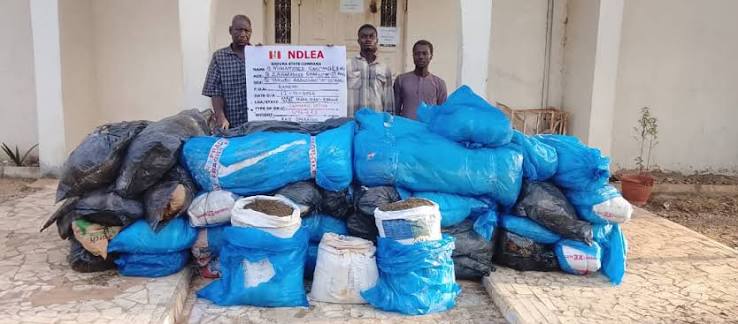
Operatives of the National Drug Law Enforcement Agency (NDLEA) have intercepted a Saudi Arabia-bound consignment of cannabis concealed in a gallon of palm oil at the Mallam Aminu Kano International Airport (MAKIA), Kano.
The agency also uncovered 8,725 kilograms of powdered tramadol worth over N6.98 billion at the Apapa Port in Lagos, and seized large quantities of illicit drugs across NDLEA intercepts Saudi-Bound drugs hidden in palm oil keg at the airport.
Chairman of NDLEA, Brig. Gen. Mohamed Marwa (retd), disclosed this in a statement issued by the NDLEA spokesman, Femi Babafemi, yesterday.
According to the statement, officers at Kano airport on Friday, October 16, intercepted a female passenger, Fatimah Ahmad, with a gallon of palm oil containing 511.75 grams of skunk during outward clearance of an Ethiopian Airlines flight to Jeddah, Saudi Arabia, via Addis Ababa.
She told operatives that the keg was given to her by her cousin, Abubakar Yahaya, who was arrested at the airport car park.
In another operation at APM Terminals, Apapa, Lagos, operatives in a joint examination with Customs on October 2 uncovered a large shipment of powdered tramadol from India declared as maize starch.
Laboratory test confirmed it to be tramadol hydrochloride powder. When separated from concealment on October 14, it came to 349 bags weighing 8,725kg with street value of over N6.98 billion.
In a separate operation at Tincan Port on October 12, NDLEA officers discovered 55kg of Canadian Loud worth N165 million hidden in brown cartons inside a Toyota Sienna conveyed in a 40-foot container.
In Lagos, operatives raided Idumota market on October 14 and arrested Elizabeth Chidera Kalu, recovering 10,600 ampoules of diazepam injection and 6,500 tablets of Molly from her store.
On October 15, two men were arrested in Mushin – Idowu Daudu with 59.95kg of skunk and Ahmed Oniyinde with 61.23kg. Same day, operatives intercepted a truck from Trade Fair market along Iyana Oba, arresting loading manager, Adeduntan and his assistant Azeez Sikiru, and recovering 18,000 pills of tramadol 250mg concealed in cartons labelled as Rambo insecticide.
In Edo State, operatives raided Warake, Ivhiaro and Ewe/Irue communities in Owan East LGA between October 15 and 16, arresting six suspects including 85-year-old Grace Ehimeka with 179kg of skunk at Warake; Ayo Aigberadion, 53, with 220.8kg; Ali Garba, 57, with 5.852kg; Habib Braimoh, 45; Musa Mubid, 35, with 2kg cannabis, seeds, tramadol, Swinol and diazepam; and Hope Okoro, 35, with 237 grams of Loud.
In Ondo State, operatives raided a cannabis farm in Okemoro Isinbode camp forest on October 17, destroying 7,500kg skunk on three hectares and arresting five suspects – Asikpo Ekpeyoung, 43; Solomon Okpani, 22; Ubong Friday, 35; Joseph Friday, 22; and Ekenimi Seth, 35.
Exhibits recovered were 92 bags weighing 1,267kg, 11kg seeds and 3kg stems.
In Owo on October 16, 53-year-old Okunebe Ndidi was arrested with 25 bags weighing 375kg.
In Bauchi, 894,800 pills of tramadol and Exol-5 were recovered from Shamsu Garba, 35, at Ragwam village, Katagum LGA on October 14, while 291 blocks of cannabis weighing 265kg were recovered from an abandoned car along Bauchi-Gombe road.
In Kano, Ali Abdullahi, 38, and Ibrahim Adamu, 23, were arrested along Zaria-Kano road on October 13 with 30,100 tablets of tramadol 225mg, while Murtala Dayyabu, 54, was arrested at Niger Street, Malan Kato on October 14 with 100,000 tablets of Exol-5.
In Kaduna, operatives arrested Mohammed Sani, 48, Zaharadeen Shafiu, 29, and Yakubu Abdullahi, 20, with 496.5kg cannabis at Kayimi village, and John Ayo David, 39, with 49,500 tablets of tramadol at Food Palace, Ali Akilu Road. In Abuja, Odo Jonas Ejike, 42, was arrested at Utako on October 17 with 29,500 capsules of tramadol.

The immediate past Commissioner for Health in Rivers State, Dr. Adaeze Oreh, has called for acceleration of enrollments into the State Contributory Health Insurance Scheme.
Oreh made the call in a keynote address at the Rivers State Health sectors Joint Annual Review (JAR) meeting in Port Harcourt, recently.
She said this was necessary in order to ensure that no Rivers family is pushed into poverty due to medical bills.
The former Commissioner also called for the training and retraining of medical and health workers in the State with a view to deploying skilled health professionals to underserved rural and the riverine areas of the State.
She also called for the sustenance of the ongoing health facilities and infrastructural upgrade across the State to ensure quality health services to the people.
Oreh harped on the need to strengthen accountability and institutional integrity in the healthcare system, saying, “progress without accountability is fleeting.
“To build the trust of our people and the state partners, accountability must be non negotiable.”
She described the event as a decisive moment in the healthcare programme of the State.
“We gather here today at a critical juncture in Rivers State’s health system’s journey. This assembly is not a mere ritual of administrative reporting; it is a decisive moment of reflection, evaluation, and strategic alignment.
“Today, we stand at the intersection of where we have been, where we are, and where we must go to guarantee the health and well-being of every resident of Rivers State.
“The mandate of this year’s JAR is clear: we must turn evidence into action, and data into tangible human impact,” she said.
The former commissioner said the administration of Governor Siminalayi Fubara, has over the last three years prioritized the healthcare needs of the State through the provision of infrastructure and upgrading of healthcare centres across the 23 local government areas.
“Over the past year, under the leadership and vision of the State Governor, Sir Siminalayi Fubara, bold strides have been taken to fortify the health sector architecture.
“The baseline strength of healthcare delivery has been prioritised by upgrading primary healthcare centres across all our 23 local government areas, ensuring that basic health interventions are brought closer to where our people live and work,” she stated.
Oreh emphasised that public health intelligence systems have been reinforced by the Fubara administration, thereby ensuring rapid response capabilities to potential disease outbreaks and safeguarding our communities against health emergencies.
“Through targeted interventions and partnership programmes, there has been an expansion of access to essential care for our women and children, the very backbone of our state’s future.
“These achievements demonstrate what is possible when political will aligns with technical rigour. However, consolidation means ensuring that we step beyond achievement to determine that these gains are resilient, scalable, and resistant to disruption” Oreh said.
The former health commissioner also said that every resources allocated to health in Rivers State from public funds to partner contributions must yield measurable health outcomes.
“The systematic elimination of bottlenecks, reducing of waste, and enforcing strict stewardship of health sector investments is critical.
” Your ultimate accountability is to the citizens of Rivers State. Access to compassionate, high-quality, and respectful healthcare is a fundamental expectation, and you must be committed to upholding that trust across all communities.
“As we look toward 2027, your strategic priorities must be bold, realistic, and focused on lasting structural transformation. In this Joint Annual Review, our discussions must crystallize into four core strategic pillars,” she advised.
Oreh said since no government can succeed in isolation. the strengthening of multi-sectoral collaborations with development partners, private sector innovators, and civil society organisations must remain an unflinching commitment.
She stressed the need for participants at the meeting to challenge assumptions, examine the evidence critically, acknowledge gaps candidly, and co-create solutions that are tailored to the unique realities of Rivers State.
In his welcomes address the Permanent Secretary Rivers state Ministry of Health, Dr Vincent Wachukwu, said the task before the ministry this year is to examine what has changed for the people who depend on the services of the ministry.
According to him, the review this year was organised around six questions covering survival and equity, continuity of care, quality, system capability, health intelligence and implementation of corrective action.
“Our responsibilities are to identify the requirements relevant to Rivers State and organise the evidence and institutional action needed to meet them,” he said.
By: John Bibor, Francis Obomate & Jimoh Omosefe
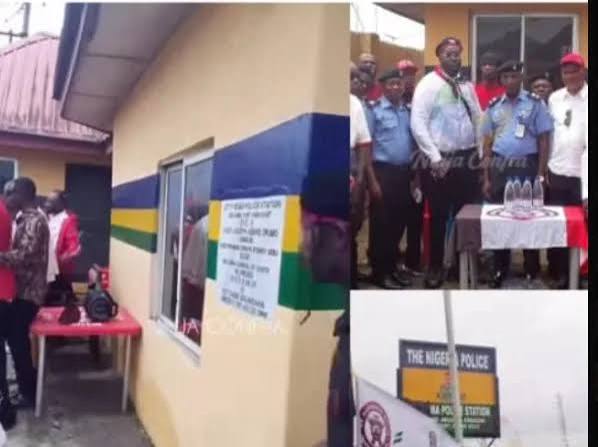
Two senior police officers, including the Divisional Police Officer of the Abuloma Police Division in Rivers State, have been removed from their positions following allegations that suspected cultists renovated a police facility under their jurisdiction.
The other officer is the divisional officer overseeing the affected police outpost.
The Rivers State Police Command disclosed this in a statement issued by its spokesperson, ASP Blessing Agabe, in Port Harcourt, last Friday.
The Police said the action followed a viral video showing suspected cultists visiting the facility on Thursday, October 15, 2026, to celebrate the completion of the renovation.
The statement, titled ‘Rivers State Police Command Condemns Purported Renovation of Abuloma Police Outpost by Suspected Cultists, Relieves Officers, Orders Full Investigation’, said the command had ordered a full investigation into the incident.
The command condemned any action or association capable of compromising the integrity, discipline and professional standards of the Nigeria Police Force or conferring legitimacy, recognition or acceptance on suspected cult groups or other unlawful organisations.
The police image maker said the State Commissioner of Police, Olugbenga Adepoju, had ordered a full-scale investigation to establish the circumstances surrounding the renovation and the veracity of the allegations.
The identities and backgrounds of the individuals or groups that financed or facilitated the renovation would also be investigated, alongside the roles played by police personnel.
The statement read, “The Rivers State Police Command has taken cognisance of a trending social media report and circulating video alleging that suspected cultists renovated the Abuloma Police Outpost and visited the facility on Thursday, October 15, 2026, to celebrate the completion of the renovation.
“The Command strongly condemns any action or association capable of compromising the integrity, discipline and professional standards of the Nigeria Police Force or conferring legitimacy, recognition or acceptance on suspected cult groups or other unlawful organisations.
“Police facilities are public institutions established for the protection of citizens and the enforcement of law and must not become platforms through which criminal groups seek public validation or influence.
“Under the leadership of CP Olugbenga A. Adepoju, the Command maintains zero tolerance for criminality and any conduct that undermines public confidence in the Police.
“Consequently, the Divisional Police Officer (DPO) in charge of Abuloma Division and the Divisional Officer overseeing the affected Police Outpost have been queried and relieved of their duties pending investigation.
“Furthermore, the Commissioner of Police has ordered a full investigation to establish the circumstances surrounding the incident and the veracity of the allegations, including the identities and backgrounds of the individuals or groups who financed or facilitated the renovation.”
The statement added that the investigation would examine whether the project was authorised, whether due procedures were followed, and whether any police officer breached professional standards or compromised the integrity of the force.
It said, “The Command welcomes legitimate community support for improving police facilities, consistent with Section 26(1)(d) of the Nigeria Police Act 2020, which provides for gifts and contributions to the Police General Fund.
“However, such support must not compromise police independence, professional standards or security.
“The investigation will establish whether the necessary approvals were obtained and appropriate checks conducted on those who financed or facilitated the renovation.
“No donation or assistance confers immunity from investigation or prosecution.
“The Command reiterates that it will not condone unprofessional conduct or compromise any form of improper association with criminal elements by any police officer.
“All personnel are expected to uphold the highest standards of discipline, integrity and accountability in the discharge of their duties.”
The command said appropriate disciplinary and legal action would be taken against anyone found culpable, in line with the outcome of the investigation and extant laws.
It urged members of the public to remain calm and continue to provide credible and timely information to the police to enhance security across the State.
The Tide reports that a viral video circulated online had shown suspected cultists posing as students, occasionally chanting “greatest Nigerian students” before using what appeared to be cult-related slogans.
The individuals were seen wearing black trousers and white shirts, with some wearing red fez caps and others black berets, celebrating in front of the renovated facility alongside some police officers.
A popular online anti-cultism platform, Naija Confra, also posted videos and pictures showing the suspected cultists chanting slogans, including “Aromate”, at the station last Thursday, shortly after taking pictures with officers at the facility.
The incident, which occurred on October 15, 2026, was said to have coincided with activities marking the annual anniversary of the Vikings confraternity.