Connect with us

Maritime

Shippers Council Rates Nigerian Ports High

Published

on

The leaderahip of the Nigerian Shippers’ Council has said that the Nigerian seaports are now more efficient and effective, with over 80 percent of cargoes West and Central African countries patronising Nigerian seaports.
This was made known by the Executive Secretary of the Council, Barr. Hassan Bello in Lagos, last Wednesday.
Bello in a statement, said Ghana and Togo port are not a threat to Nigerian seaports because of its efficiency.
Recall that there were recent reports that Lomé port in Togo hosted West Africa’s leading container port, snatching the position from Lagos ports in Nigeria in the last quarter of 2018
This was attributed to the commissioning of the Lomé Container terminal (LCT) which handles containers shipped through the port of Lomé. LCT actually handles nearly 890,000 TEU yearly that is about 75% of containers that transit via the PAL.
But Bello said that despite the feat achieved by the Ghana and Lome ports, Nigeria seaport still remained preferred destination for cargoes in the sub-region.
According to him, “Out of the cargoes that is meant for West and Central Africa coming from around the world, 80 percent of the cargoes comes to Nigeria while other countries share the remaining 20percent and distributed among themselves.
“So, how can they be a hub? Also Nigerian ports are becoming efficient by the day and we are attracting cargoes from other neighbouring ports”, he said.
Bello said further that, “The moment we get our infrastructure right and get our connectivity right, we also patronise our eastern port and also tackle insecurity on the waterways, then that’s where we see the real hub.”
He was optimistic that the actualisation of the Lekki deep-seaport project would further consolidate the hub status.
Hear him, “We have the Lekki deep seaports with its huge capacity and when the Lekki port is completed and it came fully on board, we will get bigger ships and send the smaller ones to other countries.”
Speaking on the National Transport Commission (NTC) Bill, Bello said the bill would be assented to by President Muhammadu Buhari before the end of the current administration.
“The rejection of the bill is a misconception and I would love many of your colleagues to do more research on the issue.” .

Chinedu Wosu

Continue Reading

Maritime

Nigerians Deserves Friendly Ports Taxation, Efficiency  –Muda Yusuf

Published

on

Nigeria’s quest for industrial growth and economic transformation depends largely on modern and competitive ports, efficient transport and logistics systems and affordable and reliable energy.
 It also includes accessible and low-cost industrial finance, predictable and investment-friendly taxation, and efficient, transparent and business-friendly regulation.
 CEO of Centre for the Promotion of Private Enterprise (CPPE), Dr. Muda Yusuf, stated this while speaking on ‘Nigeria’s Industrial Policy, Manufacturing Competitiveness and Economic Transformation’ at the 2026 Mid-Year Economic Review and Outlook Conference of the Lagos Chamber of Commerce and Industry (LCCI) in Lagos recently.
The CEO advised the Federal Government  to invest in world-class ports for faster turnaround, lower charges and seamless trade while developing integrated transport networks to reduce costs, time and supply chain bottlenecks.
He also noted the need for the government to ensure steady, affordable power supply to drive industrial productivity and competitiveness while expanding affordable credit and long-term financing for manufacturers and industrial enterprises.
Dr. Yusuf maintained that government must provide stable tax policies that encourage investment, reinvestment and growth.
He urged the government to simplify processes, reduce bureaucracy and eliminate multiple charges and compliance burdens.
On productivity and innovation, Muda said for Nigeria to compete globally, the country must invest in digitalisation, technology adoption, skills and talents.
The CPPE CEO said Nigeria’s domestic market is one of Africa’s greatest advantages but no country achieves sustained industrial expansion by relying exclusively on domestic demand, pointing out that “the African Continental Free Trade Area (AfFTA) presents Nigeria with one of the greatest commercial opportunities in our history.”
According to him, our export success depends on the quality, pricing, reliability, delivery, compliance with international standards and productive efficiency.
 “Nigeria’s future as an industrial nation depends on how strongly we compete beyond our borders,” he said .
He further noted that high inflation, exchange rate instability and persistent fiscal imbalances increase uncertainty and discourage long-term industrial investment, pointing out that the first responsibility of government is to ensure macroeconomic stability as manufacturers require a stable macroeconomic environment to plan investment, price product and manage risk.
By: Nkpemenyie Mcdominic, Lagos
Continue Reading

Maritime

NSC Boss Advocates Stronger Collaboration Among Govt. Ports Agencies  —As Experts Calls For Robust Framework 

Published

on

The Nigerian Shippers’ Council NSC, has called for stronger collaboration among government agencies operating at the nation’s seaports to eliminate cargo clearance delays, reduce cargo damage, and minimise the legal and financial disputes arising from prolonged port operations.
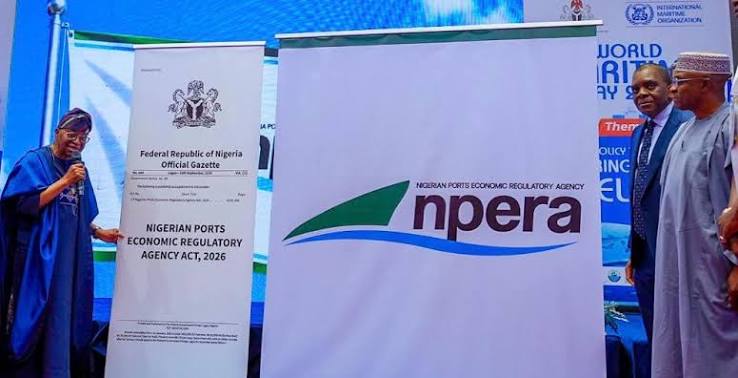
The Council has also assured that the newly enacted Port Economic Regulatory Law will address operational bottlenecks at the country’s seaports.
Executive Secretary/CEO of the Council, Dr Akutah Pius, MON, made the call while speaking during a technical session at the 18th International Maritime Seminar for Judges in Abuja.
Responding to discussions on the consequences of cargo delays and their legal and financial implications, Dr Akutah stressed that greater synergy among regulatory agencies is essential to improving operational efficiency across Nigeria’s ports.
He acknowledged that inefficiencies resulting from weak inter-agency coordination have continued to pose significant challenges to the nation’s shipping industry, leading to avoidable delays, increased costs, cargo deterioration, and protracted litigation.
Dr. Akutah noted that while some legal experts at the seminar advocated for legislation to protect port terminal operators operating under concession agreements, the proposed Nigerian Port Economic Regulatory Agency NPERA, Bill, which designates the Nigerian Shippers’ Council as the statutory Port Economic Regulator, is expected to provide the regulatory framework needed to address many of the operational and commercial challenges affecting port services and cargo clearance in Nigeria.
According to him, the proposed legislation will strengthen economic regulation within the port sector, promote efficiency, enhance accountability, and create a more predictable business environment for investors and port users.
The NSC boss also highlighted the importance of the International Maritime Seminar for Judges, describing it as a critical platform for strengthening judicial capacity in maritime law and improving the resolution of maritime disputes.
“The importance of maritime cases cannot be overemphasised. This seminar provides an important opportunity for judges handling maritime matters to deepen their knowledge while enabling stakeholders to identify areas requiring improvement for the growth of the sector,” he said.
He added that sustained engagement between the judiciary and maritime stakeholders would further support the development of Nigeria’s maritime industry by promoting faster and more efficient dispute resolution.
Dr. Akutah observed that delays in the adjudication of maritime cases discourage investment and undermine confidence in the nation’s judicial system.
“No investor will bring capital into a country where there is no confidence in the judicial system. Maritime disputes are often complex, time-consuming and expensive to resolve. One of the key objectives of this seminar is to promote alternative dispute resolution mechanisms that will ensure quicker settlement of maritime disputes and inspire investor confidence in Nigeria’s maritime sector,” he stated.
Earlier during the technical session, legal and maritime experts called for a robust legal framework to better protect terminal operators under Nigeria’s port concession regime while also ensuring a fair balance between the rights of investors, service providers and port users.
The 18th International Maritime Seminar for Judges, organised by the Nigerian Shippers’ Council in collaboration with the National Judicial Institute (NJI), continues to provide a platform for dialogue on contemporary maritime legal issues aimed at strengthening Nigeria’s maritime justice system and improving the ease of doing business in the country’s seaport sector.
By: Nkpemenyie Mcdominic, Lagos
Continue Reading

Maritime

Customs Unveils Information File Tracker,  Boosts Operational Efficiency 

Published

on

Nigeria Customs Service has unveiled a new Management Information System (MIS) File Tracker at its Port and Terminal Multi-Purpose Services Limited (PTML) Area Command, Lagos in line with ongoing efforts to deepen the deployment of technology in personnel administration with a view to enhancing the speed and efficiency of document processing,
Speaking at the unveiling ceremony, Comptroller General of the Service, Bashir Adewale Adeniyi MFR, said the initiative represents another milestone in the Service’s expanding modernisation agenda, which is focused on deploying digital solutions to improve operational efficiency, enhance transparency, and facilitate seamless trade.
The MIS is an Enterprise Platform for all Customs administrative processes that would serve as a Single Sign-On (SSO) application which enables one unified data set to be used across all departments administratively.
Represented by the Deputy Comptroller General in Charge of ICT /Modernisation, DCG Oluyomi Adebakin, the CGC reaffirmed the commitment of the Service to leveraging technology to transform its operations and improve service delivery.
Recall that DCG Adebakin had played key role in several landmark digital initiatives, including the Nigeria Trade Portal and the Customs Verification Management System.
The CG further noted that the deployment of the MIS File Tracker further demonstrates the Service’s resolve to embrace innovation in line with global best practices.
“The introduction of the MIS File Tracker will further strengthen the command’s reputation as a centre for innovation within the NCS with key features that promotes ease of administration”, the CGC further said.
He therefore urged Officers to utilise the application for key administrative functions, including Leave and Pass Applications; File Tracking; Duty Roster; Internal Staff Orders; Nominal Roll and other administrative processes.
It was gathered that the platform also provides avenues for feedback on areas requiring modifications, additions, and improvements.
The Customs boss expressed the hope that this current deployment would streamline internal workflows, reduce manual processes, and support data-driven decision-making processes across the Service.
Recall that the PTML Area Command, widely regarded as one of the most technologically advanced commands in the Service, has continued to serve as the preferred pilot location for cutting-edge Customs modernisation projects including the Unified Customs Management System UCMS, also known as B’Odogwu.
Acting Controller of the Command, Deputy Comptroller Nura Miko expressed optimism in the commands ability to successfully implement the rollout and serve as a model for customs innovation.
 Miko stated that the command is maximising all technological backed trade facilitation initiatives made possible by the NCS Management.
The Acting Controller also disclosed that efforts are in place to further reduce the two- hour cargo clearing time record
By: Nkpemenyie Mcdominic, Lagos
Continue Reading

Trending