
Featured
Rivers Agog As Wike Returns With ‘Power Of Sports’ Award …Gov Stops Over At Project Sites …Again Warns Against Street Trading …NUJ Hails Gov On Award


Rivers people yesterday trooped to the Port Harcourt International Airport, Omagwa to celebrate Rivers State Governor, Chief Nyesom Wike as he returned with the “Power of Sports” Award.
The International Sports Press Association-Africa (AIPS) Africa had conferred the Power of Sports Award in a ceremony last Wednesday in Belgium witnessed by sports journalists from 108 countries.
Accompanied by his wife, Justice Eberechi Suzzette Nyesom-Wike and Rivers State PDP Chairman, Bro Felix Obuah, Wike returned to the love and support of Rivers people who sang his praises for doing the state proud.
Defying the heavy rains, Rivers people declared their unflinching support for the governor in his commitment to change the fortunes of the state.
Wike said that the award would only spur him to further dedicate himself to the construction of a New Rivers State, adding that investments of his administration would earn the state global acclaim.
He reiterated that the state’s investments in sports, especially the Real Madrid Football Academy was to empower youth with the right footballing skills and education to conquer the world.
The construction of the Real Madrid Football Academy would be flagged off on May 28, 2018 in an international event in Port Harcourt.
Wike said: “I wish to reiterate our resolve to continue to tap the benefits of sport to advance social cohesion, peace and progress in Rivers State.”
Chief of Staff to the Rivers State Governor, Engr Emeka Woke, who welcomed the Rivers State governor alongside other Rivers people, said that the state has transformed into an international reference point because of the outstanding developmental strides of the Governor.
Meanwhile, Governor Wike on his return from Brussel yesterday appealed to street traders to desist from displaying their wares on major roads.
Governor Wike also described as unfortunate the attack of Government Officials restoring sanity on the roads by hoodlums at the Slaughter Market in Port Harcourt. .
He gave the management of the market two days to produce the hoodlums or face sanctions.
He said that nobody will be allowed to disrupt the development process of the state, under any guise.
The govenor spoke with the traders during his inspection visits to project sites on Thursday after returning Brussels where he was honoured with the Power of Sports Award by the International Sports Press Association Africa.
He said that apart from the fact that the traders damage portions of the roads recently constructed and deface the roads, street trading poses danger to the traders who are susceptible to accidents.
He urged the traders to move into different markets across Port Harcourt and Obio/Akpor Local Government Areas constructed for business activities.
He said: “Please don’t trade on the streets. What you are doing damage and deface the roads. My plea is that you go into the markets for your safety and the aesthetics of the city.”
Governor Wike said that the state government will take sustained measures to check illegal street trading, hence his personal involvement with the sensitization of traders.
He added that the meshed wires fences are beings installed on roads in areas prone to street trading to keep the traders off the roads.
“As we are working on these roads, everyone is happy. We will not allow street traders destroy the beauty of the city”, he said.
During the inspection yesterday, Governor Wike visited National Industrial Court, Mother and Child Hospital, Restaurants and Cinema, Port Harcourt Pleasure Park, Court of Appeal, Port Harcourt, Judges Quarters, Slaughter Road, Reconstruction of Government Offices at Mile One Fly Over,Traditional Rulers Secretariat, Land Reclamation at Ogbunabali/Nkpogu, Oil Mill-Elelenwo-Akpajo Road, Abacha Road, Mgboshimini Primary Health Care , Doctors Quarters among other projects.
Governor Wike said that intense projects inspection will continue ahead of the third year anniversary.
Majority of the projects visited by Governor Wike will be commissioned during the administration’s third year anniversary.
Governor Wike expressed satisfaction with the quality of work done at the project sites, emphasising that the joy of Rivers people at the execution of projects is a motivation.
In a related development, the Rivers State Council of the Nigeria Union of Journalists (NUJ) has congratulated the state Governor, Chief Nyesom Wike on the conferment of Africa ‘Power of Sports’ award on him by the International Sports Press Association (AIPS) in Brussels, Belgium.
The NUJ, in a statement signed by its Acting Chairman, Uche Agbam and Acting Secretary, Anayo Onukwugha, described the award as well deserved, considering the governor’s contributions to the development of sports in Nigeria, and Africa in general.
The union said the recent hosting of the African Wrestling Championship in Port Harcourt as well as the renovation of the Alfred Diete-Spiff Sports Complex were some of the feats achieved by the governor in the area of sports development.
“We are not surprised that AIPS conferred this revered award on Governor Nyesom Wike. The governor is the first African to be conferred with the ‘Power of Sports’ award. We believe that the governor’s immense contributions to sports development in Nigeria, and Africa in general, attracted the award.
“Recently, Rivers State hosted the whole of Africa in the African Wrestling Championship. Also, the renovation of the Alfred Diete-Spiff Sports Complex is another eloquent testimony of Governor Wike’s commitment to the development of sports,” the union added.
Meanwhile, the international sports journalists, last Wednesday, in Brussels, Belgium, honoured Rivers State Governor, Chief Nyesom Wike with the ‘Power of Sports’ award.
He was nominated by the International Sports Press Association (AIPS), Africa.
Witnessed by sports personalities and journalists from across the globe, the award to the governor was for his remarkable fidelity in raising the bar of sports matters and using sports as a catalyst for development.
The event took place at Le Plaza, Brussels and the presentation of the award was performed by the President, AIPS, Mr Gianni Merlo and President, AIPS Africa, Mr Mitchell Obi in the presence distinguished sports journalists from 108 countries.
Presenting the award to the Rivers State governor, President AIPS Africa, Mitchell Obi said Wike was being recognised for the use of sports as a tool to effectively engage the youth population in the continent.
He urged Wike to sustain his commitment to sports development as more youth would be empowered in the state.



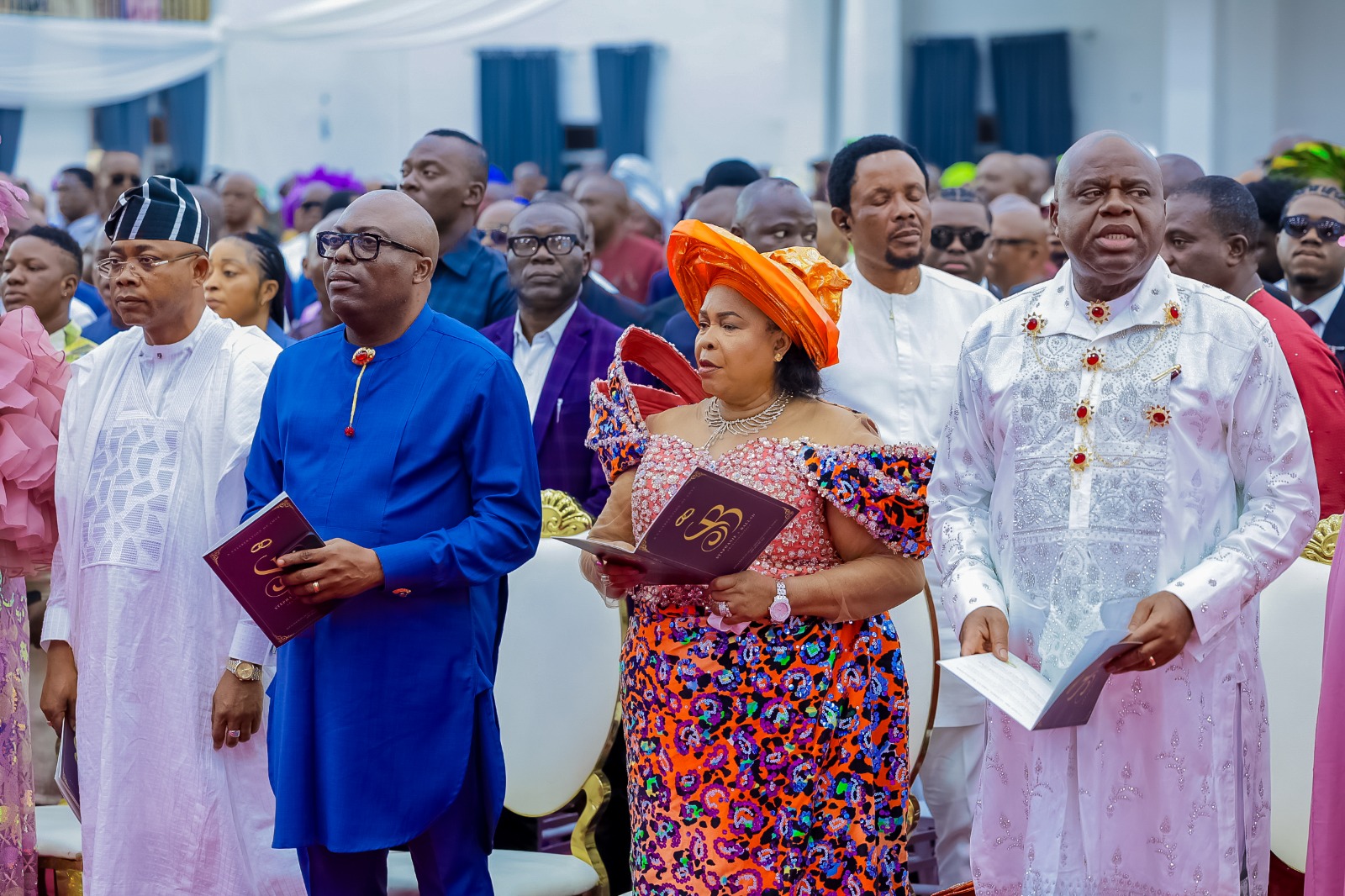
Rivers State, Sir Siminalayi Fubara, has assured members of the National Youth Service Corps (NYSC) of his administration’s commitment to supporting and strengthening the scheme in the State.
Fubara gave the assurance last Friday at the NYSC permanent orientation camp, Nonwa-Gbam, Tai Local Government Area in the State, during the swearing-in ceremony of 2026 Batch B Stream II orientation course.
Represented by the Permanent Secretary, Cabinet Bureau, Office of the Secretary to the State Government, Dr. Promise Oguzie, the governor said the State Government would remain intentional in providing the necessary support to improve the NYSC scheme and enhance the experiences of corps members deployed to the state.
He charged the corps members to be role models and quality nation-builders in their service to the good people of Rivers State in particular, and Nigeria at large.
“I charge you to be exemplary, dedicated and committed in all you do. Take full advantage of all the camp programmes and activities to enrich yourselves”, he said.
In his welcome address, the State Coordinator of NYSC in Rivers State, Mr. Moses Oleghe, urged corps members to see their deployment to Rivers State as a “veritable opportunity to make meaningful contribution to the growth of the State in particular and Nigeria at large.”
He further charged them to serve with all sense of “integrity, discipline, and the fear of God, especially when they will be engaged as INEC ad-hoc staff that will conduct the 2027 general elections.”
A total of 3,584 corps members composed of 1,421 males and 2,163 females were sworn in by the Chief Judge of Rivers State, who was represented by Justice Godspower Aguma.

Governor of Rivers State, Sir Siminalayi Fubara, says Nigeria needs God-fearing leaders for the nation to move in the right direction and make meaningful progress.
The Governor stated this yesterday when he received in audience, the World President of the Seventh Day Adventist Church, Pastor Erton Kohler; his wife, Andriene Marques Kohler; daughter Mariana Marques Kohler and a retinue of ministers of the church at Government House, Port Harcourt.
Fubara who hailed the Seventh Day Adventist Church for its contributions to education and the grooming of future leaders in Nigeria, expressed delight that the Church had over the years, been investing in education at various levels and currently runs two universities in the country.
He commended the church for not only using its institutions to spread the gospel of Christianity but to groom future leaders for the country.
According to him, religion should not be just about defending one’s faith, but also making meaningful impact on the lives of the people.
He said that by floating these educational institutions, the church has demonstrated capacity to support Nigeria in the task of producing not only educated people but a breed of God-fearing leaders.
“Our country is where it is today because we lack the fear of God. If you have the fear of God, there should be a limit to what you can do because you understand the supremacy of God. But when God is not in your equation, you’ll go beyond the line and that is what has brought us to where we are today.
“So, I feel very happy that you are contributing to the development of our future leaders in this country. We need the right people being in the right place; prepared properly with good minds; that is what we need, not just in Nigeria but round the whole world.,” he said.
Governor Fubara further observed that the absence of God-fearing people in high places to take the right decisions that could impact positively on the society, has also given rise to other problems such as social inequality, poverty, corruption and criminality. According to him, Nigeria needs a system where the average parent could afford quality education for their children and a guarantee that upon graduation, the average child will have the capacity to compete favourably with anybody, anywhere in the world.
“If we have a situation where the little money that you’re being paid as wage can also afford you quality healthcare and after working at least for 15-20 years, you have a roof over your head, tell me why you should be involved in any kind of crime? At that point, you’ll feel secured and this attitude of insecurity about the future that leads to all the social vices we have today won’t be there,” he said.
Governor Fubara expressed appreciation to the delegation for the visit and for their prayers for Rivers State, assuring them of his continued support for their programmes in the state.
Leader of the delegation and World President of the Seventh Day Adventist Church, Pastor Erton Kohler said he was in Nigeria for a special conference of the church during which thousands of the church’s ministers will be undergoing an empowerment programme to further equip them for the task of herding their flocks and serving the society.
He expressed gratitude to the Governor for the warm reception accorded his entourage, saying the memory of the visit will linger in his mind for a lifetime.
Kohler disclosed that the Church has over twenty -four million (24,000,000) members and more than 182,000 places of worship, spread across 212 countries of the world.

The Rivers State House of Assembly has approved the 2026–2028 Medium Term Expenditure Framework (MTEF) submitted by Governor Siminalayi Fubara.
This reaffirms the lawmakers’ commitment to enacting laws and taking legislative actions geared towards the overall development of the State.
The Assembly gave the approval during its Second Legislative Sitting of the Fourth Session held last Friday.
Speaking on the MTEF document during plenary, the House Speaker, Rt. Hon. Martin Amaewhule, noted that by the provision of Section 10(1)(b) of the Rivers State Fiscal Responsibility Law No. 8 of 2010, the MTEF ought to have been laid before the House in September 2025.
Amaewhule explained that traditionally, the document is expected to be presented four months before the commencement of the next financial year and immediately after the expiration of every three-year fiscal cycle.
He, however, stated that in the interest of the State and its people, the House considered it necessary to deliberate on the document, describing it as a precursor to the 2026 Budget Estimates.
The Speaker expressed concern that the year had already progressed significantly before the presentation of the framework.
During deliberations on the document, members examined the assumptions and projections contained in the MTEF and observed that strict adherence to the outlined fiscal parameters would ultimately serve the interest of Rivers people.
The lawmakers maintained that effective implementation of the framework would promote prudent financial management and enhance developmental planning across the State.
Following the debate and positive consideration by members, the Speaker put the question to the House and members voted overwhelmingly in support of the approval of the MTEF.
Meanwhile, during the same sitting last Friday, the House also received a petition from the Chairman of Obio/Akpor Local Government Council, Dr. Gift Worlu.
The petition was presented by the member representing Obio/Akpor Constituency II, Hon. Emilia Amadi.
According to the petition, concerns were raised over an imminent security breach, threats to lives, destruction of property and alleged forceful takeover of property by some lawless persons within parts of the Local Government Area.
Presenting the petition before the House, Hon. Amadi appealed to the lawmakers to revisit the matter and take necessary steps aimed at safeguarding lives and property in the affected communities.
The House is expected to further deliberate on the petition and consider measures to address the concerns raised in order to sustain peace and security in the area.
King Onunwor
-

 News3 days ago
RSG Targets Nine Million Residents in Mosquito Net Distribution Campaign
-

 Oil & Energy3 days ago
Aiyedatiwa Signs New Electricity Bill
-

 Oil & Energy3 days ago
NLNG Commissions Research And Innovation Centre In RSU
-

 Maritime3 days ago
Marine Minister Commends President Tinubu On NPERA Bill Assent
-

 News3 days ago
KenPoly Holds Eight Convocations, August 29
-

 News3 days ago
RMAFC Completes Revenue Sharing Review, Proposes New Pay
-

 News3 days ago
RSG Begins Another Phase of Projects Commissioning Today
-

 Maritime3 days ago
NAGAFF Petitions IGP Over Alleged Maritime Police Harassment