
Politics
Bruce Alerts On Pending Senatorial Elections

Senator Ben Murray
Bruce (Bayelsa East) has asked the Independent Electoral Commission (INEC) to explain why it has not conducted pending senatorial rerun elections.
Bruce noted that the non-representation of some states in the Senate was a violation of the constitution.
Bruce, who asked the Senate to take up the issue with the INEC Chairman, said the people of the affected areas have a right to be represented in the Senate.
The senator, said: “We have not had representation in this chamber from Rivers State, part of Anambra, Imo, Kogi and some other states. INEC concluded elections in one week in the Federal Capital Territory (FCT) but in these states they had no representation here and it does not make any sense.
”It is a violation of the constitution; the people of these states have a right to have representation here. The INEC Chairman owes us an explanation to explain why these elections have not been concluded.
”It is a simple matter and it is the responsibility for INEC to conclude these elections so that the people of these beautiful states have representation here in the Senate.”
Deputy Senate President, Ike Ekweremadu, who presided over the plenary, explained that he was aware that INEC would meet today to fix dates for the election.
He said: “Let me just say that I am aware that INEC will be meeting tomorrow (today) to fix dates for this rerun or bye-elections, but it is important that you have raised it so that the nation will know that we are concerned about the non-representation of some of these states.
“It is clear in the constitution that INEC should quickly conduct within 30 days bye-elections where vacancies occur and so, it is far past 30 days when vacancies occurred in some places. It is important that we urge INEC to ensure that as soon as possible that these elections are conducted so that every part of the country, every state would have their full representation in the National Assembly.”
In a related development, people from Imo North Senatorial District, Imo State, last Tuesday, staged a protest at the National Assembly to call attention to the delay in conducting Senatorial District re-run election in the area.
The Imo North Senatorial protesters, who came under the aegis of Okigwe Zonal Development Association Abuja (OZDA), displayed placards to press home their demands.



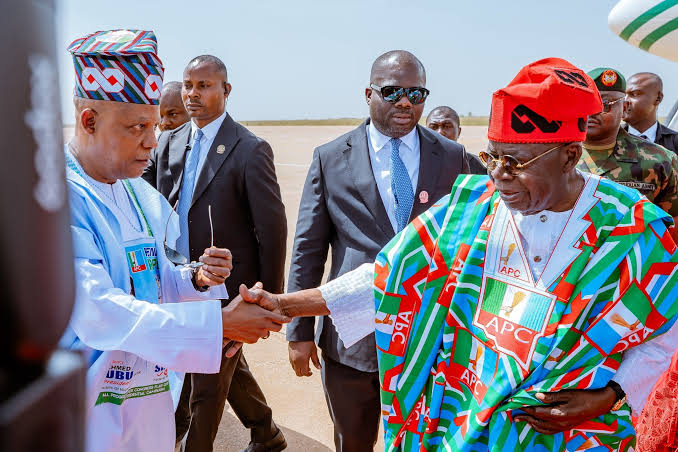
The campaign rally, held at the Kaduna Township Stadium, attracted Vice-President Kashim Shettima, APC governors, party leaders, federal and state lawmakers, political stakeholders and supporters from across the country.
The flag-off marks the beginning of the APC’s drive to secure a second presidential term for President Tinubu, with the party expected to promote its achievements, defend its economic reforms and outline its policy priorities under the proposed Renewed Hope 2.0 agenda.
Kaduna’s selection for the campaign launch underscores the strategic importance of the North-West, a region with a substantial voting population and considerable influence on presidential election outcomes.
The APC faces a significant challenge in Kaduna, where the Peoples Democratic Party’s presidential candidate, Alhaji Atiku Abubakar, defeated President Tinubu in the 2023 election. The rally therefore provides the ruling party an opportunity to strengthen its grassroots structures and regain electoral support in the state.
Addressing supporters, Vice-President Shettima appealed to Northern voters, highlighting President Tinubu’s political relationships with prominent Northern leaders, including Alhaji Abubakar, Mallam Nuhu Ribadu and the late President Muhammadu Buhari.
The Vice-President’s appeal reflects the APC’s determination to consolidate its support in the North as the party intensifies preparations for the presidential contest.
The Renewed Hope 2.0 agenda is expected to feature prominently in the campaign, providing a platform for President Tinubu to explain his administration’s economic policies and outline plans for another term.
However, the President’s record on economic reforms, rising living costs, petrol prices, employment, infrastructure and insecurity is expected to attract considerable scrutiny during the electioneering period.
-

 Niger Delta5 hours ago
Diri Restates Stance On Lagos-Calabar Coastal Highway
-

 Niger Delta5 hours ago
C’River, NUJ Pay Tribute To Late Guardian Editor
-

 News6 hours ago
NDLEA Recovers Tons Of Illicit Drug Consignments In Nine States
-

 Opinion4 hours ago
Checking Voter Apathy In Nigeria’s Electoral Process
-
 Oil & Energy5 hours ago
S&P Global Warns Hormuz Energy Shock Could Become A Global Food Crisis
-
 Oil & Energy5 hours ago
Gas Reserves Hit 215 Trillion Cubic Feet
-

 Rivers5 hours ago
Education Ministry Condemns Female Virginity Testing In CHS, Taabaa
-
 Oil & Energy5 hours ago
NCDMB, Manufacturers Commit To Scale Up Local Oil And Gas Production Components