
Nation
THE STATES

Adamawa
Officials of Adamawa State Hunters Association
assisting the military in the fight against insurgents in the state have called for public support and prayers for victory over the insurgents.
Officials of the association made the call in an interview with newsmen in Yola, saying their members were committed to contributing their quota toward curbing insurgency in the country.
Philips James, the Secretary of the hunters association, said “we need the peoples’ support and prayers. We also need government’s assistance in this assignment.”
James urged the public to be vigilant and be security conscious, as well as prayerful for victory over the insurgents.
Borno
The Bama Development Foundation, an NGO, said
yesterday that it had registered 180,000 Internally Displaced Persons (IDPs) from Bama taking refuge in Maiduguri.
Malam Mohammed Hassan, the Chairman of the foundation, stated this at a news conference in Maiduguri.
Hassan said that the IDPs were in four camps in Maiduguri.
According to him, the IDPs are those displaced during attack on the town by insurgents in September.
“We have recorded about 180,000 IDPs from Bama taking shelters in four different camps in Maiduguri as at October 31.
“The camps are located at the Yerwa Girls Secondary School, Women Teachers College, NYSC Orientation Camp and Government Girls College, Maiduguri’’, he said.
FCT
The Minister of Industry, Trade and Investment, Dr
Olusegun Aganga, said the Federal Government had identified 100 companies to be rewarded for contributing to the nation’s economic growth.
Aganga told newsmen in Abuja that the private sector was behind the country’s ranking as number one economy in Africa and one of the top 10 economies in the world.
According to him, over the last three years Nigeria has attracted more foreign direct investments and more local investments than any other economy in Africa.
“Earlier this year, the prestigious Wall Street Journal Frontier Market Settlement index which surveyed blue chip companies in developed economies ranked Nigeria number one country of global interest to investors.
”We are proud of these achievements because it is investors that create jobs for our people, wealth, facilitate economic growth and generate income for the government.
Kano
The Kano State Government said it spent N754.8
million on the construction of 74 public toilets in 74 rural markets in the state.
The State Commissioner for Rural and Community Development, Alhaji Garba Durbunde, disclosed this in an interview with newsmen in Kano recently.
Durbunde said that the provision of the toilets which was also supported with solar-powered boreholes was to stop open defecation in the communities.
He said that the projects were executed in the last two years, adding that they were jointly financed by the state government and benefitting local government areas.
He said that N407 million was spent on the construction of the boreholes while the toilets gulped N338.8 million.
Katsina
Malam Ado Sama’ila, the Education Secretary,
Dandume Local Government Education Authority in Katsina State, has urged parents to encourage their daughters to study in tertiary institutions in order to maximise their potentials.
Sama’ila made the call in an interview with newsmen in Dandume.
He said it was important for parents especially in rural areas to stop the habit of preventing their daughters from obtaining higher qualifications after secondary school.
The education secretary said that the practice limits the abilities of girls to contribute more meaningfully to societal development.
Lagos
A Consultant Public Health Physician, Dr Abdul-
Hakeem Abiola, said last Wednesday that lack of toilets was putting public health at risk.
Abiola, who works at the College of Medicine, University of Lagos, made this known in an interview with newsmen in Lagos on the World Toilet Day.
“Human faeces or human excreta is a source of infection and it is an important cause of environmental pollution.
“The health hazards of improper excreta management and disposal are one: it can cause soil pollution; it can cause water pollution; it can cause the contamination of foods and it can lead to propagation of flies, which can act as vectors for many diseases.”
Nasarawa
The Governing Council of Nasarawa State University
(NSUK), Keffi, has approved the appointment of Prof. Yakubu Ngwai and Dr Sa’adatu Liman as new Deputy Vice Chancellors, Administration and Academic respectively.
Notice of the appointment is contained in a statement signed by Prof. Muhammed Mainoma, the Vice Chancellor of the university, made available to newsmen on Thursday in Keffi.
The statement quoted Mainoma as saying “the decision to confirm the appointment of the two officers was taken at the meeting of the council, in line with the law that established the university.
“The confirmation of the appointment, which is for five years, starts with immediate effect.’’
Our correspondent reports that until their appointments, Ngwai was the Dean, Faculty of Natural and Applied Sciences, while Liman was the Head of Department of Islamic Studies and Deputy Dean Students Affairs.
Oyo
A Chief Magistrates’ Court sitting at Iyaganku, Ibadan,
has remanded a 45-year old John Jimoh in prison custody for allegedly issuing a dud cheque.
The Chief Magistrate, Alhaja Fatima Badrudeen, remanded Jimoh in Agodi prison pending his arraignment at the Federal High Court in Ibadan.
Jimoh, residing on Banji Street in Akuru Elebu area of Ibadan, was arraigned on a two-count charge of issuing a dud cheque to and obtaining money from a bank without paying back.
Jimoh was alleged to have obtained the sum of N500, 000 loans from Apex Trust Micro Finance Bank in Ibadan on September 4 with a promise to repay.
The Prosecutor, Insp. Adewale Amos, said Jimoh promised to repay the money within 30 days as agreed with the bank.
Sokoto
Journalists from Sokoto, Kebbi and Zamfara State have
called for adequate budgetary allocation for the Polio Eradication Initiative (PEI) in the country.
The journalists made the call at the end of a two-day media sensitisation/ review meeting on strategies to interrupt the transmission of the wild polio virus.
No fewer than 49 journalists attended the meeting held between November 17 and November 19, which focused on polio in the context of immunisation and child survival.
“There should also be the timely release of funds and physical involvement of PEI and other child-survival issues.
“Media practitioners and their organisations should continue to utilise their special positions in the society to strengthen and sustain the polio eradication and other child-survival programmes,’’ they said.
Taraba
Journalists who die in the line of duty should be given
post humous awards, Alhaji Bello Yero, Permanent Secretary, Bureau for Local Government and Chieftaincy Affairs in Taraba State, has suggested.
Yero made the suggestion while interacting with newsmen in Jalingo recently.
Extolling the virtues of journalists across the world that died in the line of duty, he said the slain journalists were heroes who deserved honour even in death.
“It is my considered view that such journalists should be given post humus awards.
“Journalists in Nigeria had the track record of covering violent conflicts even though it had often put their lives in danger.
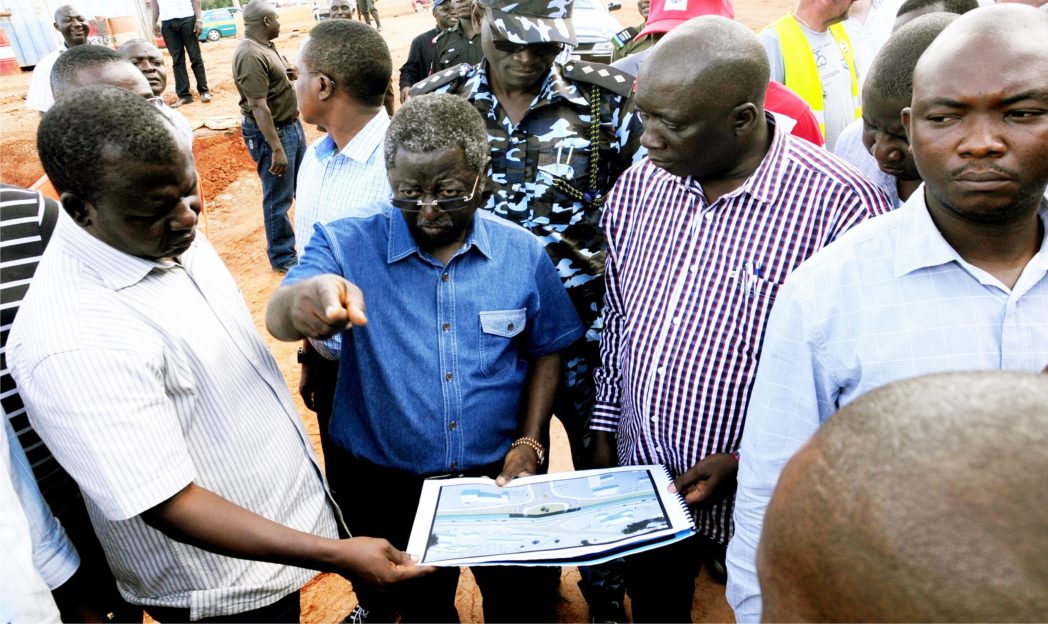
Gov. Jonah Jang of Plateau (2nd left), going through a plan of a Bridge at the Secretariat junction, Yakubu Gowon way, during inspection of road projects in Jos recently.



The Hydrocarbon Pollution Remediation Project (HYPREP) has commemorated the 15th anniversary of the release of the United Nations Environment Programme (UNEP) Environmental Assessment Report on Ogoniland, reaffirming its commitment to restoring the environment and improving the livelihoods of affected communities.
In a statement signed by the Project Coordinator, Prof Nenibarini Zabbey, to commemorate the anniversary, HYPREP described the anniversary as a significant milestone in Nigeria’s environmental restoration efforts, noting that the project has made remarkable progress in implementing the recommendations of the landmark UNEP report released on August 4, 2011.
The UNEP report had revealed extensive oil pollution across Ogoniland, severe environmental degradation, and serious public health risks resulting from decades of petroleum operations. It also recommended an initial $1 billion fund to commence the cleanup of the affected communities.
According to HYPREP, the Federal Government formally launched the Ogoni clean-up in 2016, while the Project Coordination Office was established in 2017 to drive the implementation of UNEP’s recommendations.
Zabbey said the current administration has continued to prioritise the project under the Renewed Hope Agenda.
Providing an update on the cleanup, the Project Coordinator disclosed that 30 of the 65 contaminated sites identified by UNEP have been fully remediated, while work is ongoing at several medium- and high-risk locations. It also stated that more than 1.5 million mangrove seedlings have been planted as part of what it described as the world’s largest restoration of oil-degraded mangroves, with over 1,000 hectares of shoreline already rehabilitated.
Zabbey further revealed that 49 Ogoni communities have been connected to potable water schemes through multiple water projects and booster stations aimed at providing safe drinking water across the region.
In the health sector, he said the 100-bed Ogoni Specialist Hospital in Kpite and the 43-bed Cottage Hospital in Buan are nearing completion, adding that several existing health facilities have been upgraded with modern medical equipment, while five ambulances have been donated to improve emergency healthcare services. The Project Coordinator also disclosed that a three-year human health biomonitoring study is being conducted in collaboration with the World Health Organization’s International Agency for Research on Cancer (IARC).
On economic empowerment, Zabbey stated that the Project has created more than 8,000 direct jobs and trained thousands of Ogoni youths and women in various vocational and technical skills, including software development, cybersecurity, aviation, commercial diving, seafaring, mechatronics, and creative arts. The project also reported awarding scholarships to more than 1,000 students, providing grants to small businesses, and supporting persons living with special needs through skills acquisition programmes.
The statement further highlighted ongoing legacy projects, including the Ogoni Power Project and the Centre of Excellence for Environmental Restoration, which it said is about 96 per cent complete. HYPREP also welcomed the recent designation of the Ogoni Wetland as a Ramsar Site of International Importance and pledged to continue promoting biodiversity conservation and sustainable management of the ecosystem.
Marking the anniversary, Zabbey said the progress achieved over the past 15 years demonstrates the collective commitment of government, development partners, stakeholders, and local communities to restoring Ogoniland. He called for renewed collaboration to sustain the cleanup effort, promote environmental sustainability, and support the long-term development of the region. 3
-

 News2 days ago
RSG Targets Nine Million Residents in Mosquito Net Distribution Campaign
-

 Oil & Energy2 days ago
Aiyedatiwa Signs New Electricity Bill
-

 Maritime2 days ago
Marine Minister Commends President Tinubu On NPERA Bill Assent
-

 Oil & Energy2 days ago
NLNG Commissions Research And Innovation Centre In RSU
-

 News2 days ago
KenPoly Holds Eight Convocations, August 29
-

 News2 days ago
RSG Begins Another Phase of Projects Commissioning Today
-

 News2 days ago
RMAFC Completes Revenue Sharing Review, Proposes New Pay
-

 Maritime2 days ago
NAGAFF Petitions IGP Over Alleged Maritime Police Harassment