
Business
PH Traders Take Over Walkways

Some traders in Port
Harcourt have taken over walkways as they brazenly display their wares on such facilities thereby forcing the pedestrians to contend with vehicles on the motor roads.
Regrettably, however, the purpose for which the government constructed the roads to include the pedestrian side walks seem to have been lost.
Investigations by our correspondent who went round town show that traders have practically taken over the pedestrian walk ways.
From Education Bus Stop to the New Mile One Market complex, traders are seen displaying their wares freely.
Emeka Uzoka, one of the traders at Education Bus Stop who displayed his sandals and other wares on the platform, when reminded of the illegality of his action, feigned ignorance.
Investigations from our correspondent further revealed that most of the traders who indulge in the practice own relatively large shops on Ikwerre Road but choose to display their wares on the side ways every day as they open for business.
Boniface Anyanwu, who sells travelling bags told The Tide that customers would not be easily attracted if traders’ wares remain in their shops.
He said even though he and other traders were aware of the illegality of their action, the public have come to live with the development without complaining.
An economist, Mr. Theophilus Amadike who spoke to our correspondent described the attitude of the traders as a form of illegal street trading.
He called on the appropriate government agency to call the traders to order even as he said most times the traders were seen removing their wares at the sight of sanitation officials.
He said the situation called for sensitisation of members of the public in challenging the traders as a matter of right.
“The traders are taking undue advantage of the silent public who use the pedestrian right of way.
“Let the appropriate government agency make us act so that the traders do not take the people for granted”, he said.
It would be recalled that The Tide reported recently of a partnership between the Rivers State Environmental Sanitation Authority, (RSESA), and the Mile One Market Traders Association, (MOMTA) to curb illegal trading.
However, the chairman MOMTA, Deacon Kenneth Chigozie Eze could not be reached for comments on the issue as at the time of filing this report.




-

 Niger Delta12 hours ago
Diri Restates Stance On Lagos-Calabar Coastal Highway
-

 Niger Delta12 hours ago
C’River, NUJ Pay Tribute To Late Guardian Editor
-

 News13 hours ago
NDLEA Recovers Tons Of Illicit Drug Consignments In Nine States
-

 Opinion11 hours ago
Checking Voter Apathy In Nigeria’s Electoral Process
-

 Sports9 hours ago
Nigerian Trio Target Titles At PFL Africa Finals
-
 Education9 hours ago
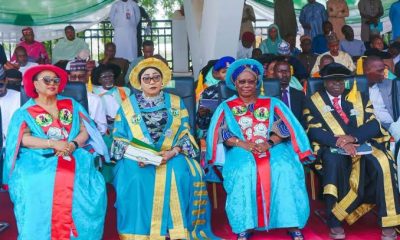
FCE Yola Graduates 3,555 Teachers , Seeks Upgrade to University
-

 Politics9 hours ago
2027: DICKSON’S EX-ALLY VOWS TO WORK AGAINST NDC INTEREST IN BAYELSA
-

 Politics9 hours ago
2027: GROUP PLEDGES 40,000 SUPPORTERS FOR COALITION CANDIDATES IN RIVERS