Connect with us

Business

NSE Extends Ban On Share Price

Published

on

The Nigerian Stock Exchange, NSE, will extend the 10 per cent ban on share price movement to include other stocks not covered by the market makers by April, said Ade Bajomo, Executive Director, IT and Market Operations, NSE.

He made the disclosure while briefing capital market correspondents on recent developments in the market.

Bajomo also disclosed that supplementary market makers would commence operation on  April 2, 2013 after the applications received from 23 interested parties must have been screened and approved for the purpose.

The NSE had in September, 2012, while introducing market making programmes, lifted the five per cent ban on share price movement of stocks in the portfolio of market makers top 10 per cent to allow for more activities in the stocks.

Stock exchanges around the world introduce circuit breakers to maintain sanity in the market and to ensure that a particular stock does not go uncontrollably to one direction. Whenever the price of a stock increases or declines beyond a specified threshold it is said to have entered into a circuit. So, the circuit breaker is needed to halt the unwarranted movement.

Bajomo said, “We did say when we introduced the limit up, limit down that we are going to vivificate it and actually look at the statistics to determine what the next step is going to be.

In fact, the initial attempt was to do that for all stocks, but the feed back we got was we should do it stage by stage and that is what we have done and I think the market reacted positively to that. So, we actually expect that to kick off come next month.”

On the supplemental market making programme, he explained that interested applicants would be required to list the stocks they intend to make market in and how they intend to go about it.

According to him, applicants would be required to have N250 million net liquid capital to participate, adding that a supplemental market maker could apply to be upgraded to a primary market maker if its role in supplementary capacity was satisfactory.

He stated that they would enjoy 50 percent fee waver during the role out period.

Continue Reading

Business

Customs Seek Support To Curb Smuggling In Ogun

Published

on

The Nigeria Customs Service(NCS), Ogun 1 Area Command, has solicited  support in fighting smuggling and other economic crimes at the Nations  border.
The  Area Comptroller, Olukayode Afeni made the appeal in an interview with Newsmen in Idiroko, Ogun.
The comptroller stressed the need for the public to provide timely and reliable information to the Service, saying noting that fighting smuggling is a collective effort
“I urge the general public to join hands with NCS by providing timely and credible information that would help toward suppressing smuggling and other economic crimes.”
“Together, we can build a prosperous nation where compliance is the norm, and criminality has no place,” he said.
Afeni reiterated the command’s commitment to combat smuggling, and facilitating legitimate trade, as well as generate revenue for national development.
 Chinedu Wosu
Continue Reading

Business

IFAD: Nigeria Leads Global Push For Youth, Women Investment In Agriculture

Published

on

The 49th Session of the International Fund for Agricultural Development (IFAD) Governing Council has concluded in Rome, with Nigeria taking a prominent leadership role in advancing global agricultural development priorities, particularly strategic investment in youth and women.
The biennial meeting, themed “From Farm to Market: Investing in Young Entrepreneurs,” underscored the growing recognition of young people as critical drivers of job creation, innovation, and inclusive economic growth across global food systems.
The session opened with the election of Nigeria’s Minister of Agriculture and Food Security, Senator Abubakar Kyari, as Chairperson of the IFAD Governing Council.
Having previously served as Vice Chair, his emergence as Chairperson reflects the strong confidence reposed in Nigeria by Member States, recognising the country’s constructive engagement and leadership in promoting global food security.
In his acceptance remarks, Senator Kyari expressed deep appreciation to Member States for the trust placed in him, pledging to serve with humility, diligence, and a strong commitment to improving the livelihoods of rural women and men across the world.
Addressing delegates during the session, the Chairperson emphasised that prioritising youth and women in agriculture is key to unlocking economic opportunities, accelerating innovation, and driving inclusive growth.
He noted that such investments would ultimately strengthen global food systems while helping to reduce hunger and poverty.
Senator Kyari also commended President Bola Ahmed Tinubu for placing food security at the centre of Nigeria’s national priorities.
He noted that Nigeria’s leadership role at IFAD aligns with the President’s directive to boost agricultural productivity, expand economic opportunities for youth and women, and build resilient food systems capable of withstanding climate and market shocks.
The Minister further praised the IFAD Nigeria Country Office, led by Country Director Ms Dede Ekoue, for translating global development commitments into measurable outcomes for rural communities.
He highlighted the office’s role in strengthening agricultural value chains, empowering youth and women, and improving resilience among smallholder farmers nationwide.
Continue Reading

Business

Expert Tasks FG On Food Imports To Protect Farmers 

Published

on

The Federal Government has been urged to balance consumer protection with farmers’ sustainability by ensuring timely food imports, input subsidies expansion and price stabilisation mechanisms to secure investments across the agricultural value chain.
An agriculture expert, Dr Fatai Afolabi, gave the advice at a forum organised by the Plantation Owners’ Forum of Nigeria (POFON), in collaboration with the Oil Palm and Other Oil Seeds Value Chain, themed ‘Current Government Food Strategy, the Concomitant Effects and Implications for Food Security in Nigeria’, and held in Lagos, Wednesday.
Afolabi cautioned that the recent food import policies, while easing consumer prices, could undermine local farmers and long-term food security if not carefully managed.
He noted that Nigeria’s food system was navigating an exceptionally difficult period, marked by inflationary pressures, climate variability, insecurity in major food-producing regions, and rising energy and logistics costs.
He said the Federal Government’s decision to temporarily relax restrictions on selected food imports was understandable, noting that the market had responded swiftly with a reduction in prices of major staples.
However, the convener observed that while the policy had brought much-needed relief to consumers, it posed significant challenges for local farmers and agriculture value chain investors.
“While output prices have fallen, the cost of producing food in Nigeria remains stubbornly high.
“Farmers continue to contend with expensive fertilisers, rising transport costs, costly improved seeds and agrochemicals, limited access to affordable credit, poor electricity supply, weak road infrastructure, and inadequate storage and processing facilities, which result in significant post-harvest losses.
“This situation, where farmers sell produce at declining prices while production costs remain elevated, has created widespread distress across agricultural ecosystems,” he said.
Afolabi said the effects were being felt across all segments of agriculture, with rice farmers among the hardest hit.
He said reports from producing states indicated that about 3,500 rice farmers were considering exiting rice cultivation after incurring estimated losses of over N93 billion.
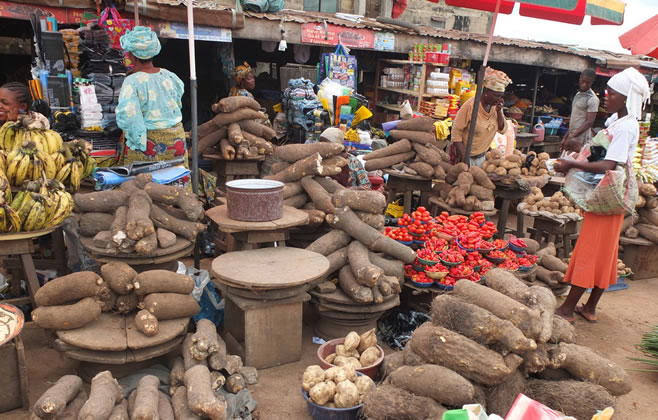
He added that cassava farmers were selling produce at prices that barely covered harvesting costs, leaving them unable to recover their investments.
According to him, vegetable and edible oil producers are also under pressure as imported vegetable oil brands reduce demand for locally processed alternatives.
He added that cocoa farmers continue to battle price volatility in international markets amid rising domestic labour and maintenance costs.
Afolabi noted that tree crops such as oil palm and cocoa, which require long gestation periods, were particularly vulnerable to sudden market disruptions that undermine investor confidence and discourage new investment.
He said the effects extended downstream to agro-processing and value addition, with soybean farmers supplying vegetable oil processors experiencing reduced demand and lower prices.
He said the development threatened not only farm incomes but also rural employment and agro-industrial growth, raising concerns about national food security.
According to him, sustained losses could force farmers out of production, increasing Nigeria’s dependence on food imports and exposing the country to global supply shocks, foreign exchange pressures and long-term vulnerabilities.
Afolabi cited India and the Netherlands as countries offering useful lessons in balancing consumer protection with farmer sustainability.
He said India deploys food imports strategically during shortages, while complementing them with strong domestic support systems.
He added that the Netherlands, despite being one of the world’s leading agricultural exporters, supports farmers through input subsidies, tax incentives, affordable energy, strong cooperatives, and close integration with research and extension services.
He said agricultural students in both countries also benefit from subsidised tuition, transportation and meals, as well as grants and start-up support for farm enterprises.
“This approach ensures generational continuity and innovation in the agricultural sector,” he said.
Afolabi said Nigeria’s current food import policy could play a stabilising role if complemented by deliberate measures to protect local producers.
He recommended carefully timed imports to avoid peak harvest periods, strengthened price stabilisation mechanisms, aggressive subsidies for critical farm inputs, and support for agro-processors to remain competitive.
He also called for clear communication of policy intentions to reassure farmers that import measures were strategic and temporary.
“Food imports should function as a strategic shock absorber rather than a permanent market feature.
“Government should develop and publish a national crop production and harvest calendar for major staples and align import decisions with documented supply gaps.
“Affordable food and profitable farming are not mutually exclusive goals. With thoughtful coordination and sustained support for farmers, Nigeria can achieve both,” he said.
Continue Reading

Trending