
Oil & Energy
‘Poor Power Supply, Bane Of MDGs’

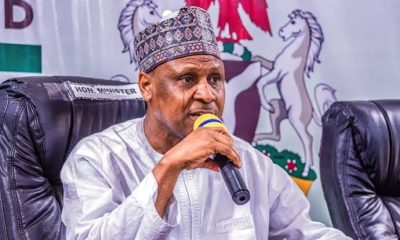
The Minister of Power, Barth Nnaji has identified epileptic power supply in the country as one of the factors militating against the accomplishment of the Millennium Development Goals (MDGs).
Professor Nnaji made the observation while speaking at the 2012 annual Herbert Macaulay Memorial Lecture organized by the Faculty of Engineering, University of Nigeria Nsukka, Enugu State recently.
Speaking on the topic, “Electricity Development and Achievement of Millennium Development and Goals,” the minister noted that modern development is hinged on power generation.
He stressed the need for proper electricity development in Nigeria to empower people, reduce poverty drastically, promote MDGs and accelerate the attainment of the post 2015 development agenda.
The United Nations had in 2010 identified the post 2015 Development Agenda as human rights, peace and security, environmental sustainability and an inclusive economic development.
According him, if Nigeria cannot achieve the goals by 2015 for any reason, the country should endeavour to succeed in the attainment of post 2015 goals, which the UN has set for humankind.
“Nigeria would certainly have fared better in the accomplishment of MDGs if not for, among other critical factors, the epileptic power supply,: he said, adding “the unemployed graduate, who took to hair salon business in a decrepit house would have done better in his self-employment if he had invested in his core business the funds used to acquire a modest generator and fuel it regularly”.
The same thing goes for the doctor who spends huge sums on acquiring expensive and big generators instead of investing in hospital equipment to save the lives of infants and expectant or nursing mothers and other patients”, Nnaji posted.
As he puts it, “if power supply had been good, the messenger in a government office who spends his resources to obtain “I-better-pass-my-neighbour generator and as a result does not have enough money to pay the daughters school fee would have had enough money to see all his children through school”.
The minister noted that had public electricity supply been efficient, there would have been less deforestation as more people would have been relying on electricity for cooking, rather than firewoods.
He pointed out that the Nigerian power sector has effectively and irreversibly headed in a new direction as it will soon be a new day for the Nigerian people, saying “the good news is that power supply has, in the last two weeks been increasing. We are getting close to the record 4,4000 megawatts we reached in January”.
He explained that by the end of the year, “we shall add a minimum of 1,000 MW and double whatever we have generated in national history by the end of 2013.
Shedie Okpara



By Felicity Bradstock for Oilprice.com 16
The State Commissioner for Works (Rural Roads) and Public Information, Charles Aniagwu, disclosed this at a press conference in Asaba, weekend, noting that the initiative was part of wider reforms aimed at opening up the power sector to private investors.
Aniagwu, who was accompanied by the Executive Assistant to the Governor on New Media, Felix Ofou, said the state was exploring alternative sources of electricity to support businesses, households and communities while reducing pressure on the national grid.
He said the government was particularly interested in exploiting Delta’s abundant natural gas resources for power generation, pointing to the Kwale Free Trade Zone, which is part of the state’s special economic zone, as a major opportunity for investors.
According to him, prospective investors were taken to the zone during the state’s recent economic summit to enable them to assess the availability of gas as a key raw material for electricity generation. ComparePower Rates
The commissioner explained that generating more electricity locally would not only increase supply in Delta but also free up power on the national grid for use by other consumers.
Aniagwu cited the 8.5MW Independent Power Plant located behind the state secretariat in Asaba as an example of what could be achieved through alternative power sources.
He said the facility had enabled the secretariat complex to operate independently of the national grid, thereby making the electricity that would otherwise have been consumed there available to other users.
He added that the planned 120MW partnership with Supply Power would further strengthen the state’s electricity supply capacity and provide a more reliable power base for small and medium-sized enterprises.
Aniagwu said the state government was also intervening in areas traditionally regarded as the responsibility of electricity distribution companies because inadequate power supply could no longer be allowed to constrain economic development. LearnQuantum Physics
He identified the extension of the electricity grid from Abraka towards the Ndokwa axis as one of the interventions being undertaken to connect more communities to electricity.
The commissioner, however, raised concerns over the burden placed on communities that are often required to provide transformers and other electricity infrastructure, only for distribution companies to take over the facilities and subsequently collect electricity bills without adequately accounting for the investments made by the communities.
He said the state would continue to support efforts aimed at energising communities, noting that improved electricity supply would stimulate businesses, create jobs and help tackle social problems associated with unemployment and idleness.
On regulation, Aniagwu said the government was working with the Ministry of Energy and a committee set up to develop an appropriate regulatory framework for the state’s emerging power sector. SwitchEnergy Plans
He said the proposed energy commission would be responsible for regulating new electricity producers, determining appropriate tariffs and overseeing distribution networks.
The commissioner stressed that liberalising the sector required effective regulation to protect consumers and investors, adding that decisions on power distribution infrastructure, including the use of overhead or underground lines, must take into account the peculiarities and safety requirements of each location.
He warned that power expansion without adequate regulation could expose residents to electrocution and other hazards, stressing the need to protect electricity infrastructure while ensuring consumers were not subjected to unfair pricing.
Aniagwu said the state government’s broader objective was to build an efficient and sustainable electricity market driven by private investment and capable of powering businesses, households and communities across Delta State.
-

 Politics4 days ago
LG CITY BOY COORDINATOR HAILS WIKE’S SUPPORT FOR ONYESOH, TINUBU
-
Politics4 days ago
DIRI INAUGURATES APC CAMPAIGN COUNCIL, SETS MILLION VOTES TARGET FOR TINUBU
-

 Politics4 days ago
NDC Candidate Urges Oborevwori To Probe Asaba Political Violence
-

 News4 days ago
Army Recovers X Account After Hack Attempt
-
Politics4 days ago
2027: Oborevwori Tasks Media On Fair, Accurate Reporting
-
Politics4 days ago
2027: AKPABIO ENVISAGES TINUBU’S VICTORY IN SOUTH SOUTH REGION
-
 Business4 days ago
Nigeria Loses N17tr Yearly To Abandoned Projects
-
Politics4 days ago
Asaba Political Violence: Police Confirm One Dead, Delta Govt Urges Probe