
Politics
2010 Election: Anambra Needs A Candidate For Change

In less than 70 days, the Anambra electorate shall get the chance to cast the vote which shall provide a new executive leadership for the state for the next four years. After the party primaries, names of candidates for the February 6th gubernatorial contest are now known. What is yet to be declared is which of these candidates symbolize the change which can bring about needed impetus to continued advancement of socioeconomic advancement of the state. From all indications, the platforms of all the political parties in the contest are ideologically the same. The PDP, APGA, AC, APP, PMP, LP etc are just variants of the same political ideological mold. These parties, if one bothers to review their stance on philosophy of governance, for example, are basically indistinguishable from the one another. As we saw during the rather tumultuous primary nomination process, aspirants who lost out in one of these partisan formations simply switched affiliation to any other that would make them their flag bearers. What the Anambra electorate is looking for in the February election, therefore, cannot be the party platform to put at helm of our affairs but instead the candidate who can bring about the needed change in managing affairs of the state.
Many are obviously perturbed by the rising sense of insecurity in Anambra in past several months. Armed robbery and kidnapping have become routine in most parts of former Eastern Nigeria, particularly Anambra state. It would not be surprising that most, if not all, the candidates shall be promising to correct this sorry situation if elected. In like manner, there is no single community in Anambra state that is not being devastated by the negative consequences of uncontrolled storm water and gully erosion. Many of the candidates are also expected to promise to rein in this monstrosity once elected as governor. There are equally confounding problems in construction and maintenance of transportation infrastructure, provision of adequate facilities for education and healthcare, reduction of massive unemployment amongst the youths and implementation of imaginative programs for mitigating material poverty and dearth of societal amenities, especially at the grassroots level. Yes, every candidate is expected, sooner or later, to make public promises about their desire to bring El Dorado to Anambra in the next four years if elected to become governor. The average voter is likely to, once more, see the candidates as same because they shall definitely be talking from the same script.
These final two months of the campaign must, therefore, be used to separate apples from oranges so as to enable the electorate to make informed choice at the polls. An uninformed voter is very likely to become swayed by other inducements, such as gifts of cash and rice etc, if he or she cannot see any compelling need for electing any particular candidate as governor. In that case, whoever pays most to the voter upfront gets the vote. To avoid this scenario, the voter must be assisted in sifting through the long list of governorship candidates in order to enable him or her to vote for the one with the best capacity to bring about the required change in the unacceptable status quo. Let’s isolate and review some critical matters which can help to realistically and fairly rate the candidates going forward:
Governance
The governor is, first and foremost, the chief executive of the state and therefore, should have the capacity to be a team leader. An effective governor does not only have to possess a vision of what needs to be done but also he or she must have the leadership quality for making all the instruments of government to work seamlessly toward actualization of a determined objective. Based on this premise, an effective governor ought to have the all branches of government namely; the executive, legislative and judiciary arms to work harmoniously toward the accomplishment of goals set for enhancing the wellbeing and welfare of the governed.
An effective governor must be seen to be respectful of the constitutional guidelines that streamline functionality of government. The local government council, which is constitutionally the third tier of governance in Nigeria, must be empowered appropriately to perform its functions without hindrance by the governor or the state bureaucracy. Role of community leadership in delivery of good governance must not be belittled or trivialized since the majority of the citizenry are more in touch with it, on daily basis, than any other level of government.
Economic Management
An effective governor must have a good appreciation of how to mobilize adequate resources to apply toward maintenance of instruments of routine governance, such as civil servants’ salaries etc as well as new capital projects. Unfortunately, most Nigerian states depend almost entirely on the monthly allocations from Abuja for meeting all their needs. Experience has shown that such monthly subventions are hardly adequate for meeting the needs of a state like Anambra. The next governor for the state should, therefore, have credible practical plans for mobilizing additional revenue at the state, local government and community levels which can be applied toward meeting the daily needs of the people.
Transparency in disbursement of public funds is key to retaining confidence of the governed. Arbitrary and spontaneous extra-budgetary spending of public funds in not a prerogative of an effective governor under normal circumstances. This practice is prevalent in Anambra today and change is urgently needed to restore some sanity in how the state’s public funds are deployed.
Job Creation
Beyond just paying monthly salaries for civil service employees, it is the duty of state governor to ensure that any major capital expenditure or undertaking by Anambra government shall result in job creation, especially at grassroots level where unemployment rate is extremely high. Public sector activities are quite substantial in Anambra and the next governor must present a credible plan for harnessing this great potential for job creation.
Environmental degradation and decay exist in all parts of Anambra state. Any expenditure of public funds for environmental remediation projects must, therefore, be accompanied by clear stipulation on how to maximize employment of local labor at all stages of their implementation.
Structural Planning & Development
Anambra state is still very young and therefore, needs to be planned well and carefully. The state now has a structural plan for the main urban centers of Onitsha, Nnewi and Awka. All governorship candidates must present, without waiting to be prompted, their envisaged road maps regarding what they intend to do with the UN HABITAT study report already delivered to Anambra state government. A reasoned meticulous implementation of the available structural plan can result in tens of thousands of new jobs in all echelons of civil society.
Environmental Husbandry
Anambra government has documented more than 1000 active gully erosion sites in the state. On the average, this amounts to about five gullies per community. The sad fact is that this number is increasing with each passing rainy season. Our large urban centers of Onitsha, Nnewi and Awka suffer perennial flooding which devastate residential and commercial parts of these cities. City dwellers are still subjected to heavy liquid and solid waste pollution which combine to wreak untold havoc to their health.
The undue emphasis on road construction, without giving required attention to drainage and maintenance regime, is actually complicating the problems facing Anambra today. The change needed, going forward, is not just to continue to deploy the state’s resources on flagging off road projects without first developing guidelines on standards for construction, drainage and maintenance of all land transportation infrastructure, for example.
Anambra state has developed a policy document on flood and erosion control which is currently lying dormant and out of sight. A governor for change must have a clear idea and plan for retrieving and resuscitating this plan for immediate implementation in order to begin to rein in the runaway erosion menace that is terrorizing the entire state. It goes without saying that taking such a bold and overdue step shall generate tens of thousands of jobs in all 177 communities of Anambra state almost immediately.
Conclusion
Anambra is in a very bad shape, as we speak. Some are bothered most by a sense of insecurity while others are irked by the contraction and devastation of our collective living space. What is incontrovertible is that things need to be done differently for these terrifying problems to be brought under control soon. Anambra certainly needs new vision for leadership at the very top.
The February election must, therefore, be all about change for the better. Does the incumbent administration, which is seeking extension of tenure, have any real plans for change? If so, what are they? Do the other candidates see the need for change or have clearly delineated plans for actualizing change in the status quo? If so, let the Anambra electorate be so enlightened now.
It is a great disservice to Ndi Anambra for governorship candidates to unleash their propagandists, whose only limited expertise is obfuscation rather than public enlightenment, on the electorate. There are barely 2 months left before the polls and Ndi Anambra deserve to learn which of the would-be governors actually possesses what it takes to bring about a much needed change for the better after the February 2010 election.
Okenwa Umuibe



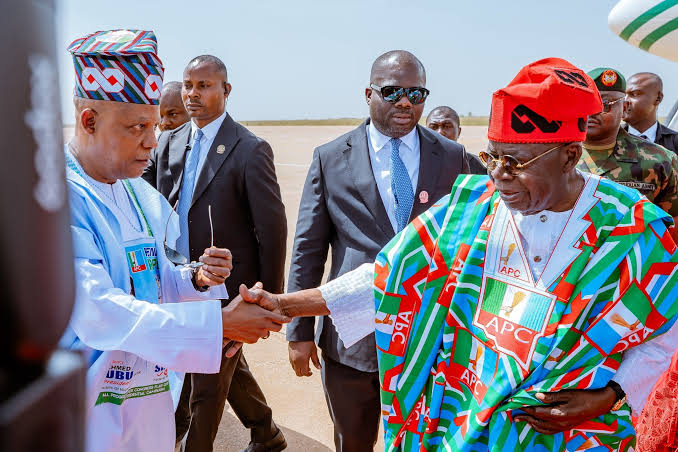
The campaign rally, held at the Kaduna Township Stadium, attracted Vice-President Kashim Shettima, APC governors, party leaders, federal and state lawmakers, political stakeholders and supporters from across the country.
The flag-off marks the beginning of the APC’s drive to secure a second presidential term for President Tinubu, with the party expected to promote its achievements, defend its economic reforms and outline its policy priorities under the proposed Renewed Hope 2.0 agenda.
Kaduna’s selection for the campaign launch underscores the strategic importance of the North-West, a region with a substantial voting population and considerable influence on presidential election outcomes.
The APC faces a significant challenge in Kaduna, where the Peoples Democratic Party’s presidential candidate, Alhaji Atiku Abubakar, defeated President Tinubu in the 2023 election. The rally therefore provides the ruling party an opportunity to strengthen its grassroots structures and regain electoral support in the state.
Addressing supporters, Vice-President Shettima appealed to Northern voters, highlighting President Tinubu’s political relationships with prominent Northern leaders, including Alhaji Abubakar, Mallam Nuhu Ribadu and the late President Muhammadu Buhari.
The Vice-President’s appeal reflects the APC’s determination to consolidate its support in the North as the party intensifies preparations for the presidential contest.
The Renewed Hope 2.0 agenda is expected to feature prominently in the campaign, providing a platform for President Tinubu to explain his administration’s economic policies and outline plans for another term.
However, the President’s record on economic reforms, rising living costs, petrol prices, employment, infrastructure and insecurity is expected to attract considerable scrutiny during the electioneering period.
-

 Education2 days ago
FCE Yola Graduates 3,555 Teachers , Seeks Upgrade to University
-

 Sports1 day ago
Nigerian Trio Target Titles At PFL Africa Finals
-

 Niger Delta2 days ago
Diri Restates Stance On Lagos-Calabar Coastal Highway
-

 Niger Delta2 days ago
C’River, NUJ Pay Tribute To Late Guardian Editor
-

 News2 days ago
NDLEA Recovers Tons Of Illicit Drug Consignments In Nine States
-

 Opinion2 days ago
Checking Voter Apathy In Nigeria’s Electoral Process
-

 Politics1 day ago
2027: DICKSON’S EX-ALLY VOWS TO WORK AGAINST NDC INTEREST IN BAYELSA
-

 Politics1 day ago
2027: GROUP PLEDGES 40,000 SUPPORTERS FOR COALITION CANDIDATES IN RIVERS