
Nation
THE STATES

Adamawa
The gubernatorial candidate of Kowa Party in
Adamawa State for the October 11 governorship election, Alhaji Dahiru Waziri, slumped yesterday during a live TV debate programme on TV Gotel, Radio Gotel on commencement.
Waziri slumped shortly after the anchorman and co-organiser introduced three gubernatorial candidates of the PDP, Alhaji Ahmadu Umaru Fintiri, the PPN candidate, Dr. Amos Sunday and himself.
Shortly after all the aspirants were introduced and were standing to commence the debate, Waziri slumped and was instantly rushed to the Federal Medical Centre, Yola.
Waziri, according to members of his party, is a diabetic patient and it took the prompt attention of the Gotel TV crew that instantly served the candidate with a bottle of soft drink as palliative measure before he was rushed to the medical centre.
Benue
It has emerged that there is considerable un
ease in Benue State over the sale of Dangote Cement Plc shares held in trust for indigenes of the state by the Benue Investment and Property Company Limited.
The sale of the company’s shares, which is taking place on the floor of the Nigerian Stock Exchange (NSE), has erased about 30 million shares valued at over N7 billion of the original 90 million shares, which Benue State held in Dangote Cement following the 2010 merger of the defunct Benue Cement Company Plc with other cement subsidiaries owned by the business mogul, Alhaji Aliko Dangote.
Sources however revealed that the state government’s plan is to sell all the shares before the elections, setting a target of N20 billion from the exercise.
FCT
Deputy Speaker, House of Representatives,
Rt. Hon. Emeka Ihedioha has expressed optimism that Nigeria will rise again and claim her rightful place in the international community.
The deputy speaker in a message by his media aide, Oke Epia, said in spite of current challenges relating to security and development, the country would be propelled to the top given the human and material resources abundant in the land and efforts being made by government to put things right.
He called on Nigerians to remain steadfast and resilient in the pursuit of national unity and glory while noting that leaders at different levels must also be patriotic and put the nation first in the discharge of their duties and oaths of office.
Kano
A prominent traditional ruler in Kano and mem
ber of the emirate council, Alhaji Tijjani Hashim, has passed away at the age of 82.
The Hashim, who held the title of the Galadima of Kano, died in the early hours of yesterday.
He is survived by many wives and 13 children. He was among the longest-traditional title holders in the emirate council.
Lagos
An Igando Customary Court in Lagos has dissolved
a 20-year-old marriage between Mr Samuel Nyeka and his wife, Charity, to save the life of the woman.
The President of the court, Mr R.I. Adeyeri, said the marriage was dissolved because it had broken down irretrievably.
“Both parties are no longer husband and wife and they are free to go their separate ways,” he ruled. The petitioner, Samuel, 54, a civil servant, had filed a suit on June 11 seeking the dissolution of the 20-year-old union to prevent him from committing murder.
Niger
Northern States Governors’ Forum (NSGF) has ex
pressed sadness over the death of Galadiman Kano, Alhaji Tijjani Hashim, who died at the age of 79. The Chairman of the forum and Governor of Niger State, Babangida Aliyu, in a statement signed by his Chief Press Secretary, Israel Ebije, described his death as a loss to the North and the country.
Aliyu, therefore, condoled with the family of the deceased, Kano State Emirate Council, the governor and people of the state.
He said: “Nigeria has lost another prominent son. The Galadiman Kano will be missed not only as a royalty but a bridge builder and a man of peace who had the interest of the country at heart.
“While we mourn him, I am indeed happy he was able to leave behind good legacy as a leader who helped in shaping the North positively. His contributions to national discourse will also remain indelible.”
Ogun
Gunmen, suspected to be kidnappers have abducted
Mrs Rachel Hazzan, the mother of the former Deputy Speaker and current member of the Ogun State House of Assembly, Pastor, Remmy Hazzan.
The lawmaker’s mother was said to have been picked up at about 8pm on Wednesday in her house at Omu-Ijebu in Odogbolu Local Government Area of the State.
According to her son, the kidnappers stormed the residence of the 69-year-old woman at about 8.10pm and whisked her away in front of her shop along Tai Solarin College of Education Road, Irete, Omu Ijebu.
The lawmaker, representing Odogbolu State Constituency, said the incident happened shortly after he spoke with the mother on the telephone.
Oyo
A retired photojournalist and the Oyo State
founding Chairman of Photo-Journalists Association of Nigeria (PJAN), Dada Osasona, is dead.
In a release signed by the Public Relations Officer (PRO) of the association, Dare Fasube, the late Osasona hailed from Ayede-Ekiti, Ekiti State where he was born 72 years ago.
A committed member of the Nigeria Union of Journalists (NUJ), the late photojournalist, at various times, served as the chairman of both the Nigerian Tribune and Correspondents’ Chapels of Oyo State NUJ.
During his active days, he worked in various media houses including Nigerian Tribune, the defunct National Concord, Frontline, Monitor Newspapers and The Sun Newspaper where he retired last year.
Plateau
The Plateau State Government has released N95
million in its effort to control the spread of Ebola Virus Disease (EVD) in the state, an official has said.
The state Commissioner for Health, Dr Fom Dakwak, announced the amount in Jos last Thursday while inaugurating some vehicles purchased for the prevention and control of EVD.
He said the vehicles were for transporting items and equipment from isolation centres to the quarantine area.
According to the commissioner, the ambulance was going to be equipped with lifesaving facilities comprising an installed patient monitor machine for observing blood pressure, respiratory rate, blood oxygen control and a host of other things.
Taraba
Seven persons including 52 children have been
killed by various diseases in the internally displaced persons (IDPs) camp situated in Bali, Bali Local Government Area of Taraba State.
The IDPs camp, which was set up to accommodate the victims of the attacks by Fulani herdsmen on Tiv communities in the local government area, which began in March this year, provides shelter for over 2,000 people mostly women and young children out of the over 126,000 people that were displaced by the crises.
Besides, no fewer than 126,000 people were said to have been displaced while over 1,000 houses in over 60 villages and farm settlements were destroyed in the various attacks on the Tiv communities.
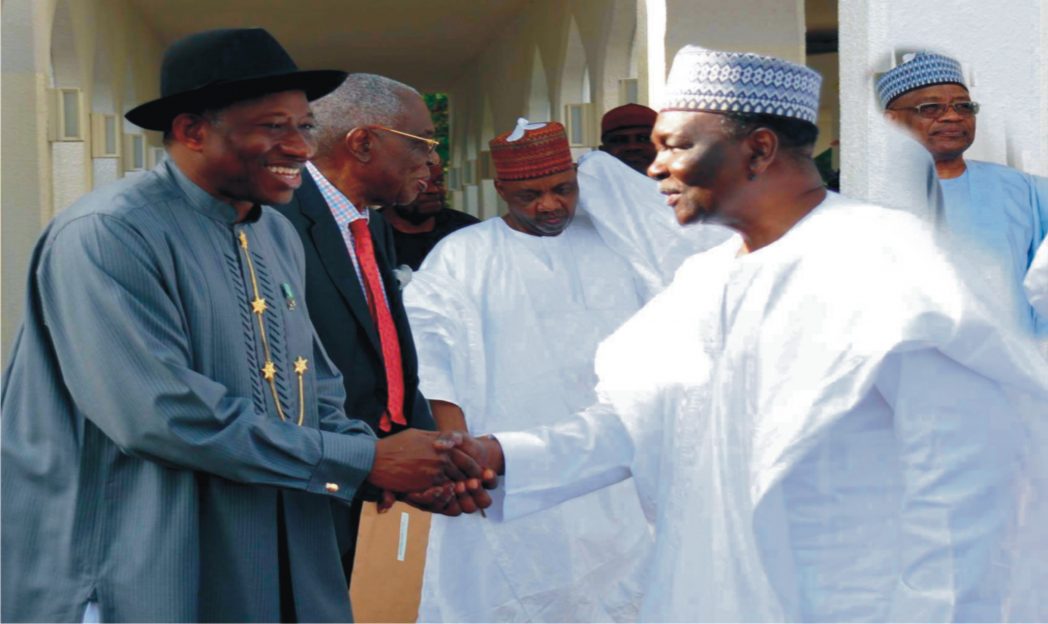
L-R: President Goodluck Jonathan, former head of Interim National Government, Chief Ernest Shonekan, Vice President Namadi Sambo, former heads of State, Gen. Yakubu Gowon and General Ibrahim Babangida, at the National Council of State meeting in Abuja recently. Photo: NAN



The Hydrocarbon Pollution Remediation Project (HYPREP) has commemorated the 15th anniversary of the release of the United Nations Environment Programme (UNEP) Environmental Assessment Report on Ogoniland, reaffirming its commitment to restoring the environment and improving the livelihoods of affected communities.
In a statement signed by the Project Coordinator, Prof Nenibarini Zabbey, to commemorate the anniversary, HYPREP described the anniversary as a significant milestone in Nigeria’s environmental restoration efforts, noting that the project has made remarkable progress in implementing the recommendations of the landmark UNEP report released on August 4, 2011.
The UNEP report had revealed extensive oil pollution across Ogoniland, severe environmental degradation, and serious public health risks resulting from decades of petroleum operations. It also recommended an initial $1 billion fund to commence the cleanup of the affected communities.
According to HYPREP, the Federal Government formally launched the Ogoni clean-up in 2016, while the Project Coordination Office was established in 2017 to drive the implementation of UNEP’s recommendations.
Zabbey said the current administration has continued to prioritise the project under the Renewed Hope Agenda.
Providing an update on the cleanup, the Project Coordinator disclosed that 30 of the 65 contaminated sites identified by UNEP have been fully remediated, while work is ongoing at several medium- and high-risk locations. It also stated that more than 1.5 million mangrove seedlings have been planted as part of what it described as the world’s largest restoration of oil-degraded mangroves, with over 1,000 hectares of shoreline already rehabilitated.
Zabbey further revealed that 49 Ogoni communities have been connected to potable water schemes through multiple water projects and booster stations aimed at providing safe drinking water across the region.
In the health sector, he said the 100-bed Ogoni Specialist Hospital in Kpite and the 43-bed Cottage Hospital in Buan are nearing completion, adding that several existing health facilities have been upgraded with modern medical equipment, while five ambulances have been donated to improve emergency healthcare services. The Project Coordinator also disclosed that a three-year human health biomonitoring study is being conducted in collaboration with the World Health Organization’s International Agency for Research on Cancer (IARC).
On economic empowerment, Zabbey stated that the Project has created more than 8,000 direct jobs and trained thousands of Ogoni youths and women in various vocational and technical skills, including software development, cybersecurity, aviation, commercial diving, seafaring, mechatronics, and creative arts. The project also reported awarding scholarships to more than 1,000 students, providing grants to small businesses, and supporting persons living with special needs through skills acquisition programmes.
The statement further highlighted ongoing legacy projects, including the Ogoni Power Project and the Centre of Excellence for Environmental Restoration, which it said is about 96 per cent complete. HYPREP also welcomed the recent designation of the Ogoni Wetland as a Ramsar Site of International Importance and pledged to continue promoting biodiversity conservation and sustainable management of the ecosystem.
Marking the anniversary, Zabbey said the progress achieved over the past 15 years demonstrates the collective commitment of government, development partners, stakeholders, and local communities to restoring Ogoniland. He called for renewed collaboration to sustain the cleanup effort, promote environmental sustainability, and support the long-term development of the region. 3
-

 News2 days ago
RSG Targets Nine Million Residents in Mosquito Net Distribution Campaign
-

 Oil & Energy2 days ago
Aiyedatiwa Signs New Electricity Bill
-

 Maritime2 days ago
Marine Minister Commends President Tinubu On NPERA Bill Assent
-

 Oil & Energy2 days ago
NLNG Commissions Research And Innovation Centre In RSU
-

 News2 days ago
KenPoly Holds Eight Convocations, August 29
-

 News2 days ago
RSG Begins Another Phase of Projects Commissioning Today
-

 News2 days ago
RMAFC Completes Revenue Sharing Review, Proposes New Pay
-

 Maritime2 days ago
NAGAFF Petitions IGP Over Alleged Maritime Police Harassment