
Nation
THE STATES

Ekiti
An Ado-Ekiti Chief Magistrates’ Court has ordered that
Ayodele Ojo, 45, be remanded in prison custody over alleged rape of a 15-year-old girl in Ijero-Ekiti.
The prosecutor, Cpl. Bamikole Olasunkanmi, told the court that the accused committed the offence on February 18 when he unlawfully had carnal knowledge of the teenager at Ijero-Ekiti.
He said the offence contravened Section 221(1) of the criminal code, cap. C 16, Laws of Ekiti State 2012.
Bamikole said he had duplicated and sent the case file to the office of the Directorate of Public Prosecution (DPP) for legal advice.
The plea of the accused was not taken and his counsel, Mr Tosin Osundahunsi, sought for an adjournment.
FCT
The House of Representatives has mandated its Com
mittee on Gas to investigate the alleged non-remittance of funds from the Nigeria Liquefied Natural Gas, Bonny, to the Federation Account.
The committee, which would investigate the non-remittance from 2004 till date, had three weeks to summit its report.
This resolution was sequel to a motion by Rep. Aminu Suleiman (APC- Kano) which was unanimously adopted without debate when put to vote by the Speaker, Aminu Tambuwal.
Suleiman said that NLNG Bonny had breached Section 162(1) of the 1999 Constitution as amended, which makes it mandatory for all ‘revenue’ collected by the government of the federation to be remitted into the Federation Account.
Kano
The Nigeria Environmental Standards, Regulations and
Enforcement Agency (NESREA) has solicited the support of media organisations in the dissemination of its activities.
NESREA’s Northwest Zonal Director, Dr Ahmed Kasim, made the call during a familiarisation visit to newsmen in Kano recently.
“Our activities will have more impact on individuals, groups and corporations with the full support of the media.
Kasim said the agency would continue to open its doors for consultations and advise from media organisations operating in the state.
Malam Muntari Tukur, NAN Kano correspondent, told Kasim that the agency would accord him the same good relationship it had with the former director.
Kebbi
The Kebbi State Government said that local government
councils would be provided additional funds to combat criminal activities in their respective areas.
The Secretary to the State Government (SSG), Alhaji Nurudden Kangiwa, told newsmen in Birnin Kebbi that the gesture would help to enhance peaceful coexistence in the state.
Kangiwa said prompt release of funds to the councils on security matters would be accorded priority.
Kangiwa, however, urged the councils to extend support to vigilante groups in their areas by providing them with stipends and working tools.
The SSG said the state government would continue to collaborate with stakeholders on security to ensure a secured and peaceful environment through the 24-hour joint security patrol of the state.
Kogi
The Kogi State Government said it was in the process of
constructing public toilets in strategic areas in Lokoja to check open defecation in the state capital.
This is contained in a statement signed by Mr Mike Abu, the Chief Press Secretary to the state Deputy Governor, Mr Yomi Awoniyi, in Lokoja, recently.
It said that the decision was announced by Gov. Idris Wada at a meeting with the members of the organising committee of the National Environmental Sanitation Day 2014 headed by the Minister of Environment, Mrs Laurentia Malam.
The statement said that the decision was to check indiscriminate open defecation by residents.
Kwara
The Chairman, Baruten Local Government Area of
Kwara State, Malam Mohammed Omar-Bio, has solicited the assistance of the state government for victims of the rainstorm in the area.
Omar-Bio made the appeal in an interview with newsmen in Kosubosu, headquarters of the council after an on-the-spot assessment of places affected by the rainstorm.
He said that a childless octogenarian, Mrs Kumbayeruma Gaaku, was among victims of the devastating rainstorm that wreaked havoc in the area.
“The effect was so much, particularly the house of an old woman, who has no child; I can assure you that we shall definitely do something to alleviate their sufferings.
“When we get back to the office, I and other members of my team will put heads together and see what we can do; very soon, you shall hear from us.
Lagos
A 24-year-old man , Valentine Ezike, charged with
obtaining N116, 000 on the pretext of procuring a Dubai visa for his client, has appeared before an Ojo Magistrates’ Court in Lagos.
The accused, who lives at No. 22, Francis Odoni St., Ajangbadi, Ojo, Lagos, is facing a two-count charge of fraud and theft.
The Prosecutor, ASP Godwin Eze, told the court that the accused committed the offences sometime in February 2013, in Ojo.
He said the accused obtained N116, 000 from one Mr Peter Chidiebere, with the promise to assist him to get a Dubai visa.
Nasarawa
The Acting Provost of College of Agriculture, Lafia,
Nasarawa State, Dr Mohammed Salihu, has warned new students of the institution to shun cultism and indiscipline.
Salihu gave the warning in Lafia at the matriculation of 4,000 students for the 2013/2014 academic session.
The acting provost also urged the students to strive for academic excellence in order to justify their parents’ investments in them.
Salihu also warned the students against vices such as examination malpractice, indecent dressing and drug abuse.
Ogun
The Ogun State House of Assembly says it is
taking steps towards the establishment of state lottery board.
The Speaker of the assembly, Mr Suraj Adekunbi, stated this in Abeokuta at a Public Forum on the Bill for an Act to establish Lottery Board for the state.
The speaker said when passed and assented to, it would also regulate public on-line lotteries.
Adekunbi, represented by the Deputy Speaker, Mr Tola Banjo, said the need to protect the interest of citizens and regulate the activities of operators necessitated the bill.
Plateau
The Federal Road Safety Corps (FRSC), Zone 4, Jos,
said recently that it had recorded “significant reduction in fatal accidents’’ in the early part of this year in the zone.
“The zone, which comprises Nasarawa, Plateau and Benue states, has recorded less accidents when compared to the early part of 2013 accident rate,’’ the corps said.
Mr Yakubu Attah, the FRSC Zonal Commanding Officer (ZCO), disclosed this while briefing newsmen on their activities in Jos.
“In January 2014, the zone has recorded 38 fatal accidents that claimed the lives of 55 people while 434 people sustained injuries.
Taraba
The Acting Governor of Taraba State, Garba Umar, has
urged the people to live peacefully with one another to achieve peace in the state.
Umar disclosed this in Jalingo at the inauguration of projects recently.
According to him, living in peace would enhance development in the state.
“As this administration makes concerted efforts to improve living standards, let me reiterate the fact that our objective can only be achieved if we continue to give peace a chance.
Yobe
Governor Ibrahim Gaidam of Yobe State has directed
political office holders to interact with people at the grassroots to assess the impact of government’s programmes on the lives of the citizens.
He gave the directive in Damaturu while swearing into office two former national legislators and two former commissioners as special advisers.
Gaidam said the advisers were appointed to tap their potentials for the socio-economic development of the state.
“We are glad to have the right calibre of people into the offices to fast track and move the state forward,’’ he said.
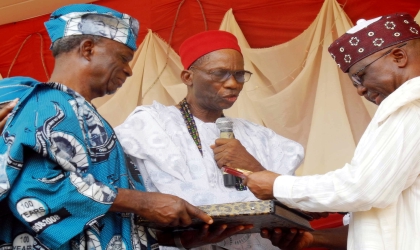
Asiwaju of Egbe, General Yinka Adeniyi (rtd) (left), presenting an award to Governor Idris Wada of Kogi State (right), at the inauguration of the revitalised ECW Hospital in Egbe, Kogi, last Saturday.




The Hydrocarbon Pollution Remediation Project (HYPREP) has commemorated the 15th anniversary of the release of the United Nations Environment Programme (UNEP) Environmental Assessment Report on Ogoniland, reaffirming its commitment to restoring the environment and improving the livelihoods of affected communities.
In a statement signed by the Project Coordinator, Prof Nenibarini Zabbey, to commemorate the anniversary, HYPREP described the anniversary as a significant milestone in Nigeria’s environmental restoration efforts, noting that the project has made remarkable progress in implementing the recommendations of the landmark UNEP report released on August 4, 2011.
The UNEP report had revealed extensive oil pollution across Ogoniland, severe environmental degradation, and serious public health risks resulting from decades of petroleum operations. It also recommended an initial $1 billion fund to commence the cleanup of the affected communities.
According to HYPREP, the Federal Government formally launched the Ogoni clean-up in 2016, while the Project Coordination Office was established in 2017 to drive the implementation of UNEP’s recommendations.
Zabbey said the current administration has continued to prioritise the project under the Renewed Hope Agenda.
Providing an update on the cleanup, the Project Coordinator disclosed that 30 of the 65 contaminated sites identified by UNEP have been fully remediated, while work is ongoing at several medium- and high-risk locations. It also stated that more than 1.5 million mangrove seedlings have been planted as part of what it described as the world’s largest restoration of oil-degraded mangroves, with over 1,000 hectares of shoreline already rehabilitated.
Zabbey further revealed that 49 Ogoni communities have been connected to potable water schemes through multiple water projects and booster stations aimed at providing safe drinking water across the region.
In the health sector, he said the 100-bed Ogoni Specialist Hospital in Kpite and the 43-bed Cottage Hospital in Buan are nearing completion, adding that several existing health facilities have been upgraded with modern medical equipment, while five ambulances have been donated to improve emergency healthcare services. The Project Coordinator also disclosed that a three-year human health biomonitoring study is being conducted in collaboration with the World Health Organization’s International Agency for Research on Cancer (IARC).
On economic empowerment, Zabbey stated that the Project has created more than 8,000 direct jobs and trained thousands of Ogoni youths and women in various vocational and technical skills, including software development, cybersecurity, aviation, commercial diving, seafaring, mechatronics, and creative arts. The project also reported awarding scholarships to more than 1,000 students, providing grants to small businesses, and supporting persons living with special needs through skills acquisition programmes.
The statement further highlighted ongoing legacy projects, including the Ogoni Power Project and the Centre of Excellence for Environmental Restoration, which it said is about 96 per cent complete. HYPREP also welcomed the recent designation of the Ogoni Wetland as a Ramsar Site of International Importance and pledged to continue promoting biodiversity conservation and sustainable management of the ecosystem.
Marking the anniversary, Zabbey said the progress achieved over the past 15 years demonstrates the collective commitment of government, development partners, stakeholders, and local communities to restoring Ogoniland. He called for renewed collaboration to sustain the cleanup effort, promote environmental sustainability, and support the long-term development of the region. 3
-

 News2 days ago
RSG Targets Nine Million Residents in Mosquito Net Distribution Campaign
-

 Oil & Energy2 days ago
Aiyedatiwa Signs New Electricity Bill
-

 Oil & Energy2 days ago
NLNG Commissions Research And Innovation Centre In RSU
-

 Maritime2 days ago
Marine Minister Commends President Tinubu On NPERA Bill Assent
-

 News2 days ago
KenPoly Holds Eight Convocations, August 29
-

 News2 days ago
RSG Begins Another Phase of Projects Commissioning Today
-

 News2 days ago
RMAFC Completes Revenue Sharing Review, Proposes New Pay
-

 Maritime2 days ago
NAGAFF Petitions IGP Over Alleged Maritime Police Harassment