
Nation
THE STATES

Bauchi
The Federal Government has been urged to resolve its
differences with the Academic Staff Union of Polytechnics (ASUP) and end the seven-month-old strike by the lecturers.
The call was made by the president of the students union government of Federal Polytechnic, Bauchi, Malam Abubakar Bako.
Bako told newsmen that the lingering strike by the lecturers was having a toll on the students hence the need to end it and prevent idle polytechnic students from taking to crime.
He said that the strike, if not resolved, could force students into social vices due to idleness and frustration.
Benue
The Benue State House of Assembly has elected a new
Minority Leader, Mr Benjamin Adanyi, representing Makurdi South constituency on the platform of All Progressives Congress (APC).
Adanyi was before his elevation the chairman, committee on Culture and Tourism.
Reading the letter on the elevation during plenary last week, the Speaker, Mr Terhile Ayua, stated that Adanyi’s elevation became possible due to the vacuum created by a Supreme Court’s ruling.
However, Mr Ianna Jato, (Katsina-Ala East), objected to the method used in Adanyi’s appointment, saying it breached the House’s Standing Rules.
Borno
The Chad Basin Development Authority (CBDA) has
distributed 1,500 irrigation pumps to 70 farmers’ associations in Borno, Yobe and Adamawa states to boost food production in the country.
The CBDA Managing Director, Dr Garba Iliya, announced this while inaugurating the 2014 dry season farming in Maiduguri.
He said that the authority also drilled boreholes in the Jere Local Government Area of Borno State to provide irrigation water to farmers in the area.
He said that CBDA also cultivated 150 hectares of rice in two irrigation schemes in Yobe in spite of the current security challenges in the area.
FCT
The Head of Service, Alhaji Bukar Aji, has charged Per
manent Secretaries in federal ministries to create programmes and policies that would improve the lives of women in the country.
Aji gave the charge when he led a team of federal permanent secretaries on a peer review meeting to the Ministry of Women Affairs, Abuja.
He said it was important for all permanent secretaries to align themselves with the activities of their ministries, department and agencies (MDAs) to make the civil service a world-class institution.
He said that the Office of the Head of the Civil Service of the Federation (OHCSF) had been restructured to focus on training and welfare to improve the lives of all civil servants.
Gombe
The Joint Admissions and Matriculation Board (JAMB)
has conducted advocacy campaign on computer-based test for 100 secondary school students in Gombe State ahead of its April Unified Tertiary Matriculation Examinations (UTME).
The JAMB Deputy Director in charge of Test Development, Alhaji Muhammad Buba-Sabo, stated this at a one-day sensitisation campaign for secondary school students in Gombe State.
Buba-Sabo told the students that JAMB decided to unify its examinations to give the students the opportunity to exhibit their abilities, and urged candidates who registered for its examinations to read hard to pass.
“Your performance will determine where you are going – university, polytechnic or college of education,’’ he said.
Kano
The National Orientation Agency (NOA) says it will col
laborate with some key stakeholders on environmental issues to prepare a work plan for the “Keep Kano Clean” campaign.
The acting Director of the agency in Kano, Alhaji Muhammad Bashir, made this known during the agency’s campaign on “Do the Right thing: Keep Kano Clean” campaign in the Kano Municipal Council..
Bashir expressed optimism that the government would facilitate the execution of the work plan in all the 44 local government areas of the state.
Kebbi
Two female hostels in the Yauri Government Girls Sci
ence Secondary School were destroyed by fire, the Permanent Secretary, Ministry of Science and Technical Education, Alhaji Garba Kangiwa, said recently.
Kangiwa who made the disclosure in an interview with newsmen in Birnin Kebbi.
He said the hostels were destroyed by an early morning inferno when the students were at the assembly ground.
He added that though no life was lost, many personal belongings of the students were destroyed.
The permanent secretary said an alternative accommodation had been provided for the 400 students displaced.
Kwara
The wife of Kwara governor, Mrs Omolewa Ahmed, has
promised to set up a cancer community of Okuta, Baruten Local Government Area of the state.
The governor’s wife disclosed this in Okuta during her cervical and breast cancer awareness campaign in the community.
Ahmed, who is the founder of LEAH Charity Foundation, said the centre to be established in March would provide facilities for screening of breast and cervical cancer at a token fee.
She told the people that cancer could be cured if detected early.
Lagos
The Nigeria Police Force has commenced training of of
ficers and men, nine months after the rehabilitation of the Ikeja Police College.
The Force Spokesman, CSP Frank Mba, told newsmen in Lagos that some officers were currently having their promotion training at the college.
It would be recalled that President Goodluck Jonathan paid a surprise visit to the institution on January 19, 2013, after a television station exposed the decay of its facilities and promised to refurbish it.
Nigerian Army engineers completed the rehabilitation of the college in May 2013, after carrying out works on 29 different buildings, including the hostels, for about three months.
Nasarawa
The Nasarawa State Chapter of Nigeria Labour
Congress (NLC) has directed workers in the state to shun calls by the state government for a staff audit.
The congress advised the workers not to attend any screening exercise called by any of the government offices, including the office of the head of service.
The directive of the workers’ union was contained in a statement issued in Lafia by the state NLC Chairman, Mr Asoloko Maku, and the Secretary, Mr Jacob Makama, which was made available to newsmen.
The statement was also signed by Chairman and Secretary of Trade Union Congress (TUC) in the state, Mr Danladi Namo and Mohammed Umar,.
Osun
A chieftain of the All Progressive Congress
(APC), Bola Tinubu, said that the large turn-out for membership registration was an indication of the party’s readiness for elections.
Tinubu made the remark while answering questions from newsmen on the just-concluded registration exercise of the party in Osogbo recently.
The APC chieftain said party faithful came out on their own, adding that the exercise was transparent and well organised.
In Ibadan, the Oyo State capital, there was a massive turn-out for the registration exercise.
Plateau
The Plateau State Executive Council has ap
proved N368 million for the completion of office accommodation for special advisers to the governor.
“Part of the money will go for the purchase of official vehicles for the speaker and deputy speaker of the state House of Assembly,’’ the Commissioner for Information, Mrs Olivia Dazyam, told newsmen after the weekly meeting in Jos.
She said part of the money would also be utilised for the purchase of equipment for the Plateau Publishing Company.
Dazyam said that the meeting, chaired by Governor Jonah Jang, also considered and approved a submission for the award of contracts by the Plateau Tender’s Board.
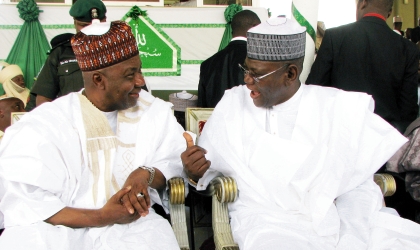
Vice President Namadi Sambo (left) with Govwenoe Sule Lamido of Jigawa State, at the National Quranic Recitation Competition in Dutse last Friday. Photo: Nan



The Hydrocarbon Pollution Remediation Project (HYPREP) has commemorated the 15th anniversary of the release of the United Nations Environment Programme (UNEP) Environmental Assessment Report on Ogoniland, reaffirming its commitment to restoring the environment and improving the livelihoods of affected communities.
In a statement signed by the Project Coordinator, Prof Nenibarini Zabbey, to commemorate the anniversary, HYPREP described the anniversary as a significant milestone in Nigeria’s environmental restoration efforts, noting that the project has made remarkable progress in implementing the recommendations of the landmark UNEP report released on August 4, 2011.
The UNEP report had revealed extensive oil pollution across Ogoniland, severe environmental degradation, and serious public health risks resulting from decades of petroleum operations. It also recommended an initial $1 billion fund to commence the cleanup of the affected communities.
According to HYPREP, the Federal Government formally launched the Ogoni clean-up in 2016, while the Project Coordination Office was established in 2017 to drive the implementation of UNEP’s recommendations.
Zabbey said the current administration has continued to prioritise the project under the Renewed Hope Agenda.
Providing an update on the cleanup, the Project Coordinator disclosed that 30 of the 65 contaminated sites identified by UNEP have been fully remediated, while work is ongoing at several medium- and high-risk locations. It also stated that more than 1.5 million mangrove seedlings have been planted as part of what it described as the world’s largest restoration of oil-degraded mangroves, with over 1,000 hectares of shoreline already rehabilitated.
Zabbey further revealed that 49 Ogoni communities have been connected to potable water schemes through multiple water projects and booster stations aimed at providing safe drinking water across the region.
In the health sector, he said the 100-bed Ogoni Specialist Hospital in Kpite and the 43-bed Cottage Hospital in Buan are nearing completion, adding that several existing health facilities have been upgraded with modern medical equipment, while five ambulances have been donated to improve emergency healthcare services. The Project Coordinator also disclosed that a three-year human health biomonitoring study is being conducted in collaboration with the World Health Organization’s International Agency for Research on Cancer (IARC).
On economic empowerment, Zabbey stated that the Project has created more than 8,000 direct jobs and trained thousands of Ogoni youths and women in various vocational and technical skills, including software development, cybersecurity, aviation, commercial diving, seafaring, mechatronics, and creative arts. The project also reported awarding scholarships to more than 1,000 students, providing grants to small businesses, and supporting persons living with special needs through skills acquisition programmes.
The statement further highlighted ongoing legacy projects, including the Ogoni Power Project and the Centre of Excellence for Environmental Restoration, which it said is about 96 per cent complete. HYPREP also welcomed the recent designation of the Ogoni Wetland as a Ramsar Site of International Importance and pledged to continue promoting biodiversity conservation and sustainable management of the ecosystem.
Marking the anniversary, Zabbey said the progress achieved over the past 15 years demonstrates the collective commitment of government, development partners, stakeholders, and local communities to restoring Ogoniland. He called for renewed collaboration to sustain the cleanup effort, promote environmental sustainability, and support the long-term development of the region. 3
-

 News2 days ago
RSG Targets Nine Million Residents in Mosquito Net Distribution Campaign
-

 Oil & Energy2 days ago
Aiyedatiwa Signs New Electricity Bill
-

 Maritime2 days ago
Marine Minister Commends President Tinubu On NPERA Bill Assent
-

 Oil & Energy2 days ago
NLNG Commissions Research And Innovation Centre In RSU
-

 News2 days ago
KenPoly Holds Eight Convocations, August 29
-

 News2 days ago
RSG Begins Another Phase of Projects Commissioning Today
-

 News2 days ago
RMAFC Completes Revenue Sharing Review, Proposes New Pay
-

 Maritime2 days ago
NAGAFF Petitions IGP Over Alleged Maritime Police Harassment