
Politics
Priotise Citizens Welfare Or Fail, Okonjo-Iweala Tells Governors-Elect

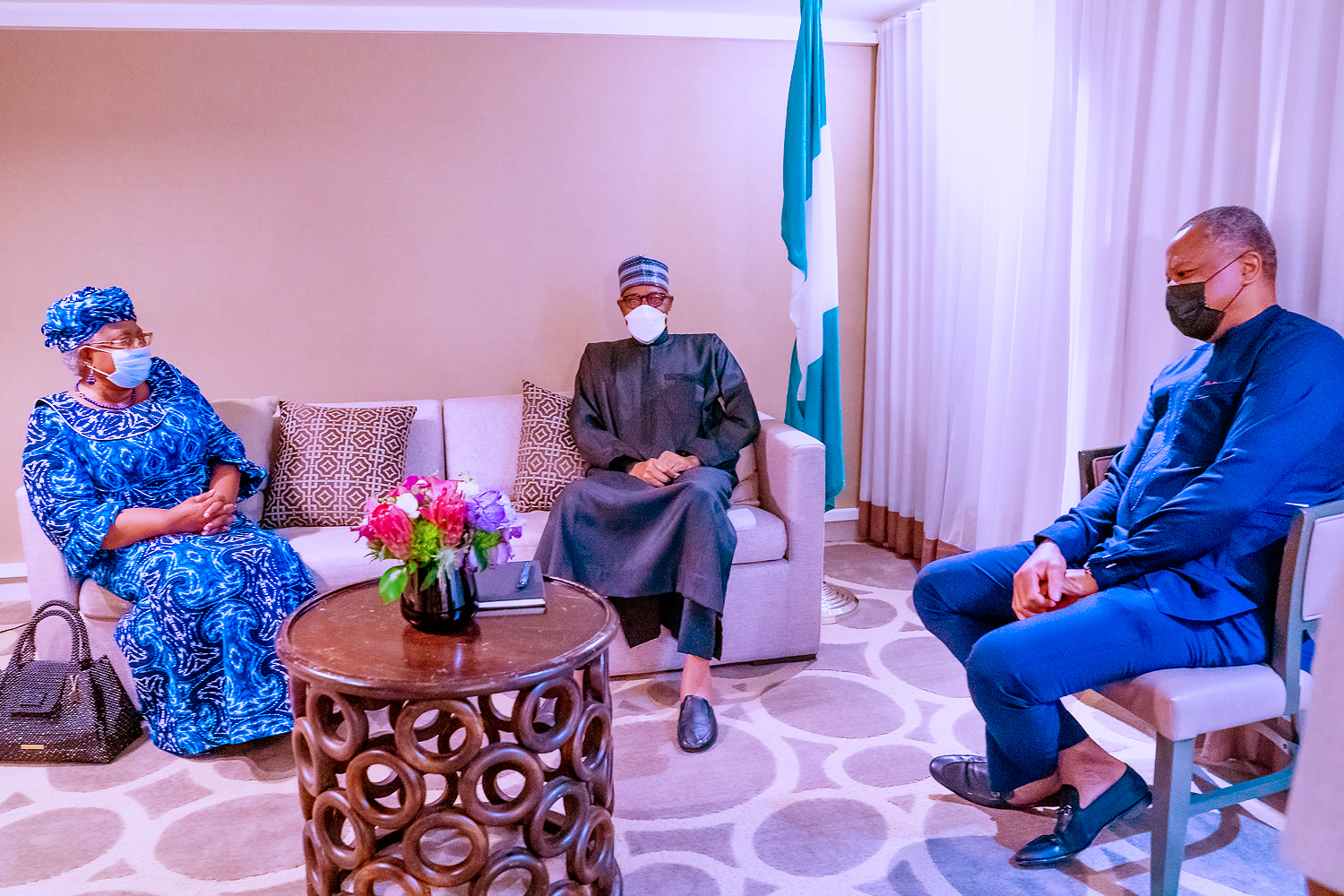
Director General of the World Trade Organisation (WTO), Dr Ngozi Okonjo-Iweala, has advised Nigerian governors to avoid piling up debts on their states and to prioritise citizens’ welfare if they want to have successful tenures as governors.
In an address at the Nigeria Governors’ Forum (NGF) induction ceremony on Monday at the Presidential Villa, Abuja, Okonjo-Iweala emphasised the importance of prudent financial management for state governments and the need to sustain payment of workers’ salaries.
The former Finance Minister and Minister during the Obasanjo and Jonathan administrations urged governors to prioritize the payment of teachers, healthcare workers, and pensioners, while investing in infrastructure, education, and basic healthcare.
Highlighting the need for increased internally generated revenue (IGR), Okonjo-Iweala suggested that governors should focus on transparency and efficiency in their financial practices.
She encouraged them to publish information about the federation revenue allocation and IGR, to enable citizens to have a clear understanding of their state’s financial situation.
She said, “Nigeria is a country with no social contract, meaning that Nigerian political leaders have never been able to agree with each other to stick to a common set of principles, values, and policies that consistently deliver for their citizens regardless of ethnic group or political persuasion.
“You have a lot of healing to do – within your states, and between them. Through your words, deeds, and policies, you need to demonstrate to Nigerians that they are equally loved; that they can settle and do business in any part of the country without fear,” she said.
Moreover, Okonjo-Iweala emphasized the importance of monitoring debt profiles and controlling expenditure.
Citing data from the National Bureau of Statistics and Budgit, an organisation dedicated to providing financial reports on the country’s budgets, Okonjo-Iweala revealed that majority of states rely heavily on federal allocations for survival.
Even though state governments experienced a slight increase in IGR, rising from N1.2 trillion in 2020 to N1.61 trillion in 2021, these figures pale in comparison to the Federal Account Allocation Committee (FAAC) allocations of N2.23 trillion in 2020 and N3.16 trillion in 2021, she noted.
“While I commend those states that have made additional efforts, governors need to do much more. States must figure out ways to increase IGR. This goes hand in hand with using your 48 percent share of federal allocations more transparently, efficiently and effectively.
“You must share with your state citizens how much FAAC allocation you receive each month, how much IGR you collect, and how you spend it.
“We used to publish this information routinely during my time as finance minister under Presidents Obasanjo and Jonathan. We must resume this practice so your citizens can hold you accountable.
“Excellencies, please watch your debt profiles, and keep careful control of expenditures, even as you invest in infrastructure, education, and basic health systems. Please endeavour to pay teachers, health workers, and others their salaries, and retirees their pensions,” Okonjo-Iweala told the governors-elect.
The WTO chief executive pointed out that the COVID-19 pandemic severely impacted Nigeria, leading to a rise in poverty rates, as according to the World Bank, an estimated 95 million Nigerians fell below the national poverty line in 2022, accounting for 43 percent of the population.
She also highlighted the potential of Nigeria’s youthful population, stating that the country has an opportunity to attract investment in labour-intensive production processes.
She encouraged governors to create business-friendly environments to attract both domestic and foreign investment, stressing the importance of Nigeria positioning itself as a platform for producing goods and services to meet regional and global demand.
Speaking on youths’ craving to relocate from Nigeria, she said: “Excellencies, you must make your states and all Nigeria a hospitable, encouraging place where young people want to stay and thrive, not leave. Much as we appreciate remittances sent home by these migrants, Nigeria will not develop and prosper if its youthful, tech-savvy population leaves. Without them, our demographic dividend disappears.
“Turning to the fashion space, people across the continent want to dress like us. Nigerian fashion is taking Africa and the world by storm. Our leather industry is moving up the value chain: we used to send tanned leather to Milan, now we are developing shoes, bags, and carpets ourselves of good quality, fit for consumption at home and abroad.”
In addition, Okonjo-Iweala acknowledged Nigeria’s achievements in the creative industries, particularly music, film (Nollywood), and fashion.
She urged the government to capitalise on these sectors’ potential for growth and explore opportunities for cultural tourism and export of digitally-delivered services.



The Independent National Electoral Commission (INEC) has extended the deadline for political parties to submit the list of candidates for the 2027 governorship and state Houses of Assembly elections from Saturday, August 8, to Tuesday, August 11, 2026.
The commission announced the extension in a statement issued on Saturday and signed by the National Commissioner and Chairman of its Information and Voter Education Committee, Mohammed Haruna.
According to INEC, the decision followed appeals by political parties for additional time to complete the submission process through the dedicated online portal.
“The submission window, which according to the revised Timetable and Schedule of Activities for the General Election was originally scheduled to close on Saturday, 8th August, 2026, has been extended to Tuesday, 11th August, 2026,” the commission said.
In a a related development, INEC announced the suspension of PVC collection in Osun State ahead of the August 15 governorship election.
The commission said voters who applied for replacement of lost, damaged or defaced Permanent Voter Cards would have until midnight on Sunday, August 9, to print downloadable copies of their cards.
The electoral body explained that the deadline was necessary to enable it compile data on downloaded PVCs and produce final statistics on the total number of cards collected ahead of the election.
INEC said PVC collection in Osun commenced at the Registration Area level from July 22 to 28, 2026, but was extended to July 31 following complaints about large crowds and difficulties experienced by voters at collection centres.
The exercise subsequently moved to the local government level and ran from August 1 to 7.
The commission also disclosed that replacement downloadable PVCs had been made available to voters in Odo-Otin and Ife Central Local Government Areas following the theft of cards during attacks on the two collection centres.
It stressed that the stolen cards could not be used to vote.
INEC reassured Osun residents of its preparedness for the August 15 governorship election.
“The commission reiterates that the stolen cards cannot be used to vote.
“INEC reassures the people of Osun State of its readiness to conduct a free, fair, credible and inclusive governorship election on 15th August, 2026,” the statement said.
The commission said the deadline, initially set for Saturday, 8 August, has been extended to Tuesday, 11 August 2026, following appeals from political parties for more time.
INEC also announced that the window for voters who applied to replace lost, damaged or defaced PVCs to download their replacement cards will close at midnight on Sunday, 9 August.
The move is to enable the commission compile final PVC collection figures ahead of the 15 August Osun governorship election.
INEC said replacement downloadable PVCs have also been provided to affected voters in Odo-Otin and Ife Central Local Government Areas after hoodlums carted away cards from two collection centres, stressing that the stolen cards cannot be used to vote.
The commission reaffirmed its readiness to conduct a free, fair, credible and inclusive election in Osun State.
Gov. Kefas made the remarks over the weekend at the Federal Medical Centre (FMC), Jalingo, during the flag-off of the second phase of the Renewed Hope Medical Outreach in Taraba State, organised as part of activities marking Prof. Yilwatda’s 58th birthday.
The governor commended Prof. Yilwatda for choosing to mark his birthday by providing medical care to people in need.
“What Professor Nentawe did is a powerful demonstration of what leadership should be,” Gov. Kefas said.
He assured that his administration would continue to support initiatives that complement government efforts to improve healthcare delivery and the wellbeing of residents.
Speaking at the event, Prof. Yilwatda called on Nigerian leaders to embrace the culture of giving and use their positions to touch the lives of the less privileged.
He said his decision to celebrate his 58th birthday in Taraba State was deliberate and informed by the needs of underserved communities, particularly people who face difficulties accessing healthcare because of distance and financial constraints.
According to him, the intervention followed a needs assessment and was extended across the three senatorial districts of the state.
He said the exercise commenced on August 3 at Takum General Hospital and covered the Federal University Teaching Hospital, Wukari; First Referral Hospital, Sunkani, Ardo-Kola Local Government Area; General Hospital, Bali; General Hospital, Gembu; and FMC Jalingo.
Prof. Yilwatda said the intervention provided medical services to thousands of beneficiaries, including people who required surgical procedures.
He said sustainable national development could only be achieved when strong institutions placed Nigerians at the centre of development.
“Leadership is about service,” he said, urging political and public leaders to make giving back to society an important part of their responsibilities.
He reaffirmed his commitment to serving Nigeria and its people, saying his personal vision was to make every day of his life useful to humanity.
“Every day that I live, the vision is: let it be useful to humanity,” he said.
The Taraba State Commissioner for Health, Dr. Bordiya Buma, commended the initiative, saying it was consistent with the Renewed Hope agenda and efforts to strengthen healthcare delivery in the state.
Dr Buma said the second phase followed the successful completion of the first phase, which was conducted simultaneously in six local government areas, with two LGAs selected from each of the three senatorial districts.
According to him, more than 10,000 patients were attended to during the first phase, including people with medical and surgical conditions.
He disclosed that 327 general surgeries, 71 eye surgeries and 575 dental procedures were carried out during the exercise.
The commissioner expressed appreciation to President Bola Tinubu for the Renewed Hope Medical Outreach and thanked Prof. Yilwatda for supporting the initiative and choosing Taraba State as a beneficiary.
The Minister of Health and Social Welfare, Prof. Muhammad Ali Pate, also commended Prof. Yilwatda for choosing Taraba State to mark his 58th birthday through a medical outreach.
Prof. Pate said making healthcare the centrepiece of the birthday celebration was significant because health affects everyone.
-

 News2 days ago
RSG Targets Nine Million Residents in Mosquito Net Distribution Campaign
-

 Oil & Energy2 days ago
Aiyedatiwa Signs New Electricity Bill
-

 Oil & Energy2 days ago
NLNG Commissions Research And Innovation Centre In RSU
-

 Maritime2 days ago
Marine Minister Commends President Tinubu On NPERA Bill Assent
-

 News2 days ago
KenPoly Holds Eight Convocations, August 29
-

 News2 days ago
RSG Begins Another Phase of Projects Commissioning Today
-

 News2 days ago
RMAFC Completes Revenue Sharing Review, Proposes New Pay
-

 Maritime2 days ago
NAGAFF Petitions IGP Over Alleged Maritime Police Harassment