
Politics
Edo: PDP Blasts APC Over Emergency Rule

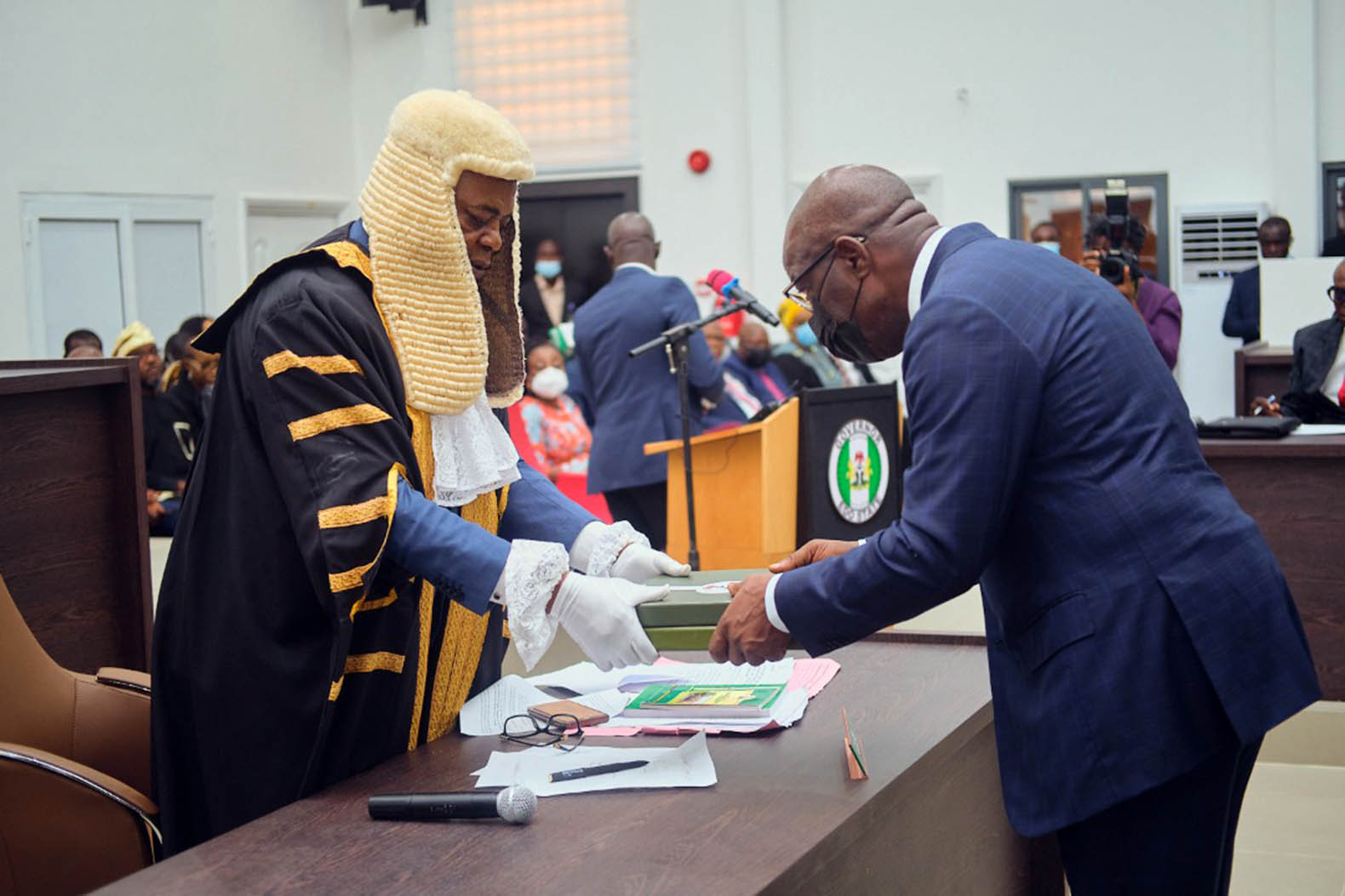
The Edo State chapter of the All Progressives Congress, has urged President Muhammadu Buhari to declare a state of emergency in the state over what it called the “collapse of governance.”
The opposition party in the state said that the call became imperative given the fact that Governor Godwin Obaseki “has emasculated the judiciary, crippled the legislature and personalised the executive branch by acting as the sole administrator of Edo State,” where “his word is law; he is the lawmaker, the judge and the prison put together.”
The state Chairman of the party, Col. David Imuse (retd.), who made the call while addressing journalists at the party’s secretariat in Benin on Thursday added that Obaseki’s “flagrant abuse of power is not provided for anywhere in the 1999 Constitution as amended.”
Imuse stated that though elected democratically, the governor was actually functioning as the sole administrator of the state and lamenting that over a year into his second term, “Edo is the only state in Nigeria today without a functional legislature. What is happening with the 10 PDP jokers, who gather regularly at Governor Obaseki’s office, is comical.
“What Obaseki is practising in Edo today is a democratic taboo. And when a taboo is allowed to exist for too long, it becomes a tradition. If this taboo is allowed to be exported to other states, using Obaseki as a reference, it will endanger our democratic culture. Edo is in serious trouble.
“Mr Obaseki’s flagrant abuse of power is not provided for anywhere in the 1999 Constitution as amended. Meanwhile, this constitution, which our country, Nigeria, is still operating, remains the grundnorm. So, we wonder where Mr Obaseki is deriving his powers from, as there is no section in the constitution either for a maximum ruler or sole administrator as we presently have in Edo.
“For almost one year, local government administration in Edo State has been thrown into a coma, with the governor’s decision not to conduct elections for chairmen and councillors. For a governor, who daily interfered with the state’s local government councils’ statutory allocations, is it not self-indictment to say that unless he is able to clear the N60bn debt they owe, he cannot conduct LG elections?
However, the state Commissioner for Communication and Orientation, Andrew Emwanta, said the call by the state chapter of the APC for the declaration of a state of emergency in the state should be directed to the Federal Government, under whose rule Nigerians were being slaughtered and maimed on a daily basis across the country.
Emwanta, in a statement, noted that the issues raised about governance and development by the party were not only a slap on the faces of the citizens of Edo State, but a sign of selective amnesia.
He stated, “Edo State, as of today, is perhaps the most peaceful place to live in the entire country with incidences of crime and criminality in the state over the last three months nearing almost zero, and the APC dares to call for a state of emergency in the state when it superintends over a Federal Government under which Nigerians are slaughtered and maimed on a daily basis all across Nigeria.
“Can the Edo APC not see that its call for a state of emergency should be more appropriately directed to a federal government, which it leads and that has reduced the value of Nigerian lives to near nothing?
“In Nigeria today, under the leadership of the APC, which their shameless and ragtag executive committee in Edo, who addressed the press conference represents, you cannot travel from Abuja to Kaduna; Abuja to Keffi; or from Abuja to Minna by road without a 70 per cent chance of being attacked, kidnapped or killed by bandits. Yet, these palace jesters gather in the safety of Benin City, provided by the excellent leadership of Governor Godwin Obaseki, and mouth non-existent chaos.
“The APC wants a state of emergency declared in a state that did not only pay salaries and pensions of state government workers by the 14th of December, but also released funds to the local governments to ensure that their employees are also paid salaries in time for the yuletide celebrations, while the APC-led Federal Government was struggling to meet their FAAC obligations for the end of the year.



The Independent National Electoral Commission (INEC) has extended the deadline for political parties to submit the list of candidates for the 2027 governorship and state Houses of Assembly elections from Saturday, August 8, to Tuesday, August 11, 2026.
The commission announced the extension in a statement issued on Saturday and signed by the National Commissioner and Chairman of its Information and Voter Education Committee, Mohammed Haruna.
According to INEC, the decision followed appeals by political parties for additional time to complete the submission process through the dedicated online portal.
“The submission window, which according to the revised Timetable and Schedule of Activities for the General Election was originally scheduled to close on Saturday, 8th August, 2026, has been extended to Tuesday, 11th August, 2026,” the commission said.
In a a related development, INEC announced the suspension of PVC collection in Osun State ahead of the August 15 governorship election.
The commission said voters who applied for replacement of lost, damaged or defaced Permanent Voter Cards would have until midnight on Sunday, August 9, to print downloadable copies of their cards.
The electoral body explained that the deadline was necessary to enable it compile data on downloaded PVCs and produce final statistics on the total number of cards collected ahead of the election.
INEC said PVC collection in Osun commenced at the Registration Area level from July 22 to 28, 2026, but was extended to July 31 following complaints about large crowds and difficulties experienced by voters at collection centres.
The exercise subsequently moved to the local government level and ran from August 1 to 7.
The commission also disclosed that replacement downloadable PVCs had been made available to voters in Odo-Otin and Ife Central Local Government Areas following the theft of cards during attacks on the two collection centres.
It stressed that the stolen cards could not be used to vote.
INEC reassured Osun residents of its preparedness for the August 15 governorship election.
“The commission reiterates that the stolen cards cannot be used to vote.
“INEC reassures the people of Osun State of its readiness to conduct a free, fair, credible and inclusive governorship election on 15th August, 2026,” the statement said.
The commission said the deadline, initially set for Saturday, 8 August, has been extended to Tuesday, 11 August 2026, following appeals from political parties for more time.
INEC also announced that the window for voters who applied to replace lost, damaged or defaced PVCs to download their replacement cards will close at midnight on Sunday, 9 August.
The move is to enable the commission compile final PVC collection figures ahead of the 15 August Osun governorship election.
INEC said replacement downloadable PVCs have also been provided to affected voters in Odo-Otin and Ife Central Local Government Areas after hoodlums carted away cards from two collection centres, stressing that the stolen cards cannot be used to vote.
The commission reaffirmed its readiness to conduct a free, fair, credible and inclusive election in Osun State.
Gov. Kefas made the remarks over the weekend at the Federal Medical Centre (FMC), Jalingo, during the flag-off of the second phase of the Renewed Hope Medical Outreach in Taraba State, organised as part of activities marking Prof. Yilwatda’s 58th birthday.
The governor commended Prof. Yilwatda for choosing to mark his birthday by providing medical care to people in need.
“What Professor Nentawe did is a powerful demonstration of what leadership should be,” Gov. Kefas said.
He assured that his administration would continue to support initiatives that complement government efforts to improve healthcare delivery and the wellbeing of residents.
Speaking at the event, Prof. Yilwatda called on Nigerian leaders to embrace the culture of giving and use their positions to touch the lives of the less privileged.
He said his decision to celebrate his 58th birthday in Taraba State was deliberate and informed by the needs of underserved communities, particularly people who face difficulties accessing healthcare because of distance and financial constraints.
According to him, the intervention followed a needs assessment and was extended across the three senatorial districts of the state.
He said the exercise commenced on August 3 at Takum General Hospital and covered the Federal University Teaching Hospital, Wukari; First Referral Hospital, Sunkani, Ardo-Kola Local Government Area; General Hospital, Bali; General Hospital, Gembu; and FMC Jalingo.
Prof. Yilwatda said the intervention provided medical services to thousands of beneficiaries, including people who required surgical procedures.
He said sustainable national development could only be achieved when strong institutions placed Nigerians at the centre of development.
“Leadership is about service,” he said, urging political and public leaders to make giving back to society an important part of their responsibilities.
He reaffirmed his commitment to serving Nigeria and its people, saying his personal vision was to make every day of his life useful to humanity.
“Every day that I live, the vision is: let it be useful to humanity,” he said.
The Taraba State Commissioner for Health, Dr. Bordiya Buma, commended the initiative, saying it was consistent with the Renewed Hope agenda and efforts to strengthen healthcare delivery in the state.
Dr Buma said the second phase followed the successful completion of the first phase, which was conducted simultaneously in six local government areas, with two LGAs selected from each of the three senatorial districts.
According to him, more than 10,000 patients were attended to during the first phase, including people with medical and surgical conditions.
He disclosed that 327 general surgeries, 71 eye surgeries and 575 dental procedures were carried out during the exercise.
The commissioner expressed appreciation to President Bola Tinubu for the Renewed Hope Medical Outreach and thanked Prof. Yilwatda for supporting the initiative and choosing Taraba State as a beneficiary.
The Minister of Health and Social Welfare, Prof. Muhammad Ali Pate, also commended Prof. Yilwatda for choosing Taraba State to mark his 58th birthday through a medical outreach.
Prof. Pate said making healthcare the centrepiece of the birthday celebration was significant because health affects everyone.
-

 News2 days ago
RSG Targets Nine Million Residents in Mosquito Net Distribution Campaign
-

 Oil & Energy2 days ago
Aiyedatiwa Signs New Electricity Bill
-

 Oil & Energy2 days ago
NLNG Commissions Research And Innovation Centre In RSU
-

 Maritime2 days ago
Marine Minister Commends President Tinubu On NPERA Bill Assent
-

 News2 days ago
KenPoly Holds Eight Convocations, August 29
-

 News2 days ago
RSG Begins Another Phase of Projects Commissioning Today
-

 News2 days ago
RMAFC Completes Revenue Sharing Review, Proposes New Pay
-

 Maritime2 days ago
NAGAFF Petitions IGP Over Alleged Maritime Police Harassment