
Nation
THE STATES

Adamawa
Adamawa State government completed 46 road projects
within one year in office, the state Governor Jibrilla Bindow, has said.
Bindow made the disclosure in Government House, Yola recently.
“The state government will embark on massive road construction projects outside the state capital while the Kiri-Shelleng road construction will be flagged off after the Sallah celebration.
“Adamawa people should support the government with prayers and words of encouragement to enable this administration achieve its mandate.
“Within one year in office, we have been able to complete 46 road projects”, he said
Bauchi
Mr Iliyasu Zwal, Senior Special Assistant on State Leg
islative Affairs to the Speaker of House of Representatives, Yakubu Dogara, has appealed to Niger Delta militants to consider the effects of their activities on their own environment.
Making the call in Bauchi during an interview with newsmen, Zwal reminded the militants that each time they destroyed oil facilities, their environment was the first victim.
“Whenever there is destruction of oil facilities, the problem of pollution in their environment is worsened as the air, water and soil are affected.
“The situation is even capable of triggering outbreak of diseases, just as farming and fishing activities are adversely affected,” he noted.
Borno
The Chief of Army Staff (COAS), Lt.-Gen. Tukur Buratai,
has, inaugurated a 50,000 litre capacity solar borehole provided by the Nigerian Army in Dikwa, Borno State, as part of the 2016 Army Day Celebrations.
Buratai, accompanied by Gov. Kashim Shettima of Borno and top brass of the Nigerian Army, performed the ceremony in Dikwa, headquarters of Dikwa Local Government Area (LGA).
He explained that the Nigerian Army provided the borehole as part of its Civil-Military Relations Program.
Buratai said that the aim was to assist in the provision of water to the numerous Internally Displaced Persons (IDPs) in the town. “The Nigerian Army decided to provide the 50,000 litre capacity borehole as part of its policy of enhancing the civil-military relations in the society”, he said.
Gombe
Some mothers in Gombe State have lauded the activities
of malnutrition centres established in three local government areas of the state for saving the lives of their malnourished children.
Our correspondent reports that the Community Management for Acute Malnutrition (CMAM) centres, were established seven years ago in Gombe,Dukku and Nafada Local Government Areas of the state by UNICEF, in collaboration with the state government.
Aishatu Umar, a mother to nine months old Muhammad Umar, said they started visiting the Gombe centre six weeks ago. She said before they commenced the treatment, the baby could not sit, talk less of crawling and walking.
Jigawa
The Emir of Hadejia in Jigawa State, Alhaji Adamu
Adubakar, has called on the state government to assist families whose houses and farmlands were recently destroyed by flood in the state.
The monarch made the call in Hadejia in his Sallah message to the people of his domain.
Abubakar, who sympathised with the victims, said that the assistance was imperative to mitigate their sufferings.
He commended the government for its empowerment programme for the youths and women and for executing viable projects that would enhance the development of the state
Kaduna
A lecturer with the College of Business and Manage
ment Studies, Kaduna Polytechnic, Mr Oteri Michael, has advised states to think like businessmen and develop capacities to create sources of revenue.
Michael told newsmen in Kaduna that the states would attain economic viability if they were creative and operate like private entities.
He pointed out that over-dependence on federal allocation had made states to be complacent in terms of investment and diversification.
He said that such approach had put pressure on the Federal Government.
“The Federal Government is already burdened with so many issues to tackle such as security, infrastructure and the economy in general.
Nasarawa
The Emir of Keffi in Nasarawa State, Dr Shehu Chindo-
Yamusa, has urged Nigerians to embrace farming so as to boost the nation’s economy and reduce dependence on oil revenue.
Chindo-Yamusa, in an Eid-el Fitr message to his subjects in Keffi, said that returning to the farm was crucial to end the age-old over dependence on the oil sector.
“We must all go back to the farm to boost food sufficiency, end the over- dependence on oil and shore up the prospects of becoming a prospective nation,” he said.
He said that it was not only wrong, but very dangerous for Nigeria to hold on to a monolithic source of income, “especially in view of current realities.
Ogun
Speaker, Ogun State House of Assembly, Mr Suraj
Adekunbi, has urged Nigerians to continue to support all the Federal Government’s programmes and policies.
Adekunbi made this call while speaking with newsmen recently.
He said that Nigerians should give support to the Federal Government because because the government meant well for them.
The speaker said that the citizens’ understanding and participation in governance remained a credible force in the development of any nation.
Oyo
Governor Abiola Ajimobi of Oyo State has requested
for a letter of apology from schools whose pupils took part in a protest against government’s proposed education initiative.
The Chairman, National Parents Teachers Association of Nigeria (NAPTAN), Oyo State Chapter, Alhaji Abiodun Jimoh, said this in Ibadan after a meeting with the governor.
Our correspondent reports that pupils in the state on June 6 went on rampage in protest against the state government’s proposed public/private participatory management of schools.
Plateau
The Presiding Bishop of the Living Faith Church (LFC)
worldwide, Dr. David Oyedepo, has described Nigeria as a country that is moving forward, in spite of its present economic challenges.
In a telecast via satellite monitored in Jos, Plateau, Oyedepo said this when he addressed both local and international assembly of the church workers in a broadcast recently.
He told the workers that both the nation and the church were in a period of revival and that sacrifices would have to be made.
The bishop said that the era of private universities championed by the church came to set standards and right moral codes in our educational system to make it thrive better, devoid of cultism and activism.
“Nigeria’s healing is taking place now, and the health of the nation is being restored now.
“We are pushing darkness back,” he said.
Sokoto
Governor Aminu Tambuwal of Sokoto State has de
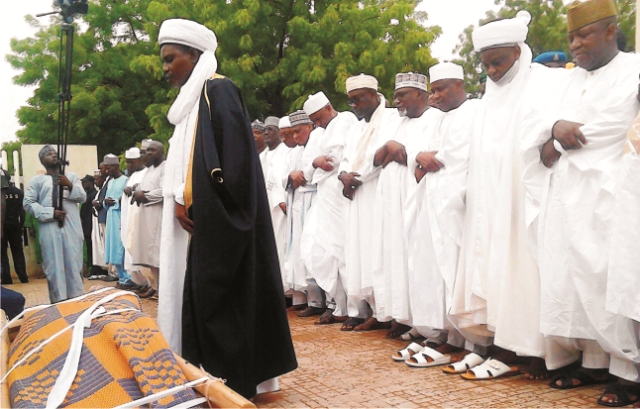
scribed the late Marafan Sokoto, Alhaji Umaru Shinkafi, as “a true statesman.’’
This is contained in a condolence message issued by his spokesman, Imam Imam and issued to newsmen in Sokoto recently.
It said: ‘’The late Marafan, who died Wednesday afternoon at a London hospital, was a true statesman. Shinkafi was born 13 January, 1937.
“His selfless and meritorious service to God, country and humanity, was felt by all.
“The late Shinkafi was a distinguished legal luminary, security expert, politician with conscience and great community leader and mobiliser.
“Marafan’s death has closed a chapter in the life of one of Nigeria’s most valuable public officers who made his mark in both public and private sectors.”
Yobe
Senator Alkali Jajere has added his voice to the call on
the Niger Delta Avengers (NDA) to embrace peace and support Federal Government’s efforts at revamping Nigeria’s ailing economy.
Jajere, who represented Yobe South Senatorial District from 2011 to 2015, made the call in an interview with newsmen in Damaturu
He cautioned that the attack on pipeline installations was not only harming the economy, but also compounding environmental problems in the Niger Delta.
He called on leaders and elders of the region to engage the youth in discussions on the negative consequences of the actions of the militants on their environment.
“They should be made to understand the attacks are doing more damage and compounding the environmental challenges in the Niger Delta.”




The Hydrocarbon Pollution Remediation Project (HYPREP) has commemorated the 15th anniversary of the release of the United Nations Environment Programme (UNEP) Environmental Assessment Report on Ogoniland, reaffirming its commitment to restoring the environment and improving the livelihoods of affected communities.
In a statement signed by the Project Coordinator, Prof Nenibarini Zabbey, to commemorate the anniversary, HYPREP described the anniversary as a significant milestone in Nigeria’s environmental restoration efforts, noting that the project has made remarkable progress in implementing the recommendations of the landmark UNEP report released on August 4, 2011.
The UNEP report had revealed extensive oil pollution across Ogoniland, severe environmental degradation, and serious public health risks resulting from decades of petroleum operations. It also recommended an initial $1 billion fund to commence the cleanup of the affected communities.
According to HYPREP, the Federal Government formally launched the Ogoni clean-up in 2016, while the Project Coordination Office was established in 2017 to drive the implementation of UNEP’s recommendations.
Zabbey said the current administration has continued to prioritise the project under the Renewed Hope Agenda.
Providing an update on the cleanup, the Project Coordinator disclosed that 30 of the 65 contaminated sites identified by UNEP have been fully remediated, while work is ongoing at several medium- and high-risk locations. It also stated that more than 1.5 million mangrove seedlings have been planted as part of what it described as the world’s largest restoration of oil-degraded mangroves, with over 1,000 hectares of shoreline already rehabilitated.
Zabbey further revealed that 49 Ogoni communities have been connected to potable water schemes through multiple water projects and booster stations aimed at providing safe drinking water across the region.
In the health sector, he said the 100-bed Ogoni Specialist Hospital in Kpite and the 43-bed Cottage Hospital in Buan are nearing completion, adding that several existing health facilities have been upgraded with modern medical equipment, while five ambulances have been donated to improve emergency healthcare services. The Project Coordinator also disclosed that a three-year human health biomonitoring study is being conducted in collaboration with the World Health Organization’s International Agency for Research on Cancer (IARC).
On economic empowerment, Zabbey stated that the Project has created more than 8,000 direct jobs and trained thousands of Ogoni youths and women in various vocational and technical skills, including software development, cybersecurity, aviation, commercial diving, seafaring, mechatronics, and creative arts. The project also reported awarding scholarships to more than 1,000 students, providing grants to small businesses, and supporting persons living with special needs through skills acquisition programmes.
The statement further highlighted ongoing legacy projects, including the Ogoni Power Project and the Centre of Excellence for Environmental Restoration, which it said is about 96 per cent complete. HYPREP also welcomed the recent designation of the Ogoni Wetland as a Ramsar Site of International Importance and pledged to continue promoting biodiversity conservation and sustainable management of the ecosystem.
Marking the anniversary, Zabbey said the progress achieved over the past 15 years demonstrates the collective commitment of government, development partners, stakeholders, and local communities to restoring Ogoniland. He called for renewed collaboration to sustain the cleanup effort, promote environmental sustainability, and support the long-term development of the region. 3
-

 News2 days ago
RSG Targets Nine Million Residents in Mosquito Net Distribution Campaign
-

 Oil & Energy2 days ago
Aiyedatiwa Signs New Electricity Bill
-

 Oil & Energy2 days ago
NLNG Commissions Research And Innovation Centre In RSU
-

 Maritime2 days ago
Marine Minister Commends President Tinubu On NPERA Bill Assent
-

 News2 days ago
KenPoly Holds Eight Convocations, August 29
-

 News2 days ago
RSG Begins Another Phase of Projects Commissioning Today
-

 News2 days ago
RMAFC Completes Revenue Sharing Review, Proposes New Pay
-

 Maritime2 days ago
NAGAFF Petitions IGP Over Alleged Maritime Police Harassment