
News
Reps Probe Police Over Alleged ?6bn Contract Splitting, Asset Sales

The House of Representatives has mandated its Committees on Public Assets and Procurement to investigate allegations of corruption against the Nigeria Police Force, ranging from illegal sale of national assets to diversion of public funds.
The resolution of the House followed the adoption of a motion of urgent public importance sponsored by Abia lawmaker, Ibe Osunwa and three others during yesterday’s plenary.
Drumming support for the motion, Osunwa stated that the core mandate of the Nigéria Police Force, as enshrined in Section 214 of the 1999 Constitution of the Federal Republic of Nigeria (as amended), includes the protection of lives and property, prevention and detection of crime, and enforcement of all laws and regulations.
He expressed worry over multiple allegations against the police involving abuse of office and unprofessional conduct.
The House is concerned that recent allegations of abuse of office, lack of due process and corruption in the Nigeria Police Force threaten the credibility, operational efficiency, and national security objectives of the Force.
“We are concerned that the NPF Procurement Department reportedly awarded a contract worth N6bn to Crown Natures Nigeria Limited by splitting it into 66 separate contracts in a deliberate attempt to circumvent the Public Procurement Act, 2007, particularly in the procurement of Police uniforms as reported by investigative media platforms including Ape Reporters.
“The House is disturbed by the reported sale of critical national security assets including Garki Police Barracks (Abuja), Falomo Police Barracks (Lagos), and Bompai Barracks (Kano) to private individuals closely linked to Exima Realty Company Ltd, without due process or required approvals from the Infrastructure Concession Regulatory Commission (ICRC), Ministry of Police Affairs, the Federal Executive Council and in total disregard for the Public Private Procurement.
“The House is worried that various contracts under the 2024 budget running into tens of billions of naira have allegedly been awarded by the Nigeria Police Force without compliance with statutory procurement processes, including the Federal Executive Council’s approval, Ministerial Tenders Board vetting, and Bureau of Public Procurement no-objection certification”, he said.
He listed the companies involved in the alleged violations to include Dexterity Development Ltd., KC Construction Ltd, Contract Technologies Ltd., Strong Tower Infrastructure Development Ltd., among others.
The House also expressed worry over reports of the diversion of ?2.9bn meant for the Safe School Initiative under a contract awarded to Vigiscope Ltd., “despite failing to meet statutory requirements such as obtaining a NITDA certificate as mandated for all ICT-related procurements in Ministries, Departments and Agencies.
Osunwa also expressed worry on behalf of the House “About credible allegations that several contracts amounting to over N50billion were paid to unqualified and unverified companies for the supply of arms, boots, gunboats, and forensic intelligence equipment, without any execution or delivery, thereby putting national security at risk.”
The companies involved in this alleged violation include PSGL Nigeria Ltd., SOLYD Nigeria Ltd., Toffy Ventures Ltd., Rush Rights Ltd., Value Exchange Ltd., and Radio Tactics Global Services, among others.
The motion stressed that if urgent steps are not taken, “These acts of impunity and financial misconduct could erode public confidence in the Police Force and sabotage national security and development efforts.”
Following the adoption of the motion, the House mandated the two committees to investigate the extent of procurement breaches and report back within six weeks for further legislative action.





Nobel Laureate, Professor Wole Soyinka, has called on Nigerians to reject silence in the face of extrajudicial killings and other abuses of human rights.
Soyinka stressed that accountability and civic courage remain essential to rebuilding public confidence in the nation’s institutions.
He made the call during the 28th Wole Soyinka Lecture held in Port Harcourt, last Friday as part of activities marking his 92nd birthday.
The lecture, themed “Reclaiming the Nigerian State through Accountability, Justice and Civic Courage,” drew participants from different sectors of society.
The renowned playwright and human rights advocate said the country’s greatest tragedy was not only the unlawful killings carried out by state and non-state actors, but also the silence that often follows such incidents, allowing perpetrators to evade justice.
According to him, indifference by citizens to abuses of power and violations of fundamental human rights has contributed to the persistence of extrajudicial killings and other forms of injustice across the country.
Soyinka said he dedicated this year’s lecture to victims of unlawful killings, noting that the event was intended to honour individuals who had lost their lives as a result of failures within the justice system and society’s inability to protect the sanctity of human life.
He stressed that the lecture was dedicated to what he described as the basic unit of every society – the human being, and urged Nigerians to place greater value on human dignity irrespective of ethnicity, religion or social status.
The Nobel Laureate recalled several incidents of violence, including the fatal shooting and killing of a young man in Ugheli in Delta State by a police officer, and the mob killing of Deborah Yakubu in Sokoto State sometime ago, lamenting that many of those responsible are yet to face justice.
He expressed concern that some perpetrators of violent crimes had openly admitted their actions without fear of prosecution, describing such situations as evidence of serious failures within the nation’s justice system.
Soyinka maintained that when justice is delayed or denied, public confidence in state institutions continues to erode, thereby encouraging further violations of human rights.
Responding to critics who accuse him of promoting religious or ethnic divisions whenever he spoke on such issues, Soyinka dismissed the allegations and pointed out that his advocacy has always centred on the protection of human life and the rule of law.
He urged Nigerians to remain vigilant and continue demanding justice in cases of alleged extrajudicial killings, including the recent shooting of a young man by a police officer, stressing that every life deserves equal protection under the law.
The literary icon also recalled an earlier pledge by a past incoming president to make public the files relating to unresolved assassinations and extrajudicial killings, questioning the status of the promised investigations.
He challenged citizens to continue asking questions about unresolved cases, insisting that justice, accountability and respect for human dignity are indispensable to building a peaceful, democratic and inclusive Nigerian society.
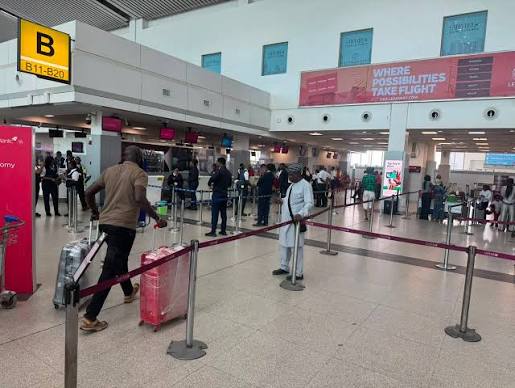
The Federal Airports Authority of Nigeria (FAAN) has clarified that there was no fire at Terminal 2 of the Murtala Muhammed International Airport, Lagos, contrary to its earlier advisory.
Earlier yesterday, FAAN had announced that a fire incident had occurred at Terminal 2 of the nation’s busiest airport, and assured that its Aerodrome Rescue and Firefighting Service had been deployed to contain the situation.
There were also reports that activities were briefly disrupted at the airport yesterday after smoke was seen inside parts of the terminal.
Videos circulating online showed passengers kept standing outside the terminal while firefighters responded to the incident.
However, in an update issued less than two hours later by the Director of Public Affairs and Consumer Protection, Henry Agbebire, and posted on FAAN’s official X handle, the authority said preliminary findings showed that the smoke seen at the terminal was caused by the discharge of the facility’s FM-200 fire suppression system.
“Further to our earlier advisory regarding the incident at Terminal 2 of the Murtala Muhammed International Airport, Lagos, the Federal Airports Authority of Nigeria (FAAN) wishes to provide the following update,” the statement read.
“Preliminary findings indicate that there was no fire at the terminal. The smoke observed within the affected area resulted from the discharge of the terminal’s FM-200 fire suppression system. The reason for the activation of the fire suppression system is currently being investigated,” FAAN stated.
The authority said normal operations had resumed at the terminal while investigations were ongoing to determine the cause of the incident.
“Normal operations have since resumed at the terminal, while detailed investigations are ongoing to determine the exact cause of the incident,” the statement added.
The authority thanked passengers, airlines, airport users and other stakeholders for their understanding and cooperation.
FAAN appreciated the understanding and cooperation of passengers, airlines, airport users and all stakeholders, and reiterated its commitment to the safety and security of all airport operations.