Connect with us

Featured

Recreate Rivers Economy As Best Investment Destination, Fubara Charges RSIPA Board

Published

on

Rivers State Governor, Sir Siminalayi Fubara, has restated that the resolve is stronger now than ever to create the climate conducive for growth of agriculture, manufacturing, small and medium enterprises, and key services because they are the productive sectors that will put Rivers’ economy on a competitive pedestal.
The Governor, therefore, charged members of the maiden Governing Board of the Rivers State Investment Promotion Agency (GBoRSIPA) to streamline their activities in such a manner that will attract real investors across critical sectors so that the State can become self-sustaining, comparatively.
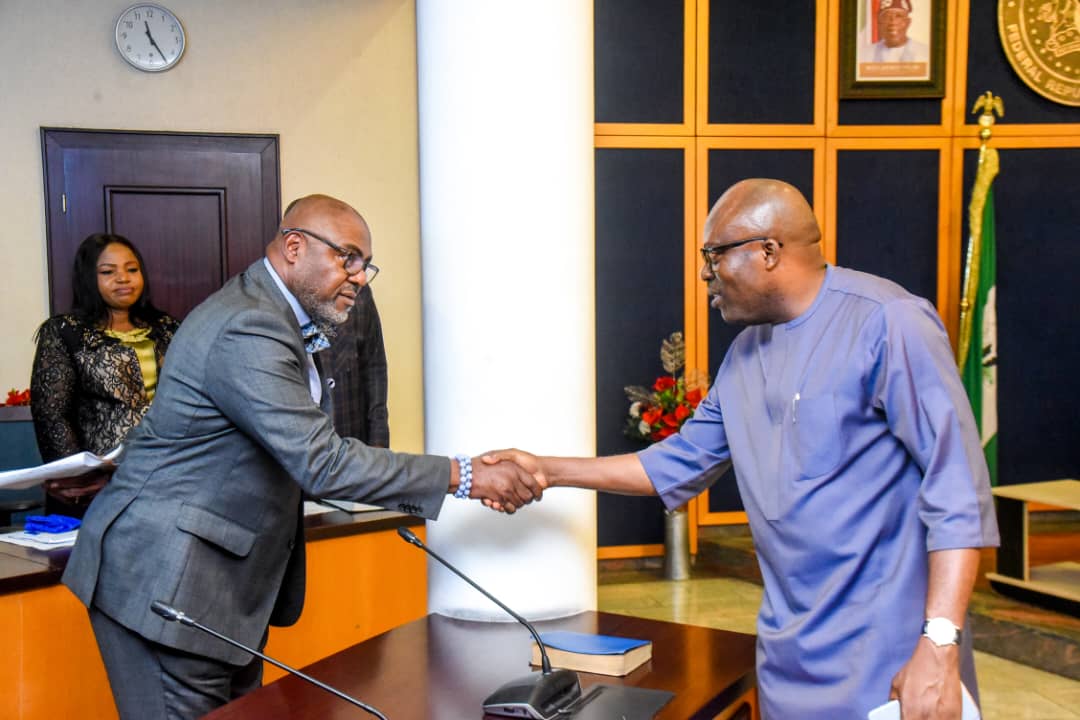
Governor Fubara gave the charge when he inaugurated members of the six-man Board at Government House in Port Harcourt on Monday.
Those inaugurated are: Lawrence Fubara Anga, SAN, as Chairman; Dr. Chamberlain Peterside as Director-General; and Mrs Tamunoibuemi Life-George, who is to serve as Secretary.
The rest include, Mr Goodliffe Nmekini, Barrister Havey Ideozu, and Baritor Lenusikpugi Kpagih as members.
Governor Fubara explained that Rivers State used to rank first in the comity of states in terms of productive economic activities, which attracted various business interests and made the State a well-groomed investment haven.
But, he expressed regret that the attendant expansion and population growth were not maximally managed because the challenges overwhelmed those who superintendent over business activities then, lamenting that the expected blessings were wrongly channelled, which left the State in very pitiable economic situation.
Governor Fubara said: “We might be celebrating, that yes, we have a very fat allocation. We have been able to improve our Internally Generated Revenue (IGR), but we still have a lot to do; and, that has to do with this agency.
“The purpose of this agency is to give our people – to assure them, that Rivers State can still come back to that enviable position that it once occupied. Those people that were doing business in Rivers State that left, for one reason or the other – that they can still come back.
“We want to see people who intend to come back and invest because Rivers State is blessed – it has oil, the most important item for development today, which is gas, in abundance.
“Look at what is happening in Trans-Amadi Industrial Layout: We can make Trans-Amadi Industrial Layout come back to what it used to be. We can develop the resources that we have in Onne Town. We have Ogba-Egbema gas hub. These are part of the promises we made during our campaigns, and we must fulfill those promises,” he said.
Governor Fubara emphasised that the agency is established to rigorously harness tenable economic and human potentials abundant in the State that can be translated into making Rivers the economic gateway and one-stop- shop for productive economic activities.
The Governor said: “We have waited for this moment for a long time. It is a moment we all have been praying for because we want to leave a State that will be remembered: Rivers State that can compete, and Rivers State that can stand the test of time as a proud State.
“People that are coming here would begin to know that Rivers State is now serious. Rivers State is not about coming here and saying I want to take the side of maybe, I am interested in 10 percent or 20 percent of what you are coming with, that is not the purpose now”.
He explained that Rivers State is about genuine business interactions that will be mutually beneficial to all parties in a sustainable way, insisting that investors desirous of gaining value from their stakes should boldly come to the State for partnerships that will work in the interest of all stakeholders.
He said, “The purpose is to build our State. The purpose is to grow this State economically in such a way and manner that even if we don’t get federal allocation anymore, for example, we can still sustain ourself (as a State) with our IGR.”
Governor Fubara acknowledged that in discharging its responsibilities, the Board will encounter challenges and stiff opposition from those who abhor change but urged the members to brace up and be forthright in their quest to achieve their mandate.
The Governor clarified that the board should not be preoccupied with people who are only interested in real Estate, which seemed to be the current drive now.
Governor Fubara said: “Not just issues of people coming to build houses and other things. I want your concentration to be more on agriculture, (manufacturing).
“Look to find people who are coming in to invest. People that are coming to build factories because it is only when we start production that employment issues will be resolved, (and we will witness economic boom).
“So, please, those things that will solve the problem of unemployment, and promote creation of wealth for the State should be your focus,” he advised.
Governor Fubara further said: “The responsibility of this agency is going to be very challenging because I know they will want to fight back. But, I know that these crop of men and woman have what it takes, and I am very convinced that they are going to lead Rivers State to where we want the State to be.
“The Chairman of this agency is a private legal practitioner and a businessman that has made his name. Let me say it here: let it be on record that I had to beg him to accept the offer. I even had to send emissaries to him to plead with him.
“He said he doesn’t want to get involved with any political thing. I said this is not about politics. You live in Lagos, you have made your name in Lagos. Please, come and help us. We need help, Rivers State needs to be salvaged.”
Governor Fubara charged them to approach their task with an open mind to make a difference, adding that he nurses no doubt that they will make the State proud with the results they will achieve.
The Governor also assured that his doors will remain open, should they require his attention to tackle any challenge in order to get the necessary support to ensure success.
In his acceptance speech, Chairman of the Governing Board of Rivers State Investment Promotion Agency (GBoRSIPA), Lawrence Fubara Anga, SAN, said they consider their appointment as an opportunity to serve among other Rivers people who are willing to be so appointed.
Anga noted the enormity of the task before them but expressed appreciation that even the Governor understands it so, which is why he consulted widely to gather very distinguished, proven and tested personalities, who depict his foresight.
He said: “Your Excellency, we have heard, listened very attentively to your charge, and that charge resonates, I believe, with everybody in this room.
“This is the time, whether we like it not, to many people, it is a time to want to despair. It is a time of problems, and it is also a time of challenges. And everybody has an option: your cup can either be half-full, or half-empty.
“But Your Excellency has decided that the cup of Rivers State shall be completely full. For every challenge, there is an opportunity. And what His Excellency has done is to tell us: go and look for those opportunities.”
Anga reaffirmed that Rivers State, known and still is the ‘Treasure Base of the Nation’, noting that the charge before them is to make that appellation march the reality of what prevails, desirably.
The chairman assured that they shall offer their best by delivering on their mandate but solicited support to work in strong synergy with other organs: ministries, departments and agencies (MDAs) of government, to succeed.
This, he noted, will reduce unhealthy competition and bureaucratic bottlenecks that often frustrate genuine development efforts because of what he described as likely policy inconsistencies.
He said, “The charge is to restore it (State) to be the ‘Treasure Base of the Nation. The charge is to make Rivers State economy probably the 10th or 12th largest economy in Africa, standing on its own. The charge is to turn Rivers State into the Dubai of Africa. That is what you have told us to do.
“It is not going to happen overnight. It is not going to happen just through us as individuals. It is a collective effort. But, we are convinced that with your support, and with the kind of leadership that you have already provided, it is very possible in the shortest period of time to start the transformation to change the narrative. And once the ship has left the port, nobody can stop it.”
Anga further said: “Your Excellency, investors’ monies have choices. No matter how potentially attractive a business proposition is, where there is insecurity, where there is confusion, where there is bureaucratic bottleneck, investors will run away because they have choices.
“And, one of the things your administration is trying to do is to restore security, safety of lives and property; security of tenor, when you buy land, you know that your title is secured because without security of tenor, you can’t get a loan.
“These are the things your administration is doing, which will go a long way to achieving the goal you have set. I am happy, this is a brand new agency, and we don’t have any excuse. What comes out; we are the ones that will shape it,” he emphasised.
Anga also reassured that: “This board will try its best to provide oversight. This board will try and provide the policy guidance. This board will try and use the rich connections it has to reach out locally and internationally (to attract investments).
“But, in all of these, our youths should stop being applicants. We want to create an environment where the unemployed become entrepreneurs, they become employers of labour. We want to triple the Internally Generated Revenue (IGR) of the State from our home grown businesses.
“We are not just looking for people to bring their money from outside. It’s been proven time and again that if the owners of the place don’t invest, outsiders will not come to invest. And so, your charge to us is to make Rivers State attractive for Rivers people. And when Rivers people invest, the whole world will come and invest. That is our task, and we will strive to achieve it,” he assured.

Featured

JUNE 12: Democracy Remains Nigeria’s Strongest Path To Unity, Progress, Says Fubara ….Extols Abiola, Wife

Published

on

Governor of Rivers State, Sir Siminalayi Fubara, has reaffirmed that democracy remains the most effective system of government for Nigeria, given the country’s rich diversity of ethnic, religious, and cultural identities.

In a goodwill message to Nigerians on the occasion of the 2026 Democracy Day celebration, Governor Fubara said June 12 represents far more than a historic date; as it embodies the enduring struggle, sacrifice, and collective aspiration of Nigerians for freedom, justice, and representative governance.

The Governor extended warm felicitations to Nigerians at home and in the Diaspora, paying tribute to the heroes and heroines of the democratic struggle, particularly Chief MKO Abiola, his wife, Kudirat Abiola, and countless others whose courage and sacrifices helped secure the democratic freedoms Nigerians enjoy today.

According to him, “June 12 is a reminder of the price paid for the democracy we enjoy today. The sacrifices made by Chief MKO Abiola, Kudirat Abiola, and many other patriots who laid the foundation for the democratic journey we continue to enjoy today. Their commitment to the principle that power must ultimately reside with the people remains a source of inspiration for every generation of Nigerians.”

Governor Fubara noted that thirty-three years after the historic June 12, 1993 election, Nigeria’s democratic experiment has continued to evolve despite challenges and setbacks.

“Our democratic journey has not been without difficulties, but the resilience of our institutions and the determination of our people have kept the nation moving forward. The ability to express differing opinions, engage in constructive debate, and peacefully choose leaders through the ballot remains one of the greatest achievements of our nation,” he said.

Governor Fubara stressed that democracy provides the best framework for managing Nigeria’s diversity and transforming it into a source of national strength.

“Nigeria’s diversity should never be seen as a weakness. Properly harnessed, it is our greatest asset. Democracy offers us the opportunity to build consensus, promote inclusion, strengthen national unity, and create the conditions for sustainable development and shared prosperity,” he said.

Governor Fubara commended President Bola Ahmed Tinubu, for his commitment to the Renewed Hope Agenda and ongoing efforts aimed at economic revitalization, strengthening security, and deepening democratic institutions across the country.

He reiterated the readiness of Rivers State to continue partnering with the Federal Government in advancing policies and programmes that improve the lives of citizens through infrastructure development, job creation, enhanced security, quality education, healthcare delivery, and good governance.

The Governor further called on Nigerians, regardless of political affiliation, ethnic background, or religious belief, to use the occasion of Democracy Day to renew their commitment to the Nigerian project and the ideals that underpin democratic governance.

“Democracy must not be viewed merely as a periodic electoral exercise. It must be reflected in our daily commitment to accountability, transparency, tolerance, justice, respect for the rule of law, and responsible leadership. As citizens and leaders, we all share a collective responsibility to strengthen our democracy and build a nation that future generations will be proud to inherit,” he said.

Governor Fubara expressed optimism about Nigeria’s future, urging citizens to remain united, hopeful, and committed to the values of peace, dialogue, and national development.

“Together, we can build a stronger, more inclusive, and more prosperous Nigeria where every citizen has the opportunity to thrive and contribute meaningfully to national progress,” he said.


Continue Reading

Featured

Fubara Reaffirms Commitment To Peace, Development

Published

on

Governor of Rivers State, Sir Siminalayi Fubara, has reaffirmed the unwavering commitment of his administration to peace, unity, security, and inclusive development as Rivers State marked its 59th anniversary, last Wednesday.


In a goodwill message issued on Wednesday to commemorate the anniversary, Governor Fubara stated that despite the challenges faced over the years, the people of Rivers State have continued to demonstrate resilience, strength, and an enduring spirit of unity that has sustained the state since its creation.


The Governor noted that the strong bond of brotherhood among the various ethnic nationalities of the state, including the Ijaw, Ikwerre, Ogoni, Etche, Ekpeye, Andoni, Kalabari, and others, remains one of Rivers State’s greatest strengths and a critical foundation for peace, stability, and progress.


He further observed that Rivers State has remained a major driver of Nigeria’s economy for decades, not only because of its abundant oil and gas resources, but also because of the exceptional contributions of its people across diverse sectors including academia, jurisprudence, business, entertainment, public service, and sports.


Governor Fubara assured the people that his administration will continue to prioritize policies and programmes that promote peace, protect lives and property, and expand development across all parts of the state. He emphasized that governance must be people centered and impactful, with equal attention given to every Local Government Area of the state.


The Governor also paid tribute to the elders and founding leaders of the state for preserving the spirit of unity and coexistence over the years, while urging the youths to remain hopeful, responsible, and actively committed to building a greater Rivers State through innovation, hard work, and patriotism.


He equally acknowledged the invaluable role of women in strengthening families, communities, and society, describing them as indispensable partners in the continued growth and stability of the state.


Governor Fubara called on all Rivers people to use the occasion of the anniversary as a moment of reflection and renewed commitment to peaceful coexistence, mutual respect, dialogue, and collective progress, stressing that the unity and future of Rivers State must always rise above personal interests and political differences.


Rivers State was created on May 27, 1967, by General Yakubu Gowon.

Continue Reading

Editorial

Nigeria’s 27 Years of Civil Rule Journey

Published

on

Nigeria returned to civil rule on May 29, 1999, after several years of military intervention in politics. The transition marked a major turning point in the nation’s history and raised hopes for freedom, stability, economic growth and accountable leadership. Citizens expected that elected governments would strengthen institutions, improve living conditions and unite the country after years of authoritarian rule. Twenty-seven years later, civil rule has survived without interruption, making it the longest uninterrupted civilian administration since independence in 1960.
Since 1999, Nigeria has witnessed six administrations at the federal level. Olusegun Obasanjo governed from 1999 to 2007, followed by Umaru Musa Yar’Adua from 2007 until his death in 2010. Goodluck Jonathan served from 2010 to 2015, while Muhammadu Buhari led the country between 2015 and 2023. Since May 2023, Bola Ahmed Tinubu has been in office. Though democracy has remained stable, governance outcomes have produced mixed reactions among Nigerians.
The country has made some notable progress over the past 27 years. Democratic institutions such as the National Assembly, judiciary, political parties and the media have become stronger than they were during military rule. Elections are now regular, though still imperfect. Telecommunications, banking, entertainment and digital technology have expanded greatly. Nigerian youths have also become more politically aware and active. The country’s economy, despite its difficulties, remains one of the largest in Africa.
However, many of the expectations that came with democracy remain unmet. Corruption, unemployment, poverty, insecurity and poor infrastructure continue to trouble the nation. Public confidence in government institutions has weakened over time because many citizens believe political leaders have not done enough to improve their welfare. Ethnic and religious tensions also remain major challenges. While democracy has endured, good governance has not always matched the hopes of the people.
President Tinubu’s administration began with bold economic decisions aimed at reforming the nation’s finances. His government removed fuel subsidy and unified the foreign exchange system. Supporters argue that these measures were necessary to reduce waste and attract investment. The government also increased revenue allocation to states and sought to improve tax administration. Yet the immediate impact has been severe hardship for millions of Nigerians. Inflation, high transport costs and the falling value of the naira have placed enormous pressure on households and businesses.
In education, the Tinubu administration has promised reforms through student loan schemes, support for technical education and efforts to reduce strikes in tertiary institutions. Some progress has been recorded with the establishment of the Nigerian Education Loan Fund. However, public schools still face poor funding, inadequate facilities and shortage of teachers. Many students continue to struggle with rising school fees and declining quality of education.
The health sector under the current administration has also recorded both efforts and challenges. Government has pledged to improve health insurance coverage. Nevertheless, hospitals across the country still suffer from inadequate equipment, shortage of medical personnel and brain drain as doctors and nurses continue to leave Nigeria for better opportunities abroad. Access to affordable healthcare remains difficult for many rural communities.
The power sector remains one of Nigeria’s biggest disappointments after nearly three decades of democracy. Despite repeated promises and reforms, electricity supply is still unstable. Businesses and households spend heavily on generators and fuel. The Tinubu administration has introduced policies aimed at decentralising power generation and encouraging investment, but ordinary Nigerians are yet to feel significant improvement in electricity supply.
The rising cost of living has become the greatest concern for many Nigerians today. Food prices, transportation costs and rent have increased sharply. Though the Federal Government introduced palliative programmes and cash transfer initiatives to cushion the effects of reforms, many citizens believe the interventions have been inadequate or poorly distributed. There is growing demand for more effective social protection programmes targeted at vulnerable citizens.
On national security, the government continues to battle terrorism, banditry, kidnapping and communal violence. Security agencies have recorded some successes in parts of the country, yet insecurity remains widespread. Farmers in many rural communities still face attacks, affecting food production and increasing fear among citizens. Regional stability in West Africa has also become more uncertain due to political crises in neighbouring countries. Nigeria continues to play a leading diplomatic role in the region, but internal security challenges weaken its influence.
In infrastructure and other key sectors, the Tinubu administration has continued several road, rail and housing projects inherited from previous governments. Investments in ports, gas and digital technology have also been encouraged. In agriculture, government has promoted mechanised farming, dry season cultivation and access to credit. Yet food insecurity remains high because insecurity, inflation and poor rural infrastructure continue to affect agricultural productivity. Nigeria still imports many food items despite its vast agricultural potential.
To improve national conditions, the Federal Government must place greater attention on job creation, industrialisation and support for small businesses. More investment is needed in agriculture, healthcare, education and electricity. Anti-corruption institutions should be strengthened while government spending must become more transparent. Leaders must also prioritise national unity and reduce political divisions. Nigerians expect reforms that produce visible improvements in their daily lives, not only policy announcements.
In Rivers State, the 27 years of civilian rule have produced substantial development alongside political tensions. The state has remained economically important because of its oil and gas resources. Different administrations since 1999 have invested in roads, schools, healthcare facilities and urban renewal projects. However, political conflicts and struggles for power have often affected governance and slowed development in parts of the state.
Governor Siminalayi Fubara assumed office in May 2023 amid high expectations and intense political disagreements. In infrastructure, his administration has initiated projects such as massive road construction, bridge rehabilitation and urban development schemes in parts of the state. Ongoing works on major roads and public facilities have been presented as efforts to improve transportation and economic activities. Critics, however, argue that political instability in the state has distracted government’s attention from faster project delivery.
In education and health, the Rivers State Government has continued support for public schools and healthcare centres. Efforts have reportedly been made to improve learning environments and sustain payment of workers’ salaries. In health, there have been interventions in hospitals and primary healthcare services. On security, the administration has worked with security agencies to maintain peace, although political tensions in the state have created uncertainty. In the civil service, workers and pensioners have largely continued to receive salaries, stipends, and welfare support. The state government has also shown interest in agriculture and power development, though these sectors still require stronger investment and clearer long term strategies.
Going forward, Rivers State needs greater political stability to achieve meaningful development. The government should focus more on rural roads, youth employment, agricultural expansion and uninterrupted healthcare services. Investments in independent power projects and industrial development would help attract businesses and reduce unemployment. Above all, political leaders in the state must place the interest of the people above personal or factional battles. Democracy can only succeed when governance delivers peace, development, and hope to ordinary citizens.
Continue Reading

Trending