
Business
NCDMB Hails Nigerian Content Achievements In NLNG’s Train 7 Project

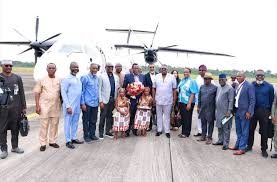
The Executive Secretary, Nigerian Content Development and Monitoring Board (NCDMB), Engr. Felix Omatsola Ogbe, has praised the significant Nigerian Content strides achieved in the Nigeria LNG Ltd (NLNG) Train 7 Project.
Ogbe, who gave the commendation on Friday during a visit to the NLNG six-train plant, Train 7 Project construction site, and the NLNG Shipping and Marine Services Limited (NSML) training centre, Maritime Centre for Excellence (MCOE) in Finima, Bonny Island, Rivers State, emphasised the need for increased collaboration and advocacy for Nigerian Content in the oil and gas industry.
In his remarks, Ogbe highlighted how the Train 7 Project has significantly boosted local capacity through the production of ancillary components and accessories within Nigeria, saying this has contributed directly to the project’s successful execution.
He commended the recent Presidential Directives on Local Content implementation, which mandated that contracts in the oil and gas sector be awarded exclusively to local companies with proven in-country capabilities, as instrumental to the Train 7 project’s achievements.
“The accomplishments we’re witnessing today at the NLNG Train 7 Project are a testament to the NLNG’s unwavering commitment to Nigerian Content.
“This project stands as a beacon of what we can achieve when we prioritise our local industries and talents”, the Executive Secretary said.
The NCDMB’s scribe also lauded NLNG’s management for achieving 52 million man-hours on the Train 7 project with zero lost time injury (LTI), assuring that the Board will support handlers of the project to achieve everything they desire in their quest to accomplish the project for the overall development of Nigeria.
Similarly, Engr. Ogbe commended his predecessor, Engr. Simbi Kesiye Wabote, for what he called his immense contributions to the approval, take-off and success of the Train 7 project.
While commenting on the Maritime Centre for Excellence (MCOE), the NCDMB helmsman expressed delight that it is the first training centre in Africa to receive accreditation from the UK Maritime and Coastguard Agency (UK MCA) to deliver and issue certificates for the STCW 2010 Electronic Chart Display and Information System (ECDIS) and Basic Liquefied Gas Tanker Cargo Operations courses.
The Tide learnt that the MCOE, a maritime training and research facility, aims to enhance maritime expertise in Nigeria and the entire West African region.
The MCOE, according to the Directorate of Corporate Communications and Zonal Coordination of the Board, currently hosts a specialised training programme for marine services providers in the upstream oil and gas sector, with the support of NCDMB.
Also speaking, Managing Director/CEO of the NLNG, Dr. Philip Mshelbila, represented by the Deputy Managing Director, Mr. Olakunle Osobu, lauded the NCDMB’s unwavering support for the Train 7 Project.
He described the partnership as a shining example of the public-private collaboration that can drive Nigeria’s industrial growth, emphasising that NLNG’s Nigerian Content deliverables showcases the power of strategic collaboration and capacity building, aligning with the NCDMB’s broader objectives and contributing to national development goals.
Mshelbila reiterated that Nigerian Content was not just a regulatory requirement for NLNG, but a core business strategy.
“We’re committed to going beyond compliance, embracing Nigerian Content as a fundamental part of our vision of helping to build a better Nigeria”, he said.
He highlighted the economic impact of the Train 7 Project, stating that the addition of Train 7 will expand Nigeria’s LNG production capacity from 22 Metric Tons (MT) to 30MT per annum, which he said will not only boost the nation’s economy by creating jobs and driving sustainable development, but also reinforce Nigeria’s position as a formidable player in the global energy market.
By: Ariwera Ibibo-Howells, Yenagoa



Business
Jonathan, Diri, Others Laud Firm’s Milestone in Bayelsa …Says Project Will Drive Industrialisation, Create Jobs



-

 News4 days ago
RSG Targets Nine Million Residents in Mosquito Net Distribution Campaign
-

 Oil & Energy4 days ago
Aiyedatiwa Signs New Electricity Bill
-

 Oil & Energy4 days ago
NLNG Commissions Research And Innovation Centre In RSU
-

 Maritime4 days ago
Marine Minister Commends President Tinubu On NPERA Bill Assent
-

 News4 days ago
KenPoly Holds Eight Convocations, August 29
-

 News4 days ago
RSG Begins Another Phase of Projects Commissioning Today
-

 News4 days ago
RMAFC Completes Revenue Sharing Review, Proposes New Pay
-

 Maritime4 days ago
NAGAFF Petitions IGP Over Alleged Maritime Police Harassment