
Politics
Yar’Adua Centre Identifies Govt, Citizens Relations Challenges

There is distrust between the Nigerian government across all levels and the citizens, says Muttaqa Rabe-Darma, the president of Umaru Musa Yar’Adua Human Development Centre.
Rabe-Darma disclosed this in Katsina during the 13th Umaru Musa Yar’Adua Day Memorial Lecture, organised by the ‘Katsina State First Youth’, Fix Under Grassroots Aids Initiative.
According to him, functional governmental systems require a trustworthy leader who exploits an all-inclusive government, considering all stakeholders as part of the decision-making body.
He noted that it also required appreciating people’s functionality and ability, irrespective of whether they acquired knowledge and skills formally or distinctly.
“Therefore, governments took a large chunk of responsibility for societal decay. Unlike what Islam teaches, leadership is no longer based on trust. The leaders and those they lead no longer trust one another,” Mr Rabe-Darma explained, adding “Islamic provisions on leadership emphasised that leaders should be trustworthy, transparent and accountable.”
The Yar’Adua Centre boss also mentioned that one way to ensure followers’ trust in leaders “is to appreciate that leadership comes with self-responsibility, responsibility to the general public and importantly, to Allah (SWA).”
Mr Rabe-Darma described the late president and former Katsina State Governor as an excellent transformational leader.
He said the late president exhibited commitment and dedication towards transforming the state as the governor of Katsina and also had plans to move Nigeria to a greater level.
He explained that Mr Yar’Adua left legacies in the state that would never be forgotten in the history of Kataina, saying that he was a leader worth imitating.
Mr Rabe-Darma added that the Islamic principle of governance is the best system and model that would make the state governing system workable and curb its multiple challenges.
He acknowledged the need for a new leader-follower model based on Islamic leadership principles to be embraced by the incoming government to succeed.



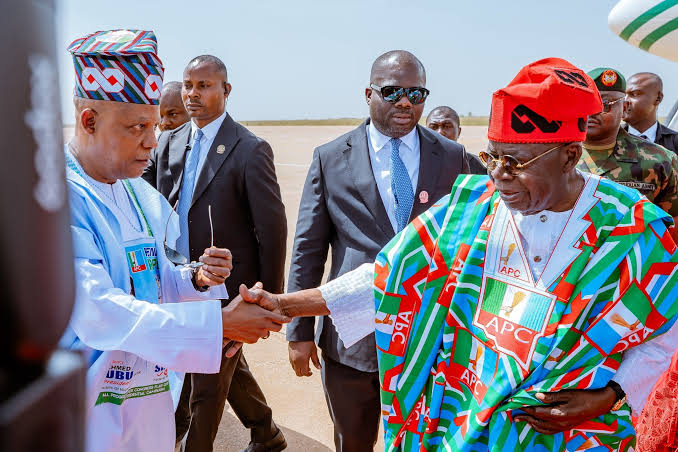
The campaign rally, held at the Kaduna Township Stadium, attracted Vice-President Kashim Shettima, APC governors, party leaders, federal and state lawmakers, political stakeholders and supporters from across the country.
The flag-off marks the beginning of the APC’s drive to secure a second presidential term for President Tinubu, with the party expected to promote its achievements, defend its economic reforms and outline its policy priorities under the proposed Renewed Hope 2.0 agenda.
Kaduna’s selection for the campaign launch underscores the strategic importance of the North-West, a region with a substantial voting population and considerable influence on presidential election outcomes.
The APC faces a significant challenge in Kaduna, where the Peoples Democratic Party’s presidential candidate, Alhaji Atiku Abubakar, defeated President Tinubu in the 2023 election. The rally therefore provides the ruling party an opportunity to strengthen its grassroots structures and regain electoral support in the state.
Addressing supporters, Vice-President Shettima appealed to Northern voters, highlighting President Tinubu’s political relationships with prominent Northern leaders, including Alhaji Abubakar, Mallam Nuhu Ribadu and the late President Muhammadu Buhari.
The Vice-President’s appeal reflects the APC’s determination to consolidate its support in the North as the party intensifies preparations for the presidential contest.
The Renewed Hope 2.0 agenda is expected to feature prominently in the campaign, providing a platform for President Tinubu to explain his administration’s economic policies and outline plans for another term.
However, the President’s record on economic reforms, rising living costs, petrol prices, employment, infrastructure and insecurity is expected to attract considerable scrutiny during the electioneering period.
-

 Niger Delta10 hours ago
Diri Restates Stance On Lagos-Calabar Coastal Highway
-

 Niger Delta10 hours ago
C’River, NUJ Pay Tribute To Late Guardian Editor
-

 News12 hours ago
NDLEA Recovers Tons Of Illicit Drug Consignments In Nine States
-

 Opinion10 hours ago
Checking Voter Apathy In Nigeria’s Electoral Process
-

 Sports7 hours ago
Nigerian Trio Target Titles At PFL Africa Finals
-

 Education8 hours ago
FCE Yola Graduates 3,555 Teachers , Seeks Upgrade to University
-

 Politics8 hours ago
2027: DICKSON’S EX-ALLY VOWS TO WORK AGAINST NDC INTEREST IN BAYELSA
-

 Politics8 hours ago
2027: GROUP PLEDGES 40,000 SUPPORTERS FOR COALITION CANDIDATES IN RIVERS