
Politics
CSOs Submit Petition At Lagos Assembly, Insist On Bawa’s Removal

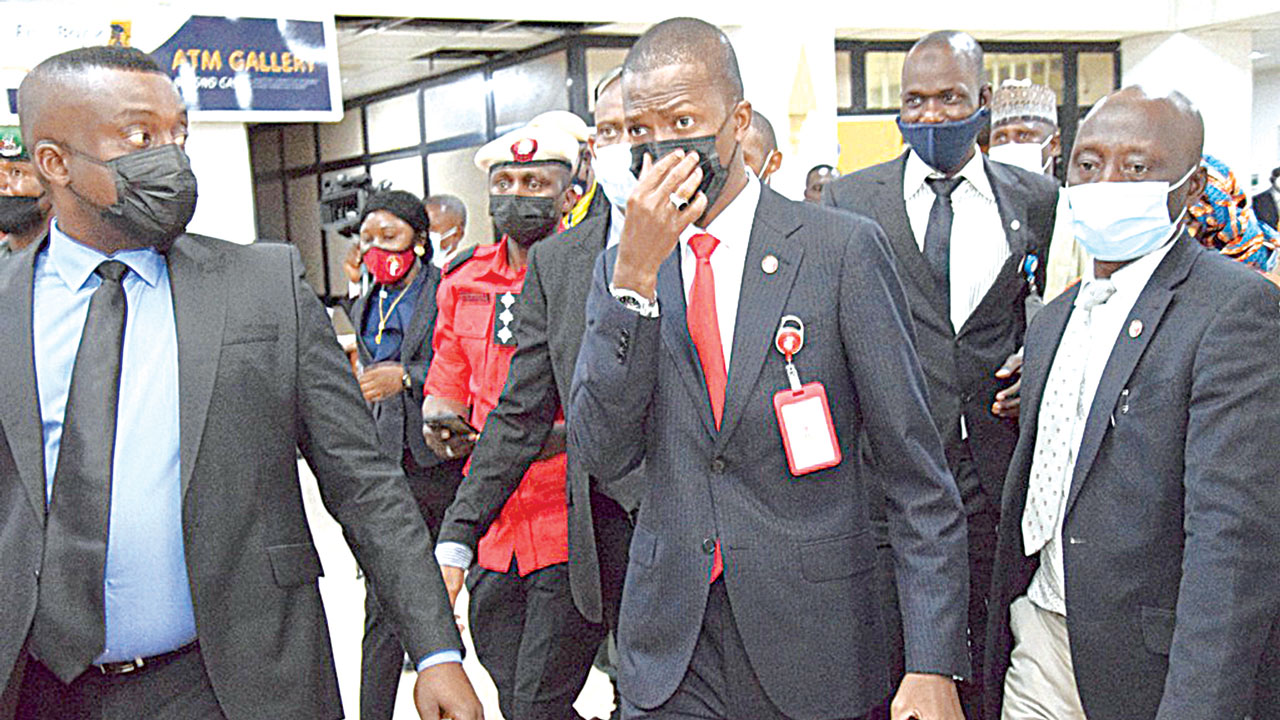
Frontline Anti-corruption Civil Society Organisations (CSOs) yesterday, submitted a petition to the Lagos State House of Assembly, as their protest for removal of the EFCC Chairman, Mr Abdulrasheed Bawa entered day four.
The coalition of CSOs, which began a weeklong protest in Ikeja on Sunday, on Tuesday took the protest to the assembly and submitted a petition against the Economic and Financial Crimes Commission (EFCC) boss.
They alleged that the EFCC under Bawa had politicised operations and had perchant for disobeying lawful court orders and infringement on human rights.
The News Agency of Nigeria (NAN) recalls that the coalition, comprising scores of anti corruption CSOs on Sunday started daily protests at Ikeja, calling for the sack of the EFCC chairman.
It would also be recalled that the Kogi High Court in Lokoja on Feb. 5, ordered the arrest and remand of the EFCC chairman in prison for disobeying a court order.
However, EFCC had filed a motion at Court of Appeal to stop the execution of judgment of the Kogi High Court which ordered the committal of its chairman to prison for disobedience of court order.
The activists, who marched through the streets of Ikeja on Tuesday and converged on the Lagos state house of assembly, Alausa, noted that the majority of Nigerians were intelligent people, who could easily differentiate between a genuine cause by the EFCC and sponsored ones.
Vowing not to be intimidated, the protesters added that there was no going back on the call for Bawa’s removal.
A leader of the coalition and Director, Activists for Good Governance, Mr Declan Ihekaire, alleged that the activists had uncovered plans by some supposed CSOs to discredit the coalition’s genuine cause.
“We are waiting for them. We don’t expect them to fold their arms. But no amount of falsehood can cover the truth.
“We have been on this struggle for close to a week now. All what we want is for Bawa to leave that office so the commission can be sanitised. “He that comes to equity must come with clean hands,” Ihekaire said.
According to him, there still God-fearing EFCC officials.
Spokesperson for the Transparency and Accountability Group, Mr Ayodeji Ologun, who spoke shortly after protesters arrived at the assembly, said that EFCCshould be seen to respect court orders, respect the rule of law and believe in fair hearing.
Ologun said: “What we are agitating against is his disobedience of the courts and the brazen politicisation of the EFCC.
“The IGP should immediately effect his arrest in line with the court ruling.
“Before Bawa can appeal against a court order sending him to prison, he must obey the order first. This is settled in law.
“Recently, the Court of Appeal, Abuja Division, directed ASUU to first comply with an order of the National Industrial Court ( NIC) directing them to suspend their strike before their appeal could be heard.
“Also, just last week, the EFCC itself arrested a senator for refusing to go to prison after he was sent there by the Federal High Court. This is despite his appeal against his sentence.”
“Appeal or no appeal, Bawa must report to Kuje prison. His appeal can’t be heard until he complies with the valid court ruling sending him to prison.”
He disclosed that the CSO leaders were at the assembly to submit a petition on Bawa’s disobedience of court orders and the politicisation of the EFCC to the National Assembly through the Speaker of the state assembly.
Another activist, Mrs Funmilayo Ajayi of the Community Women Initiative, added: “All we are telling him is obey our courts, let us preserve the integrity of our legal system.
“If the head of a frontline anti-corruption agency is being controlled by a few people in the political space, and he is breaking the law with impunity, it portends danger for our democratic system and the wellbeing of the society at large.”
The ‘Bawa Must Go’ protests are being led by the Chairman, Centre for Anti-corruption and Open Leadership (CACOL), Mr Debo Adeniran; Executive Director, Centre for Public Accountability, Mr Olufemi Lawson; the Executive Director, Zero Graft Centre, Kolawole Sanchez-Jude; the Chairman, Coalition Against Corruption and Bad Governance, Mr Toyin Raheem; and Ahmed Balogun of Media Rights Concern.
Other activists present at the protest were Messrs Ochiaga Jude, Cletus Okedube, Johnson Areola, George Sanda, among a host of other notable activists, lawyers and women’s rights NGOs. (NAN)
Elections: PWDs demand inclusion in electoral processes, access to polling units
February 14, 2023 by Auta Justina
Elections: PWDs demand inclusion in electoral processes, access to polling units
PWDs
By Justina Auta
Abuja, Feb. 14, 2023 (NAN) Network of Women with Disabilities (NWD), Tuesday, have demanded for inclusion in the electoral process at all levels and access to polling units nationwide.
The network, in collaboration with the Women’s Rights Advancement and Protection Alternative(WRAPA) made the call during a walk and presentation of the charter of demand for women with disability to the Federal Ministry of Justice in Abuja.
Hajiya Zainab Abdulrasheed, Programme Officer WRAPA, said the removal of any physical barrier faced by PWDs during election day and in the electoral processes would enable them vote in line with Nigeria’s polling system.
Abdulrasheed, stressed the need for election management bodies and other stakeholders to protects the rights of women and PWDs, urging them to include them in the implementation of electoral processes in Nigeria.
“Part of it is ensuring polling units are accessible for PWDs and be able to participate meaningfully during election to exercise their franchise or voting candidates of their choice.
“ And not be intimidated because inaccessibility of polling units can deter prospective voters from exercising their franchise.
“And this is the right time to promote PWDs especially women in the 2023 election and beyond.”
According to her, the rally exercise was to create more awareness and promote the rights and inclusion of PWDs in the forthcoming election.
She added that an abridged version of a charter of demands that spells out what the provisions of the laws of Nigeria in disabilities rights are pertaining to the PWDs, particularly women in the forthcoming elections was also launched to make their demands known.
“We came to create awareness on this purpose for all stakeholders to come on board and ensure that the forthcoming 2023 election and beyond have to be very inclusive of women with disabilities.
“ And to ensure that their rights are not infringed upon.
“ They should not be discriminated for any reasons, they should be part of any development and governance in any society where they may exist.
“That is why we are here for people to know that they have a rights to vote and be voted for.
“ This activity came at the right time towards the 2023 election, where we know that polling is about to take place and we hope INEC has put in place resources to ensure inclusiveness for PWDs and others alike,” she said.
Also, Ms Rose Daniels, Vice President, decried that women with disability have been relegated to the background in every sector, stressing the need for inclusion, which would empower them and contribute to national development.
“We want to be heard, To be included in the political sphere, we have capable women with disability who can run for offices and be voted for, to be in the parliament.
“We are demanding for our 10 per cent quota which I believe is not too much, to have our space in the national polity,” she said.
On her part, Ms Godiya John, Media and Communication Officer NWD, FCT Chapter, reiterated the need for inclusion of women with disability in all the affairs of the government, adding their right to inclusion should not be denied.
“All we are asking is inclusion in politics, governance, health, education. We are asking of inclusion, our rights to vote, rights to be voted for, rights to education, rights to gainful employment.
“We want government to include us in politics, we want them to know that there is so much ability in us, so much we can contribute to the political sphere of the government.
“ So, we are asking for inclusion, women generally are asking for just 35 per cent, but we are asking for only 10 per cent from government.
“When you empower a woman with disabilities, you empower the nation because most are mothers.
“We have been discriminated and abandoned, but when we are empowered it will go along way in the contribution of the development of the country,” she said.
Responding, Representative of the Ministry of Justice, Winifred Oyekunle, assured the group that issues tabled will be presented to the relevant authorities with a follow up action.
Oyekunle said, “be assured that your issues are always considered as your interest will be protected.
“The Attorney General will do his best as your message will get across and you will be happy with his decision,” she said. (NAN)



The Independent National Electoral Commission (INEC) has extended the deadline for political parties to submit the list of candidates for the 2027 governorship and state Houses of Assembly elections from Saturday, August 8, to Tuesday, August 11, 2026.
The commission announced the extension in a statement issued on Saturday and signed by the National Commissioner and Chairman of its Information and Voter Education Committee, Mohammed Haruna.
According to INEC, the decision followed appeals by political parties for additional time to complete the submission process through the dedicated online portal.
“The submission window, which according to the revised Timetable and Schedule of Activities for the General Election was originally scheduled to close on Saturday, 8th August, 2026, has been extended to Tuesday, 11th August, 2026,” the commission said.
In a a related development, INEC announced the suspension of PVC collection in Osun State ahead of the August 15 governorship election.
The commission said voters who applied for replacement of lost, damaged or defaced Permanent Voter Cards would have until midnight on Sunday, August 9, to print downloadable copies of their cards.
The electoral body explained that the deadline was necessary to enable it compile data on downloaded PVCs and produce final statistics on the total number of cards collected ahead of the election.
INEC said PVC collection in Osun commenced at the Registration Area level from July 22 to 28, 2026, but was extended to July 31 following complaints about large crowds and difficulties experienced by voters at collection centres.
The exercise subsequently moved to the local government level and ran from August 1 to 7.
The commission also disclosed that replacement downloadable PVCs had been made available to voters in Odo-Otin and Ife Central Local Government Areas following the theft of cards during attacks on the two collection centres.
It stressed that the stolen cards could not be used to vote.
INEC reassured Osun residents of its preparedness for the August 15 governorship election.
“The commission reiterates that the stolen cards cannot be used to vote.
“INEC reassures the people of Osun State of its readiness to conduct a free, fair, credible and inclusive governorship election on 15th August, 2026,” the statement said.
The commission said the deadline, initially set for Saturday, 8 August, has been extended to Tuesday, 11 August 2026, following appeals from political parties for more time.
INEC also announced that the window for voters who applied to replace lost, damaged or defaced PVCs to download their replacement cards will close at midnight on Sunday, 9 August.
The move is to enable the commission compile final PVC collection figures ahead of the 15 August Osun governorship election.
INEC said replacement downloadable PVCs have also been provided to affected voters in Odo-Otin and Ife Central Local Government Areas after hoodlums carted away cards from two collection centres, stressing that the stolen cards cannot be used to vote.
The commission reaffirmed its readiness to conduct a free, fair, credible and inclusive election in Osun State.
Gov. Kefas made the remarks over the weekend at the Federal Medical Centre (FMC), Jalingo, during the flag-off of the second phase of the Renewed Hope Medical Outreach in Taraba State, organised as part of activities marking Prof. Yilwatda’s 58th birthday.
The governor commended Prof. Yilwatda for choosing to mark his birthday by providing medical care to people in need.
“What Professor Nentawe did is a powerful demonstration of what leadership should be,” Gov. Kefas said.
He assured that his administration would continue to support initiatives that complement government efforts to improve healthcare delivery and the wellbeing of residents.
Speaking at the event, Prof. Yilwatda called on Nigerian leaders to embrace the culture of giving and use their positions to touch the lives of the less privileged.
He said his decision to celebrate his 58th birthday in Taraba State was deliberate and informed by the needs of underserved communities, particularly people who face difficulties accessing healthcare because of distance and financial constraints.
According to him, the intervention followed a needs assessment and was extended across the three senatorial districts of the state.
He said the exercise commenced on August 3 at Takum General Hospital and covered the Federal University Teaching Hospital, Wukari; First Referral Hospital, Sunkani, Ardo-Kola Local Government Area; General Hospital, Bali; General Hospital, Gembu; and FMC Jalingo.
Prof. Yilwatda said the intervention provided medical services to thousands of beneficiaries, including people who required surgical procedures.
He said sustainable national development could only be achieved when strong institutions placed Nigerians at the centre of development.
“Leadership is about service,” he said, urging political and public leaders to make giving back to society an important part of their responsibilities.
He reaffirmed his commitment to serving Nigeria and its people, saying his personal vision was to make every day of his life useful to humanity.
“Every day that I live, the vision is: let it be useful to humanity,” he said.
The Taraba State Commissioner for Health, Dr. Bordiya Buma, commended the initiative, saying it was consistent with the Renewed Hope agenda and efforts to strengthen healthcare delivery in the state.
Dr Buma said the second phase followed the successful completion of the first phase, which was conducted simultaneously in six local government areas, with two LGAs selected from each of the three senatorial districts.
According to him, more than 10,000 patients were attended to during the first phase, including people with medical and surgical conditions.
He disclosed that 327 general surgeries, 71 eye surgeries and 575 dental procedures were carried out during the exercise.
The commissioner expressed appreciation to President Bola Tinubu for the Renewed Hope Medical Outreach and thanked Prof. Yilwatda for supporting the initiative and choosing Taraba State as a beneficiary.
The Minister of Health and Social Welfare, Prof. Muhammad Ali Pate, also commended Prof. Yilwatda for choosing Taraba State to mark his 58th birthday through a medical outreach.
Prof. Pate said making healthcare the centrepiece of the birthday celebration was significant because health affects everyone.
-

 News3 days ago
RSG Targets Nine Million Residents in Mosquito Net Distribution Campaign
-

 Oil & Energy3 days ago
Aiyedatiwa Signs New Electricity Bill
-

 Oil & Energy3 days ago
NLNG Commissions Research And Innovation Centre In RSU
-

 Maritime3 days ago
Marine Minister Commends President Tinubu On NPERA Bill Assent
-

 News3 days ago
KenPoly Holds Eight Convocations, August 29
-

 News3 days ago
RSG Begins Another Phase of Projects Commissioning Today
-

 News3 days ago
RMAFC Completes Revenue Sharing Review, Proposes New Pay
-

 Maritime3 days ago
NAGAFF Petitions IGP Over Alleged Maritime Police Harassment